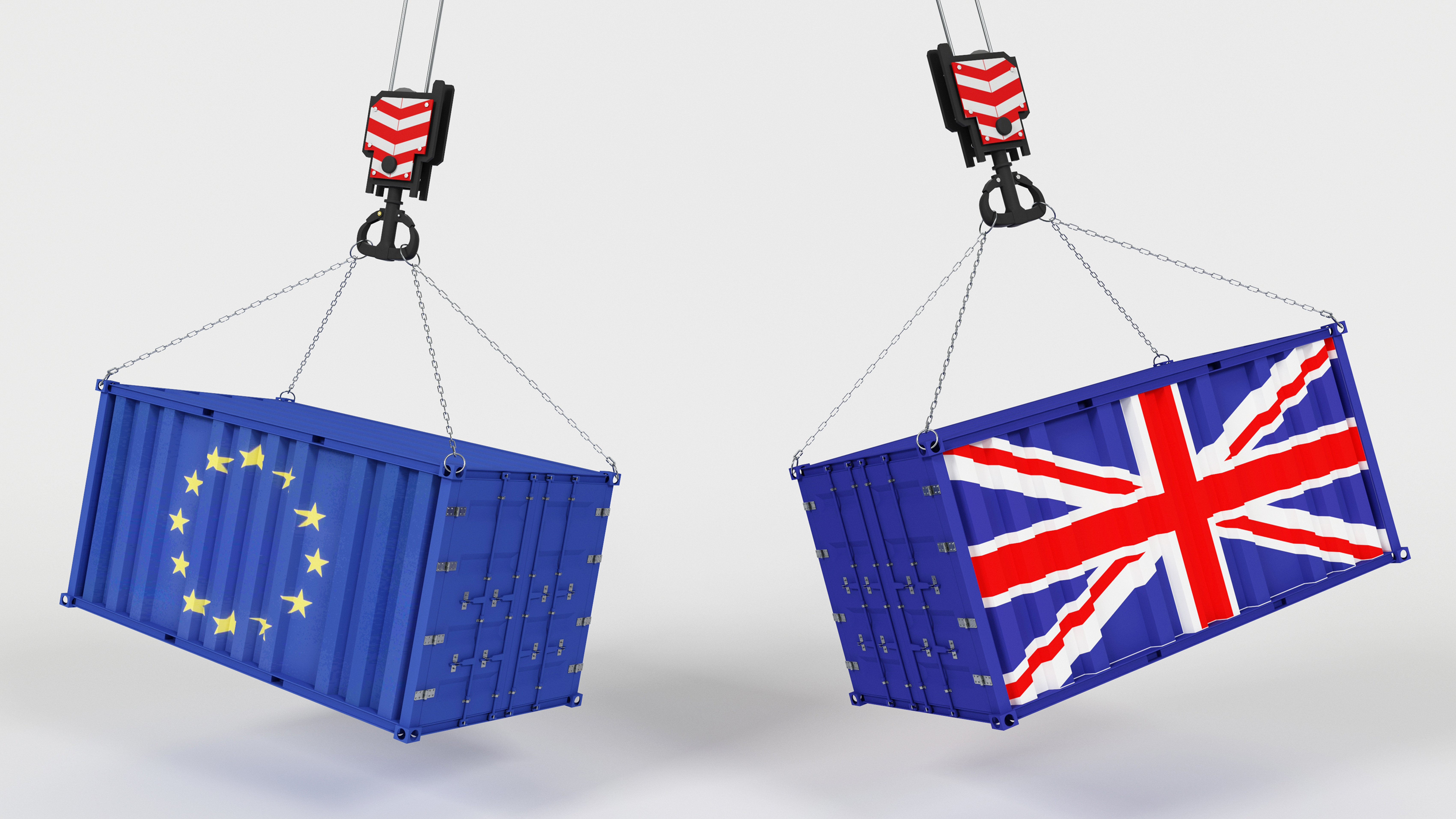
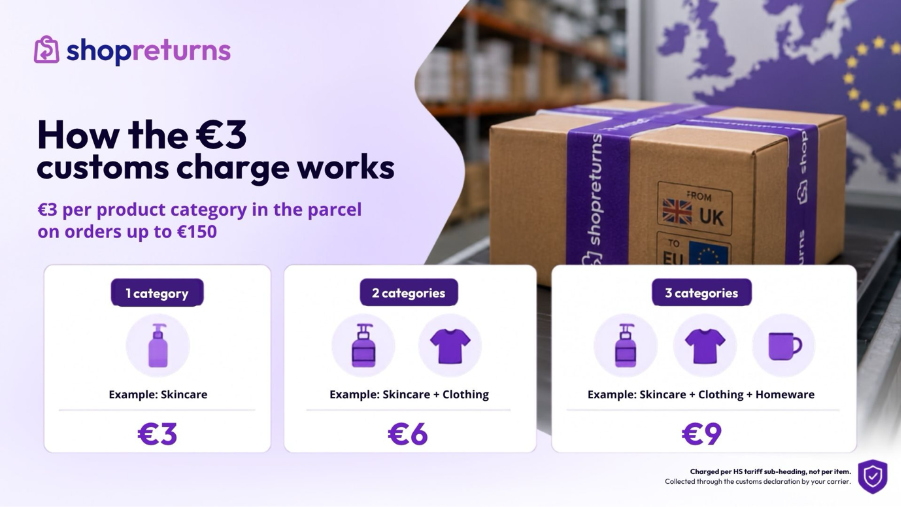
Since 1 July 2026, UK ecommerce sellers shipping consumer orders into the EU have faced an extra €3 customs charge for every product category in the parcel: €3 for the first category, and another €3 for each additional one.
A single-category order pays €3; a three-category gift box pays €9.
So if you’re searching how to avoid EU customs duty as a UK business, the practical answer is this: you usually can’t remove it completely, but you can legally reduce it to nearly zero, and in some operating models eliminate it in practice. This guide is the roadmap we share at ShopReturns with the UK brands we support, small to midsize businesses selling through Shopify, WooCommerce, Amazon, Zalando or Etsy, that want to protect margins while keeping cross-border shipping and returns compliant.
Below you’ll find nine legal ways to reduce that fee: consolidating SKUs under shared HS codes, reworking bundles and retail sets, increasing order values, shifting volume to B2B channels, using preferential UK origin where it applies, weighing the trade-offs of IOSS, moving fulfilment into the EU, and managing returns through local EU return addresses.
The essentials in 30 seconds
The duty applies from 1 July 2026 under Council Regulation (EU) 2026/382, to every B2C consignment up to €150 imported into the EU. It’s charged per HS tariff sub-heading, not per item, and collected through the customs declaration, in practice by your carrier; commercially the cost lands on you or your customer, depending on how you price.
B2B shipments sit outside it entirely.
First, a crucial point: “avoid” means legal structuring only. Undervaluing parcels, artificially splitting orders or declaring false origin is customs fraud, and the EU runs monthly monitoring from October 2026 to catch exactly that. Every strategy here survives an audit. Stricter data rules cut both ways too: declarations marked “gift” or “accessories” no longer clear customs automatically.
1. Consolidate SKUs under shared HS codes
The most important fact: the €3 duty applies per distinct tariff sub-heading, not per item. Ten identical T-shirts cost €3 total; one T-shirt plus one mug costs €6. Start by auditing your catalogue’s HS codes, because many sellers discover their product data is simply wrong or inconsistent.
To be clear about what this strategy is and isn’t: it’s not about squeezing different products under one convenient code. Each product has one correct classification, and you’re legally responsible for it. What it is about: variants of the same product, like colours, sizes and prints of the same garment, usually share a sub-heading legitimately. Map every SKU to its correct 6-digit code using the free UK Trade Tariff and the EU’s TARIC database, which determine the applicable duty rates. Where classification is genuinely uncertain, apply for a Binding Tariff Information (BTI) decision: it’s free, it binds EU customs authorities for three years, and it turns “we think” into confirmed compliance.
Then merchandise around the confirmed codes: “complete the set” upsells within the same code avoid extra duty, while cross-category add-ons incur €3 each. Dropping average parcel codes from three to two saves €3 per order, over €14,000 annually at 400 EU orders monthly, for a spreadsheet exercise and a few BTI applications.
2. Correctly classify genuine retail sets
Under customs law (GRI 3(b)), goods sold as retail sets can be classified under a single HS heading, the one representing the set’s essential character, and the commodity code is what customs authorities use to determine your duty. A skincare gift set, a toolkit or a boxed game with accessories may count as one tariff line instead of four, saving €3–€9 per parcel, consistently.
This is technical territory: consult a customs broker or obtain a BTI decision before relying on it, and keep evidence to support the treatment if it’s ever challenged. Misclassification risks delays and penalties. Correct classification is good compliance that happens to yield an immediate, structural saving.
3. Increase your EU minimum order value
You can’t reduce the duty itself, but you can lessen its impact. Six euros on a €21 order is a big hit; on a €52 order it’s negligible. Raising free-shipping thresholds for EU orders, offering volume bundles of the same product (same HS code, so still one €3 charge) and adding checkout nudges like “add another item with no extra customs charge” all increase order value and dilute the duty honestly. One thing to remember: post-Brexit, value added tax still applies to all goods as part of the wider taxation position on EU sales, based on the item’s value and type, and it is assessed on the total value including shipping and insurance costs; it’s the duty you’re diluting, not the tax. And none of this involves splitting orders or playing games with declared values.
4. Redesign bundles with customs duty in mind
Mixed-category gift boxes are the hardest hit by this reform. If bundles are central to your brand, redesign rather than abandon them: reduce the number of categories per box, or price multi-category bundles above €150. The €3 flat rate applies only below €150; above that, normal tariff rules take over, and this cuts both ways. Genuinely UK-made goods under the Trade and Cooperation Agreement (TCA) can enter at 0%, but goods manufactured elsewhere pay their standard EU tariff rates based on their classification. Model it per product before repricing to see which side of the threshold serves your margin better.
5. Shift volume to B2B and wholesale channels
The €3 duty targets consumer distance sales; B2B and wholesale export shipments into the EU are outside its scope. If you sell to EU retailers, subscription-box partners or corporate buyers, consolidating hundreds of small consumer parcels into wholesale shipments removes the duty on that volume. A single commercial import of UK-origin goods clears at 0% under the TCA with valid origin documentation.
6. Use UK preferential origin outside IOSS
As a third country for EU customs purposes, the UK can still use one lesser-known exemption: goods qualifying for preferential origin under the UK–EU TCA are excluded from the €3 duty, provided VAT isn’t collected via IOSS and the shipment travels under a standard H1 customs declaration.
This requires genuine qualification under TCA rules of origin: products must be manufactured or sufficiently processed in the UK to count as originating, and wholly obtained goods are produced without foreign materials. A UK warehouse doesn’t confer origin; Chinese-made goods stored in Manchester remain Chinese-origin. Origin declarations are audited, so keep supporting documentation, typically a statement on origin on the invoice, and retain the evidence for at least four years. And parcels must leave the simplified IOSS lane for full customs processing, meaning slower clearance, per declaration broker fees, and the customer may need to pay VAT at import rather than at your checkout when IOSS is not used.
When does it pay off? For higher-value UK-made goods, roughly €70–€140, where €3–€9 saved per order justifies the paperwork at scale. For low-ticket, frequent orders, broker fees usually outweigh the savings. Evaluate by SKU, and weigh the customer-experience cost of leaving IOSS.
7. Beware of dropping IOSS to avoid the duty
Some sellers try dropping IOSS to evade the duty, but it’s a trap. This doesn’t exempt parcels from the new rules; it pushes them into standard EU customs processing: slower clearance, import VAT, customs charges, and a handling fee collected on delivery, with carriers notifying your customer and taking payment before handing the parcel over; with postal operators like Royal Mail, that often means a notification, a reference number, and payment before delivery. Refused deliveries and chargebacks follow. One clarification, because these systems get mixed up: Britain’s own £135 import threshold governs goods coming into the UK. Since January 2021, all shipments from the EU to the UK have required customs declarations under UK customs rules. It has nothing to do with your EU bound parcels; when you ship into the single market, the EU’s €150 line is the only benchmark that matters. Before Brexit, the customs union allowed more frictionless movement, but parcels between the UK and EU now face customs processing.
And the regulation saw this move coming. From 1 October 2026 the European Commission monitors IOSS diversion monthly and can extend the €3 duty to non-IOSS shipments if avoidance patterns appear. You’d gain a few months of disruption before the loophole closes on top of you.
8. Move to EU-based fulfilment
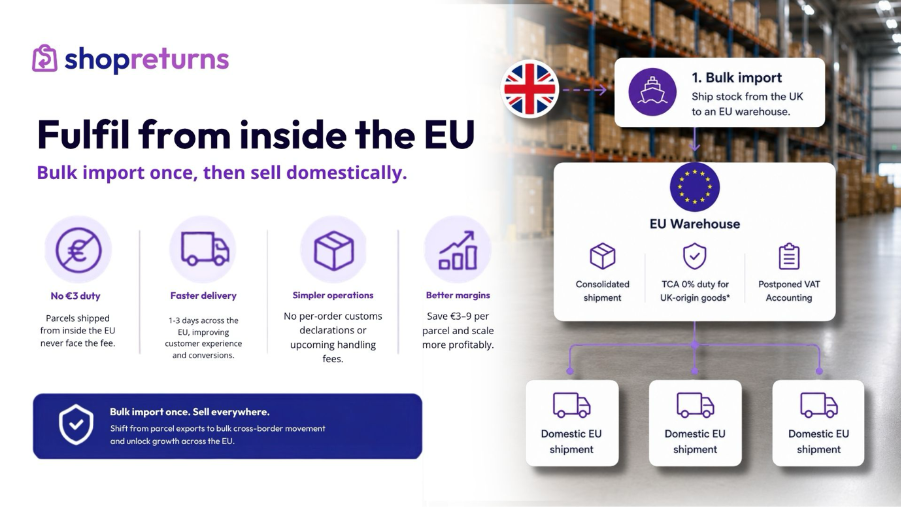
All previous strategies manage the duty; this one eliminates the per-parcel version of it. The €3 charge applies only to parcels crossing the EU border. Parcels shipped from stock already inside the EU never face it.
How? Bulk-import your stock into an EU warehouse in one consolidated shipment, shifting from parcel exports to bulk cross-border movement and simplifying international shipping. UK-origin goods enter duty-free under the TCA with origin proof; non-UK goods pay their normal tariff once, on wholesale value, usually far cheaper than repeated €3–€9 charges on retail parcels. Plan the import VAT too: Postponed VAT Accounting lets businesses account for VAT on their VAT return rather than at the border. From there, each customer order is a domestic EU shipment: no €3 duty, no upcoming handling fees, no per-order customs data, and delivery drops from 5–10 days to 1–3, which shows up directly in checkout conversion. (One footnote for completeness: Northern Ireland follows different customs rules under the Windsor Framework, so UK businesses trading through it need a separate review because some goods remain subject to EU rules and may enter from the EU in free circulation under a different framework.)
The break-even point is lower than expected. At €6 average duty per parcel, 300 EU orders monthly cost €1,800 in duties alone, before the late-2026 handling fees and the conversion you lose to slow delivery. That covers a significant portion of third-party fulfilment. Our [EU fulfilment setup guide] walks through the whole build: entity, warehouse, B2B import, OSS.
9. Solve returns - the hidden cost
Returns are the cost almost nobody models, and the one we see surprise our clients most often. An EU customer returning to a UK address triggers a second border crossing: re import paperwork, refund delays, and when you reship or the customer reorders, the €3- plus duty again. Returned Goods Relief can remove customs duty on qualifying re-imports, but it doesn’t solve the wider friction, the paperwork or the duty on the way back out. In high-return categories, the return leg can exceed the outbound duty.
The solution is an EU returns address. Customers return domestically; items are inspected and restocked locally; stock sells to the next EU customer without crossing borders or triggering duties again. If you’re in fashion or footwear with 15–30% return rates, start here, not with the outbound side.
This is what we do at ShopReturns: local EU return addresses, inspection, restocking and reverse logistics that keep UK brands’ stock, and margin, inside the single market.
Quick example: three approaches
A UK home-fragrance brand averages €30 per EU order (about £26), typically a candle, wax-melt pack and greeting card, three HS codes, with 350 orders monthly.
Doing nothing costs 3 × €3 = €9 per order, about €3,150 monthly, roughly 30% of order value, around €38,000 annually before handling fees. Country-level charges are also diverging across EU member states: Italy adds a €2 customs administration fee on sub-€150 items from October 2026, Romania applies a RON 25 logistics tax from 2026, and France suspended its small parcel tax in July 2026, so your final burden increasingly depends on the destination country, with different administration or logistics fees layered onto post-Brexit customs processes. Many EU countries now apply post-Brexit customs processes to goods imported from the UK.
Basket engineering (strategies 1–4) repositions the card as a free insert, aligns melts with candles where classification genuinely allows, and confirms the gift set qualifies as a single retail set. Average codes drop from 3 to 1.4; monthly duty falls to about €1,470. That represents approximately €20,000 in annual savings, achieved in weeks, with no fulfilment changes.
EU fulfilment plus returns (strategies 8–9) eliminates per-order duty, cuts delivery to 1–3 days, and turns returns into domestic restocks. Moving stock doesn’t erase tariffs from the world; it means clearing customs once, on wholesale value, instead of paying retail parcel fees forever. The new fulfilment cost is largely offset by cheaper postage and the conversion lift from fast, surprise-free delivery.
The takeaway: the gap between doing nothing and acting is five figures, even for a modest brand.

Which strategies should you start with?
This is the roadmap we walk through with every brand that comes to us. Find your situation, start there, and stay informed because customs rules can change by date and market.
Low-volume marketplace seller (under ~100 EU orders monthly)? Start with 1 and 3. The platform handles compliance; you focus on listings and order values.
Own site, single product category? Start with 1 and 3. The impact is lighter; absorb the cost or nudge baskets higher.
Mixed baskets or gift boxes? Start with 1, 2 and 4. Basket engineering delivers the fastest savings.
UK manufacturer selling higher-value goods? Explore 6. Preferential origin may apply; seek professional advice first.
300+ EU orders monthly? Prioritise 8 and 9: fulfil and handle returns inside the EU. The duty you already pay can fund the move.
High return rates (fashion, footwear, 15%+)? Start with 9. Returns may already cost you more than the duty.
Temporary movements or processing workflows? Edge case worth knowing: ATA Carnets cover duty-free temporary admission, and Inward Processing suspends duty on goods re exported after processing. Specialist options, not core fixes for parcel sellers, and usually worth specialist advice for ensuring compliance.
Two final audit warnings. Never copy competitors’ HS codes: you’re legally responsible for your own classification, and reaching for a “cheaper” code is an offence. And be transparent with customers about charges, especially for e-commerce sellers: if anything can reach them at delivery, disclose it, or price DDP so nothing ever does.
The sellers who thrive in 2026–2028 won’t be those finding temporary dodges. They’ll be those who understood early that HS codes set costs and borders decide payment, and acted accordingly while others were still scrambling over parcel fees.
FAQ
Is it legal to avoid the €3 EU customs duty? Yes. Reducing duty via accurate HS classification, basket design, B2B channels, preferential origin or EU fulfilment is lawful structuring. Undervaluing parcels, artificial order splits or false origin declarations are customs fraud; the EU monitors for these patterns from October 2026.
How much is the duty on my parcel? €3 for the first HS tariff sub-heading and €3 for each additional one, calculated per parcel or customs consignment rather than by item-level counts, so large orders should not be split into smaller consignments just to chase the charge. A single-category order pays €3; three categories pay €9. Multiple items sharing one code incur only one charge.
Do UK-made goods automatically avoid the duty? No. Goods must genuinely qualify for preferential origin under the TCA and ship outside IOSS via a standard H1 declaration, with origin evidence retained. A UK warehouse alone doesn’t confer origin.
Does the €3 duty apply to B2B orders? No. It targets B2C distance sales; wholesale and B2B shipments follow normal commercial customs rules.
Can I use an EU fulfilment centre to avoid the €3 duty? Yes. The charge applies only to parcels crossing the EU border, so stock shipped from Great Britain is treated differently from stock already held inside the EU in the destination EU member state.
What happens above €150? The flat rate stops because the de minimis treatment no longer applies, and normal tariff rules apply to imported goods based on origin and commodity code: 0% for genuinely UK-origin goods under the TCA, standard rates for goods of other origin. VAT also applies to all goods post-Brexit based on the item value and type. (And separately, for goods travelling the other way: gifts into the UK under £39 can be relief eligible, but commercial orders must never be misdeclared as gifts.)
Keep your margin inside the EU
Every strategy above helps you reduce the impact of the new €3 EU customs duty. What we do at ShopReturns is solve the operational side of the problem.We provide local EU return addresses, inspection, restocking and reverse logistics, so returned stock stays inside the single market, can be resold to the next EU customer, and doesn’t repeatedly cross the UK–EU border.For brands ready to go further, we also connect you with trusted fulfilment and incorporation partners to support a complete EU operating model.If you’re shipping 50,000+ parcels into the EU each year, or your return rate sits in the 15–30% range typical of fashion and footwear, this is where operational improvements can translate into six-figure annual savings.Stop letting new customs regulations erode your European margins.
Contact the ShopReturns team to calculate your current shipping and returns costs, identify where the €3 duty is affecting your business, and explore whether local EU returns or fulfilment could significantly reduce your total landed cost.