

Starting July 1, 2026, every parcel you send from the UK to an EU customer costs €3 more in customs duty. Most sellers know this. What they don't know is what happens to that €3 when the customer sends the package back.
The short answer: you can get it back. But whether you will depends entirely on your order volume, your logistics setup, and whether you act within a strict time window.
Here's the math that most guides skip.
First, let's be clear about what the €3 actually is
The EU's new flat-rate customs duty — introduced by Regulation (EU) 2026/382, in force from 1 July 2026 — applies to all goods valued under €150 entering the EU from a non-EU country. For UK sellers, that means virtually every parcel you ship directly to an EU consumer.
A few things to know before we get to returns:
- It's €3 per item category (HS tariff code), not per parcel. A parcel with a T-shirt and a pair of jeans = €6.
- It's a customs duty, not a handling fee. That distinction matters — a lot — for refunds.
- It runs until July 2028, when the EU Customs Data Hub goes live and standard tariffs apply.
- On top of this, Italy (€2/parcel since Jan 2026), France (€2/item since Mar 2026) and several other countries charge national handling fees — and those are not refundable.
What happens to the €3 when a customer returns?
Under EU law (Union Customs Code, Article 116), customs duties paid on goods purchased under a distance contract (i.e., an online order) can be refunded when those goods are returned. This isn't new — but the €3 flat-rate duty falls squarely within this framework.
There are three practical paths:
Path 1: Declaration invalidation (fastest — 90-day window)
The carrier or postal operator that filed the original customs declaration can request its invalidation within 90 days. If accepted, the full duty + VAT is refunded. This is the cleanest route — but it requires your carrier to actually do it, and most won't unless you ask explicitly.
Path 2: Formal duty refund application (up to 3 years)
After 90 days, you can submit a refund application to the customs authority in the country of import. Decision time: up to 120 days. Requires: original customs declaration, proof of return, invoice, and export evidence. Manageable at scale. Painful one by one.
Path 3: Bulk recovery through specialist services
Companies like Trade Duty Refund handle consolidated duty recovery across hundreds or thousands of returns. They submit bulk claims, reducing the per-unit cost of recovery to a level where €3 per item actually makes financial sense.
The real question: is it worth it for your business?
That depends on three variables: monthly orders to EU, return rate, and average item value.
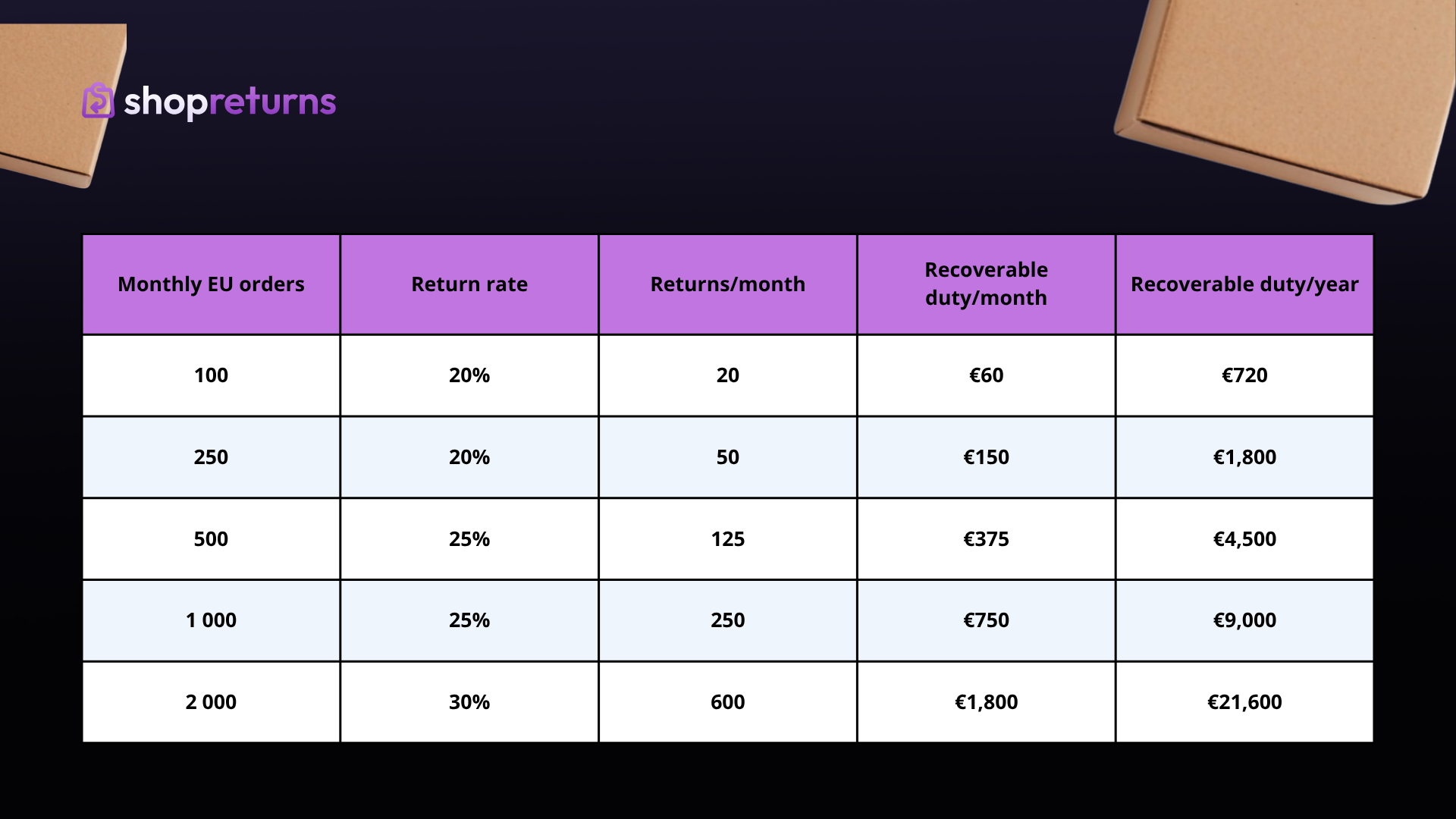
Assumes 1 item per order. Fashion / apparel typically has higher return rates (25–40%) and often multiple items per order.
The numbers tell a clear story:
Under ~250 orders/month to EU: The administrative cost of individual claims typically exceeds the recovery amount. You'd spend more chasing €720/year than you'd get back.
250–1,000 orders/month: It starts to make sense — but only if you process claims in bulk, not one by one. Annual recovery in the €2,000–€10,000 range is real money.
Above 1,000 orders/month: Non-negotiable. You're leaving €10,000–€20,000+ on the table every year if you don't have a recovery system in place. At 2,000 monthly orders with a 30% fashion return rate, that's over €21,000 annually — and that's just the €3 duty, before you add VAT recovery.
But there's a second problem most calculators ignore
The €3 duty is what your customer pays to receive the item in the EU. But when they return it — and the goods travel back to the UK — you may face another duty on reimport to the UK.
This is the double duty trap.
The only protection is Returned Goods Relief (RGR): a procedure that allows goods re-entering the UK to come back without paying UK import duty, provided you can link the return to the original export declaration. Without that documentation trail, you pay twice.

Getting to the third row requires proper documentation on every shipment. Most mid-market sellers aren't there yet.
What this means in practice
The €3 customs duty is recoverable in principle. In practice, recovery requires:
- A carrier or logistics partner who knows how to file an invalidation request or duty refund claim
- Clean documentation linking each return to its original export
- Volume sufficient to justify the admin — or a partner who handles bulk recovery
- A physical return address inside the EU so returned goods don't have to cross the border twice just to be processed
That last point matters more than most sellers realise. If your returns go directly from an EU customer back to a UK warehouse, you're creating a cross-border return flow that complicates both the EU refund claim and the UK RGR application. A local EU return point consolidates the paperwork, the physical handling, and the documentation in one place.
The bottom line
The €3 fee is not the real problem. The real problem is the operational complexity that makes recovery hard at scale — and the double cost for sellers who haven't set up the right infrastructure.
If you're shipping more than 250 orders a month to the EU, run this calculation for your business:
Monthly EU orders × return rate × €3 × 12 = your annual unrecovered duty.
If that number is above €2,000, it's worth solving properly — not with a spreadsheet and a prayer, but with a system.
ShopReturns provides local return addresses in 9 EU countries and the UK, with consolidated returns processing and documentation support for cross-border duty recovery. If you want to understand what the new customs rules mean for your specific return volumes, get in touch.
