Zalando partner returns requirements and SLA: a 2026 compliance checklist
15.10.2026 · 13 min read

Navigation
- Why this matters nowWhich Zalando model you are on decides who handles the returnThe return window: 30 days in the rules, not 100Labels, carriers and the return addressThe SLA that matters: Reimbursement on TargetReporting the return via APIDamaged, worn and out-of-policy returnsWhat happens on a breachCommission, fees and deductions on returned ordersNon-EU partners: what UK brands need to plan forWhat this looks like inside the businessZalando returns compliance checklist by stageHow ShopReturns helpsFAQNot sure what your current setup is costing you?
For Zalando partners, a return isn’t complete when the customer sends the parcel back. It must also be processed and confirmed within the marketplace’s required timeframe.
Missing these deadlines can affect product visibility and, in more serious cases, put a seller’s account at risk.
The challenge is that Zalando measures return performance from the moment the customer hands the parcel to the carrier, not when it reaches your warehouse.
This guide explains Zalando’s 2026 returns requirements, the deadlines that apply across different European markets and the practical steps sellers can take to stay compliant.
In this article:
- Zalando returns requirements across fulfilment models.
- Return windows, shipping labels and approved carriers.
- Country-specific processing deadlines and SLA penalties.
- A practical compliance checklist for Zalando partners.
Why this matters now
The rulebook changed on 1 July 2026. Platform Rules version 13 took effect that day. Zalando’s summary of the update lists three points that touch returns: the correct return tracking number is now a blocker requirement, the wording on EU stock locations was tightened, and carriers were removed from the authorised list, including DPD and GLS for Germany.
The return window is no longer 100 days in the rules. Section 7.2.8 states that “the return period is 30 days from delivery date”. Any SOP that still says 100 needs updating.
The partner models are being consolidated. In April 2026 Zalando announced that Connected Retail will be discontinued by 30 June 2027.
EU customs changed on the same date. Since 1 July 2026 a €3 customs duty per item applies to distance-sale consignments with an intrinsic value up to €150.
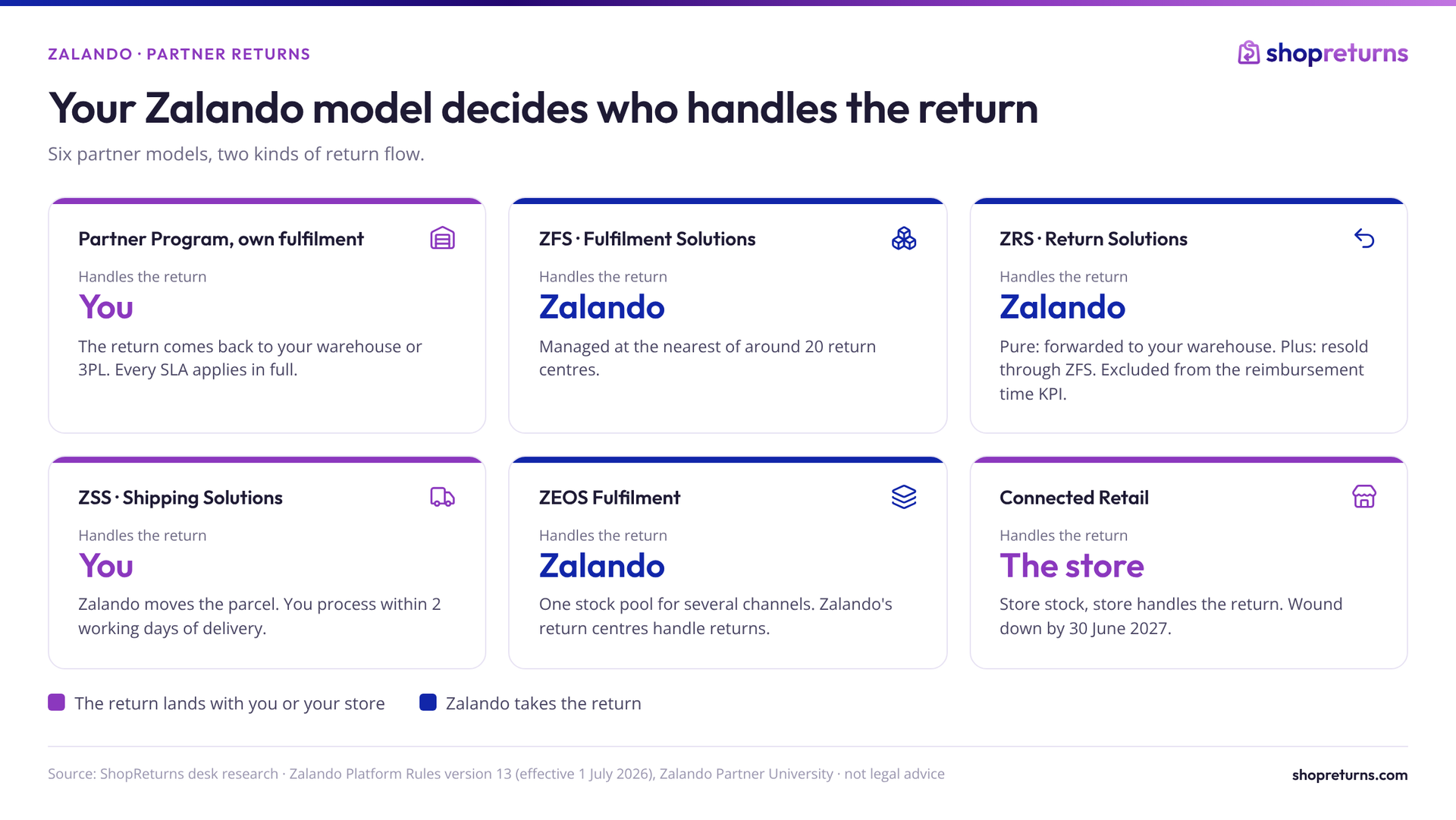
Which Zalando model you are on decides who handles the return
Partner Program with own fulfilment. You ship from your own warehouse or 3PL and the return comes back to you. Every SLA in this article applies to you in full.
Zalando Fulfilment Solutions (ZFS). Your stock sits in Zalando’s network and Zalando manages the return, at the nearest of around 20 return centres.
Zalando Return Solutions (ZRS). You ship, Zalando takes the return. Under ZRS Pure returns are consolidated and forwarded to your warehouse. Under ZRS Plus they go into a Zalando warehouse and are resold through ZFS. Zalando lists 14 markets, and you cannot run ZRS and your own return handling in the same market. ZRS returns are excluded from the reimbursement time KPI, and Zalando sets the returned status itself.
Zalando Shipping Solutions (ZSS). Zalando’s transport network moves the parcel while you keep the warehousing. If ZSS delivers returns to your warehouse, you have 2 working days from delivery to process them.
ZEOS Fulfilment. Formerly Multichannel Fulfilment: one stock pool serving Zalando, other marketplaces and your own site, with Zalando’s return centres handling returns.
Connected Retail. Store stock integrated into the Zalando shops, with the store handling the return. It is being wound down by 30 June 2027.
The return window: 30 days in the rules, not 100
What the Platform Rules say. The return period is 30 days from the delivery date. The days run from the date the customer receives the article to the date the customer sends it back, not the date you receive it. In a dispute, the carrier’s timestamps decide.
Where the 100 days went. Zalando cut the return window to 30 days across markets, culminating in Platform Rules version 13, which standardises the return period to 30 days from delivery for all markets and partner models.
Returns remain free for the customer. Zalando requires a prepaid, pre-printed return label in every parcel. You buy that label from the carrier, so the return transport cost sits with you.
Late returns can be refused. If a customer returns an article after the return period and it is not a reclamation, you are entitled to refuse the refund. You must tell Zalando Customer Care, with the reason, within 2 working days of arrival.
Worth a mention: the rules also require you to keep your technical connection to Zalando live for 100 days after your contract ends, so that late returns can still be processed.
Labels, carriers and the return address
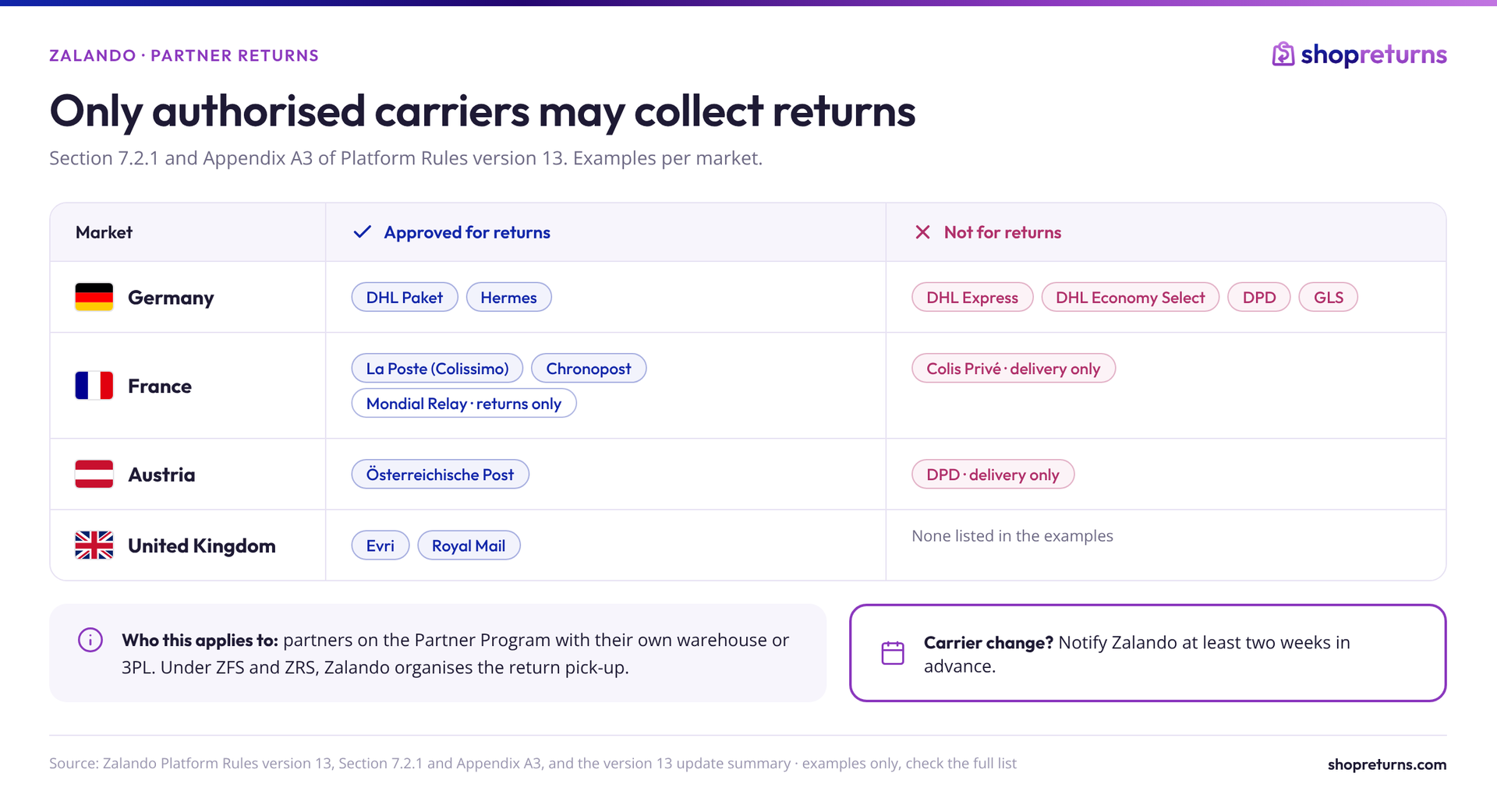
Who this section applies to. These rules apply to partners on the Partner Program who fulfil orders from their own warehouse or a 3PL. Under ZFS and ZRS, Zalando’s network organises the return, so the label, carrier and return address are handled by Zalando.
Four documents travel with every order. Zalando’s delivery documentation guide lists a delivery note, a return note, a return flyer with the partner-specific return and reimbursement instructions, and the return label. Article details must be pre-printed on the return note, and documents must use one consistent language.
Only authorised carriers may collect returns. Section 7.2.1 requires both last-mile delivery and return pick-up to be performed by a carrier listed in Appendix A3. Some carriers are approved for delivery only. Examples from version 13:
- Germany: DHL Paket and Hermes. DHL Express and DHL Economy Select are not approved.
- France: La Poste (Colissimo) and Chronopost, with Mondial Relay for returns only and Colis Privé for delivery only.
- Austria: Österreichische Post for both legs, DPD for delivery only.
- United Kingdom: Evri and Royal Mail.
Carrier changes must be notified to Zalando at least two weeks in advance.
The return address. Zalando’s logistics overview requires own-fulfilment partners to maintain a valid return address within the European Union. A domestic return address in each market is recommended because it shortens transit time inside the RoT clock. Sending returns with an authorised domestic carrier to one EU return hub also meets the platform rules.
The SLA that matters: Reimbursement on Target
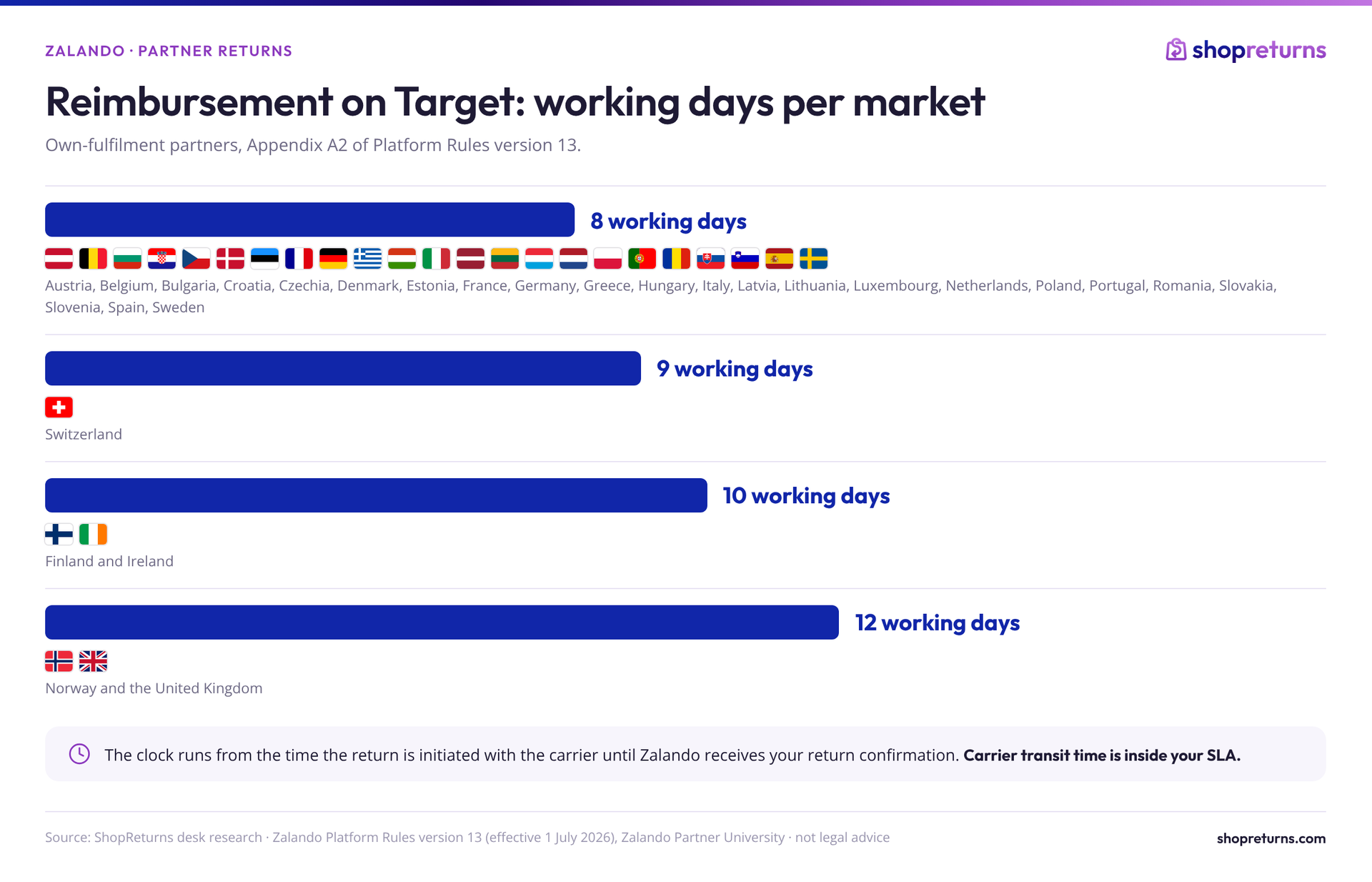
How the clock runs. Return performance is measured by Reimbursement on Target (RoT). A return must be processed within the country target, in working days, “counted from the time the return was initiated with the carrier until Zalando receives the return confirmation from the Partner”. Carrier transit time is inside your SLA.
The targets per market, from Appendix A2 of version 13:
- 8 working days: Austria, Belgium, Bulgaria, Croatia, Czechia, Denmark, Estonia, France, Germany, Greece, Hungary, Italy, Latvia, Lithuania, Luxembourg, Netherlands, Poland, Portugal, Romania, Slovakia, Slovenia, Spain, Sweden.
- 9 working days: Switzerland.
- 10 working days: Finland and Ireland.
- 12 working days: Norway and the United Kingdom.
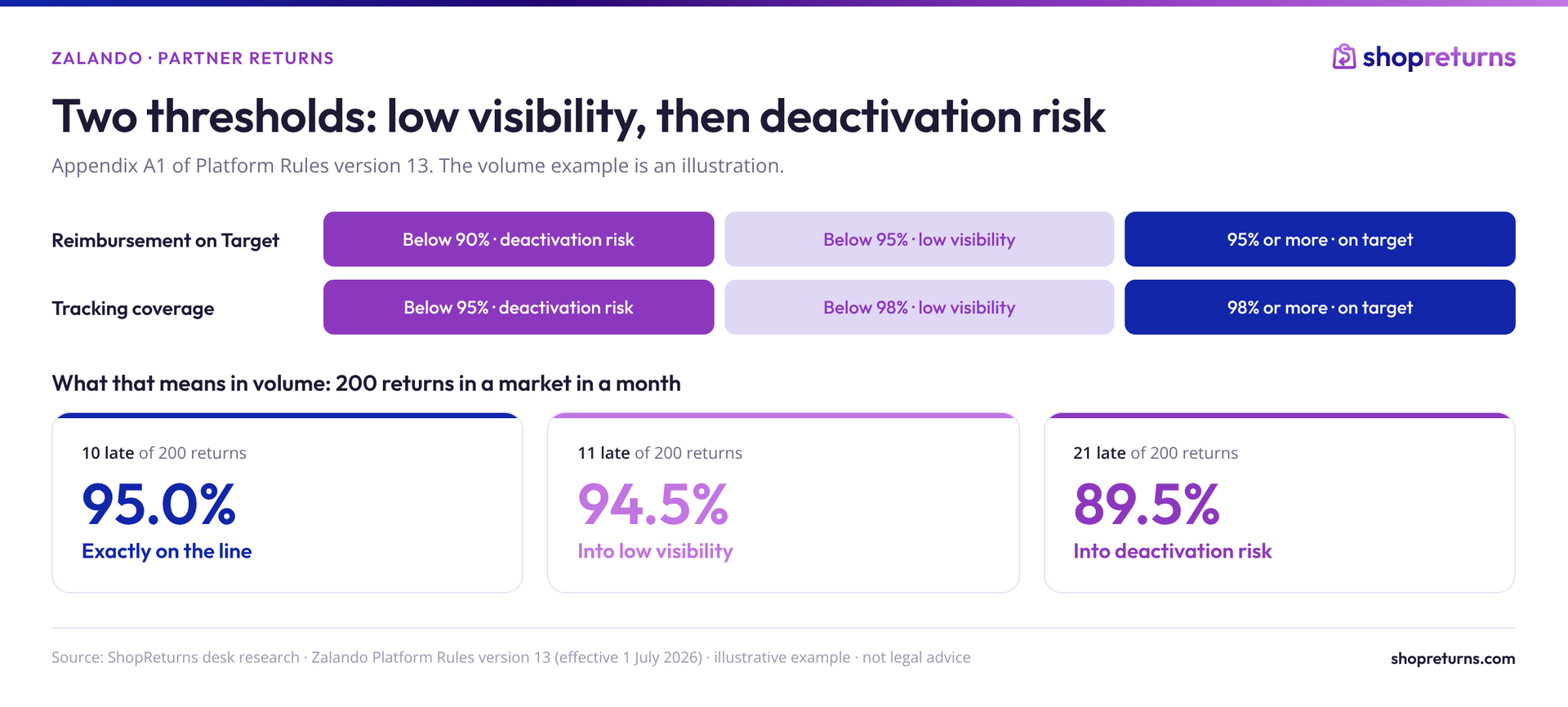
The thresholds. Appendix A1 sets two lines for RoT. Below 95% of returns processed on time, you fall into low visibility. Below 90%, you are at deactivation risk. Tracking coverage has the same structure at 98% and 95%.
What that means in volume. As an illustration, a partner with 200 returns in a market in a month can have 10 late and still sit at exactly 95%. The 11th late return takes them to 94.5% and into low visibility. At 21 late they are at 89.5% and into deactivation risk.
Worth a mention: your confirmation triggers the customer’s refund, but Zalando pays it. If the customer complains about a missing refund and you have not booked the return, Zalando can issue a manual refund on your behalf and deduct it from your payout.
Reporting the return via API
One status change per order line. In the zDirect Orders API, an order line moves through initial, reserved, shipped, canceled and returned. The developer documentation defines returned as: “You have received an Order Item that was returned by the customer.” You report it with a PATCH on the order line, setting the status to returned, even if the order as a whole is already fulfilled.
Tracking comes first. The shipment confirmation, due within 12 hours of shipping, must carry both the delivery tracking number and the tracking number of the return label in the parcel. The API documentation says to set both before you ship, and they cannot later be blanked. The return update also accepts an optional reason code.
Damaged, worn and out-of-policy returns
You have 2 working days to raise a problem. If a return shows signs of use or wear and Customer Care had not told you to expect a reclamation, you must notify the Customer Care team for the order’s market within 2 working days of arrival, with the order number, the article SKU and photos. The same window applies to empty boxes and suspected counterfeits. Customer Care then tells you whether to book, refuse or dispose.
Reclamations are booked as normal returns. Zalando reimburses the customer and tells you in advance that the item is coming back. The rules state that customers may return defective items for up to two years from delivery, and that within the first year the partner bears the burden of proof.
Lost and partial returns. For a missing return or a partial-refund complaint, Zalando checks tracking and may ask you for clarification. Written inquiries must be answered within 24 hours. If you miss that, Zalando may refund on your behalf.
What happens on a breach
Visibility goes first. Missing a CXM target on any KPI in a country may lead to lower visibility or temporary exclusion from Price Mode.
Document failures are checked by test order. Zalando can place a test order at any time. A blocker finding, such as a missing return label or an incorrect return tracking number, means immediate low visibility and deactivation if not fixed within 15 days. A successful follow-up test order reverses the consequences.
Costs can follow. Zalando reserves the right to charge partners for costs caused by poor customer experience, including replacement return labels it issues and Customer Care contacts above market-specific thresholds.
Commission, fees and deductions on returned orders
What we could verify publicly. Manual refund amounts are deducted from the partner invoice, itemised with the monthly payout. Press reports from February 2023 put the Partner Program basic fee at €40 a month (€480 a year) from 1 July 2023, with commission bands of 5% to 25% of gross sales price depending on exclusivity.
Commission and fee structure. Commission credit and specific service fees for returned orders are governed by the partner's individual commercial agreement and specific solution tier (ZRS Pure, ZRS Plus, or ZFS).
Non-EU partners: what UK brands need to plan for
Stock must be in the EU before the order. Section 7.2.2 requires all orders for EU customers to be fulfilled from a stock location within the European Union and states that direct cross-border shipping from a non-EU location to an EU customer is “strictly prohibited”. Goods must be in free circulation first, at the partner’s cost.
Returns must land in the EU too. The return travels on a domestic carrier label to an EU address. A UK warehouse cannot serve as the return address for German or French orders.
The leg home is the customs event. Anything you bring back to the UK is an export from the EU and an import into Great Britain, with declarations on both sides. The practical answer is to keep saleable returns in EU stock and move only consolidated lots.
Worth a mention: the €3 duty does not attach to your Zalando orders, because that stock was imported in bulk under the normal tariff. It applies to direct UK-to-EU consumer parcels up to €150 from your own webshop. For those, the Commission’s guidance states that operators “may no longer request the invalidation of the customs declaration” when such goods are returned, so the €3 cannot be recovered through that route, although the general refund rules in Article 116 of the Union Customs Code still apply.
What this looks like inside the business
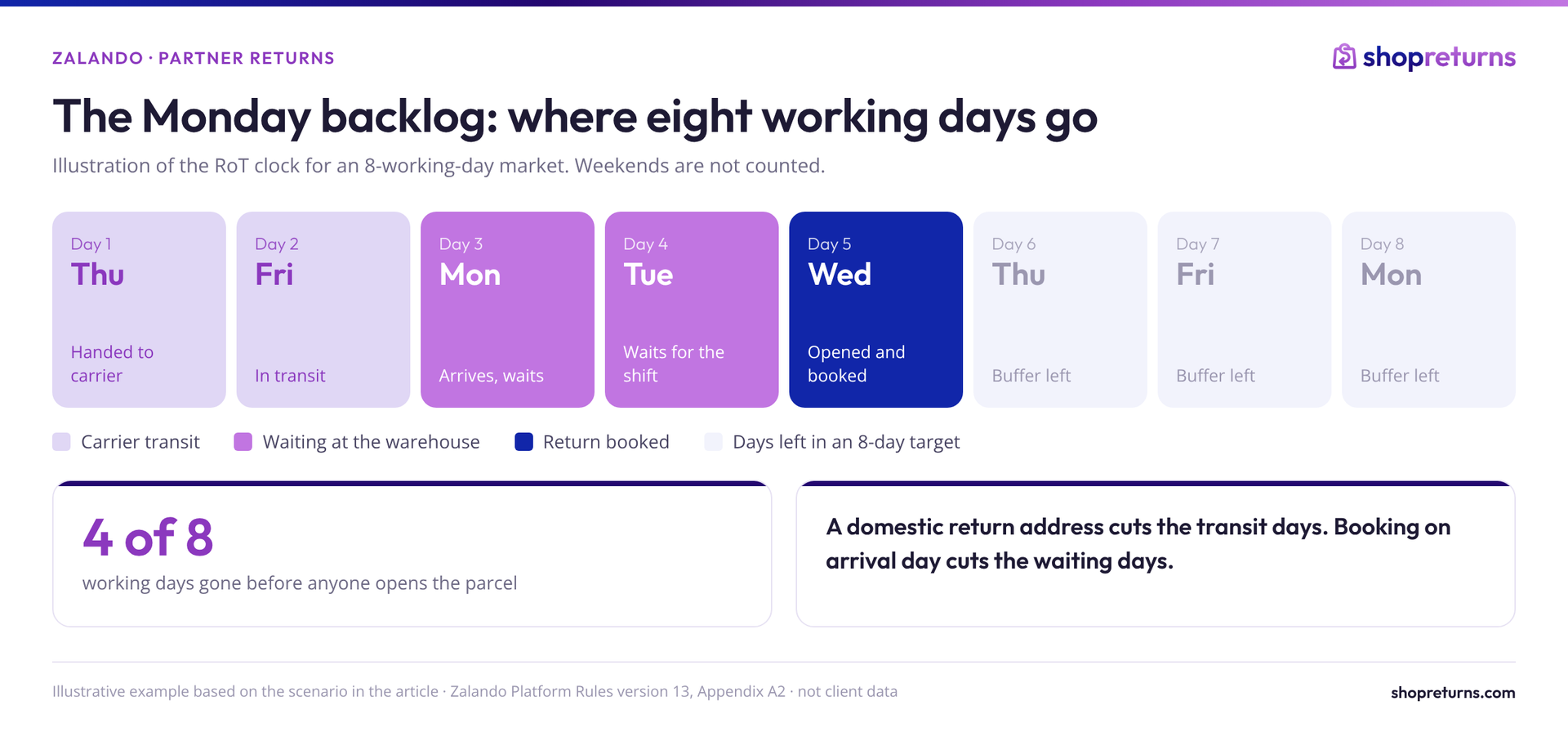
The Monday backlog. Returns handed over on Thursday arrive on Monday and wait for Wednesday’s processing shift. Four of the eight working days have gone before anyone opens the parcel.
The carrier that only delivers. Operations switches Austrian outbound to DPD for price and uses the same contract for return labels. DPD is authorised for delivery only in Austria, and the next test order records a blocker.
The worn trainers. A pair comes back visibly used. The warehouse books it as returned, then emails photos a week later. The 2 working day window has closed and the refund has been paid.
Zalando returns compliance checklist by stage
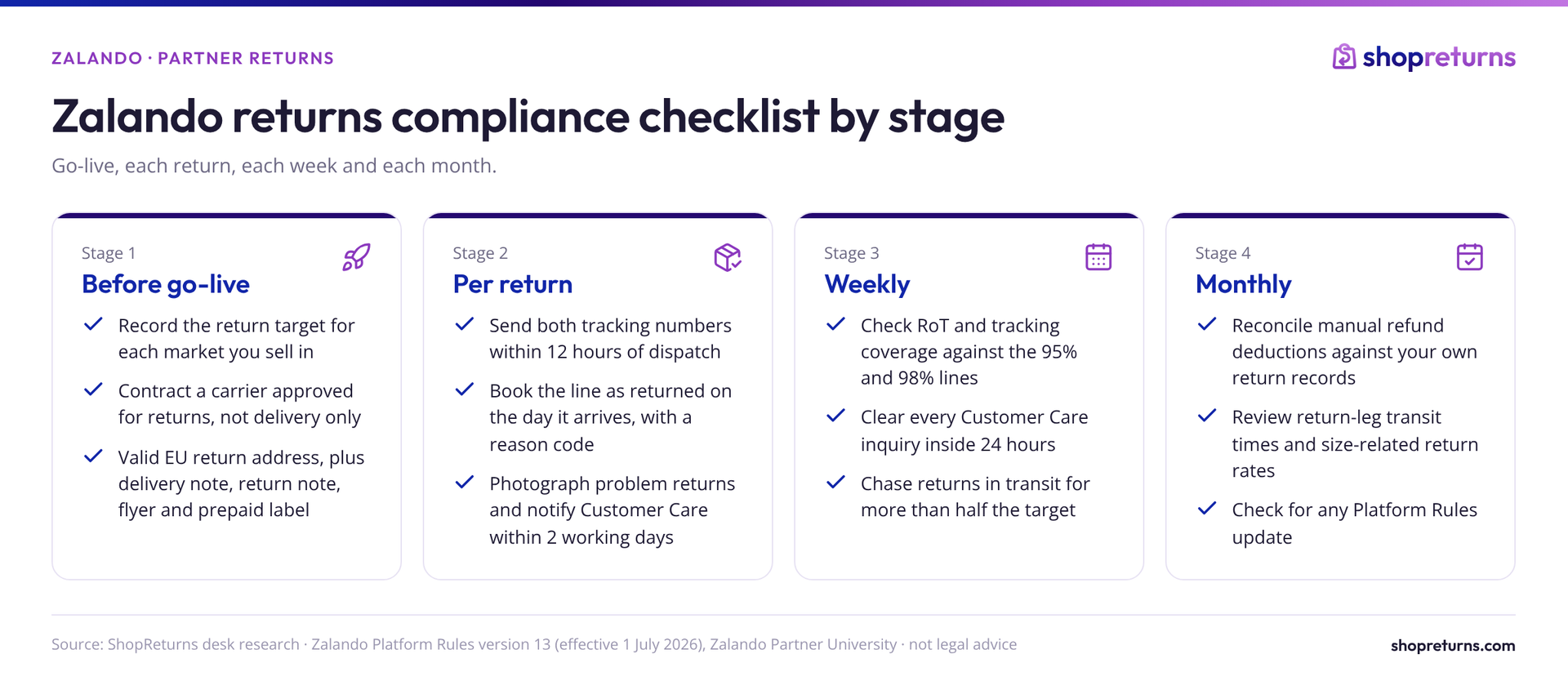
Before go-live
- Read the current Platform Rules version and record the return target for each market you sell in.
- Contract an authorised return carrier per market, and check it is approved for returns, not delivery only.
- Set up a valid EU return address and build the delivery note, return note, return flyer and prepaid label from Zalando’s country templates.
Per return
- Send both tracking numbers before shipping, within 12 hours of dispatch at the latest.
- Scan and book the return line as returned on the day it arrives, with a reason code.
- Photograph any worn, damaged, empty or wrong-item return and notify Customer Care within 2 working days.
Weekly
- Check RoT and tracking coverage per market in zDirect against the 95% and 98% lines.
- Clear every Customer Care inquiry inside 24 hours and chase returns in transit for more than half the target.
Monthly
- Reconcile manual refund deductions on the payout statement against your own return records and dispute those you can evidence.
- Review carrier transit times on the return leg, size-related return rates, and any Platform Rules update.
How ShopReturns helps
For Zalando partners managing their own returns, every day spent in transit reduces the time available to inspect, process and confirm a returned product.
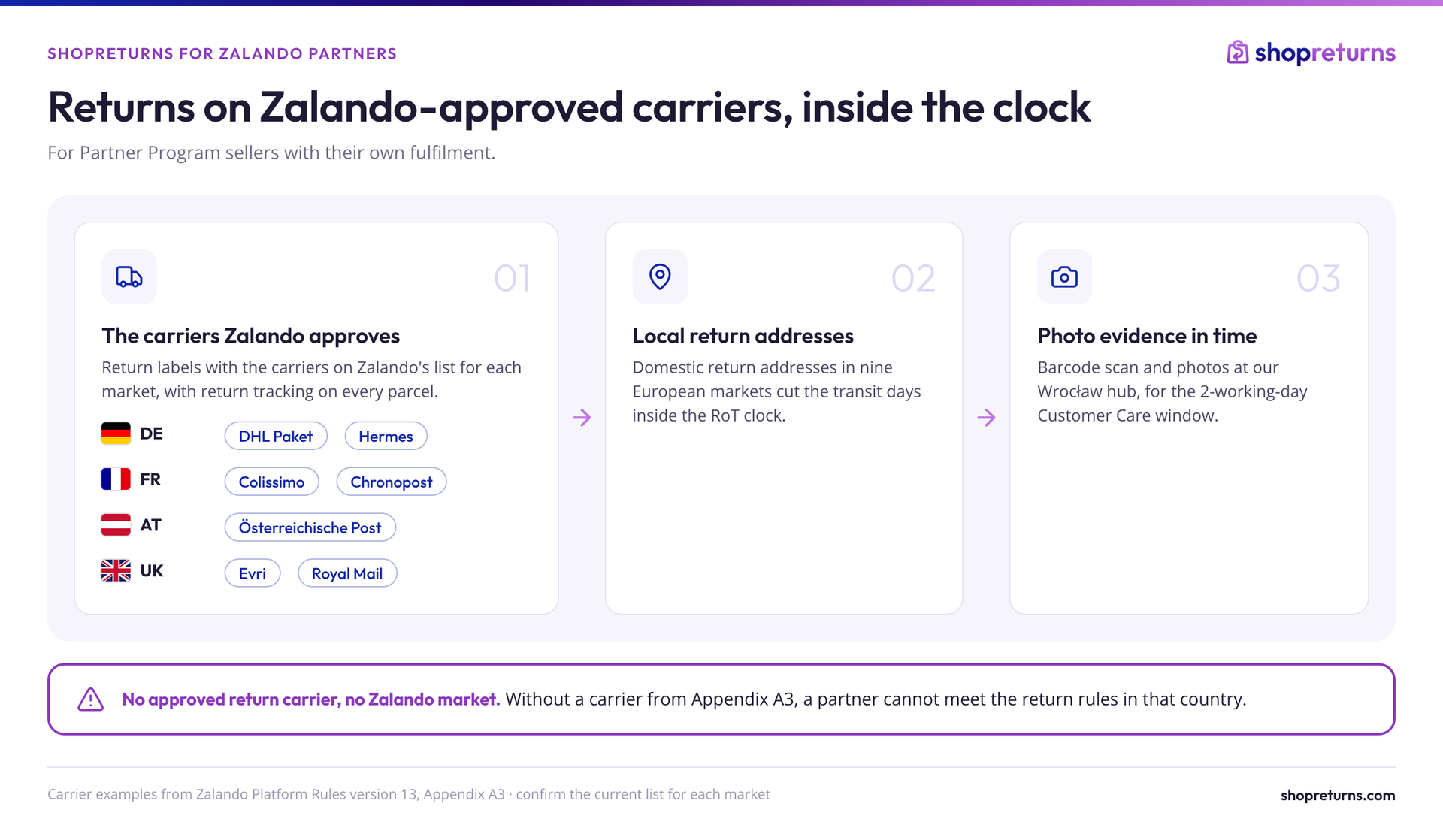
The carriers Zalando approves. Zalando lets only carriers listed in Appendix A3 collect returns, and without an approved return carrier a partner cannot sell in that market. ShopReturns works with the carriers Zalando requires for return handling, including DHL Paket and Hermes in Germany and Evri and Royal Mail in the UK. Every return gets a tracking number, which is now a blocker requirement under Platform Rules version 13.
Local return addresses. ShopReturns provides local return addresses in nine European markets, helping brands organise domestic returns instead of shipping individual parcels internationally. Fewer transit days leave more of the RoT target for processing.
Photo evidence in time. At our Wrocław hub, returned items are verified within 48 hours using barcode scanning and photo-documented inspection. This gives sellers visibility over product condition and the evidence Customer Care asks for within 2 working days for worn, damaged or empty returns.
Depending on the brand’s instructions, items can be returned to stock, prepared for resale, donated or disposed of. Consolidated bulk transportation is available where financially justified.
The goal is to shorten the returns process and help sellers stay within Zalando’s country-specific deadlines.
FAQ
How long do Zalando customers have to return an item? Platform Rules version 13 sets the return period at 30 days from delivery, counted to the day the customer sends the item back.
How fast must a Zalando partner process a return? For own-fulfilment partners the target is 8 working days in most markets, 9 in Switzerland, 10 in Finland and Ireland, and 12 in Norway and the UK. The count starts when the return is initiated with the carrier and stops when Zalando receives your return confirmation.
What happens if I miss the Zalando return SLA? If fewer than 95% of returns in a market are processed on target, your articles can be given lower visibility. Below 90% you are at risk of deactivation in that market.
Can a UK brand use a UK return address for Zalando EU orders? No. Zalando asks own-fulfilment partners for a valid EU return address and EU orders must be fulfilled from stock inside the EU.
Not sure what your current setup is costing you?
Send us your numbers and we'll run them against the new regime - where the duty is hitting twice, what your return freight actually costs against the goods you recover, and how much of it is avoidable. One working session, and you leave with the figures either way.
Keep reading
More from the knowledge base

Resale vs refurbish vs liquidate: what to do with returned fashion stock

Zalando vs ASOS vs About You: returns terms compared for sellers