Resale vs refurbish vs liquidate: what to do with returned fashion stock
02.11.2026 · 12 min read

Navigation
- Why this matters nowThe disposition routes for a returned unitA grading standard: A, B, C, DWhat the rules do to each routeThe decision model: net recovery per routeA decision rule for each routeWhat this looks like inside the businessWhat to check before you scaleHow ShopReturns helpsFAQNot sure what your current setup is costing you?
Not every returned fashion item should go straight back into stock. Some products can be resold at full price, others need cleaning or minor repairs, and some are worth more when sold through an outlet or liquidation channel.
The right decision depends on product condition, remaining seasonal demand and the cost of getting the item ready for resale.
For fashion brands operating across Europe, the choice also involves logistics costs and regulations governing unsold products.
This guide compares the main recovery options for returned fashion stock and introduces a financial model to help brands decide when to restock, refurbish, resell or liquidate.
In this article:
- The main options for handling returned fashion stock.
- How to classify returned products using an A–D grading system.
- Key EU rules affecting the treatment of unsold clothing.
- How to compare resale, refurbishment and liquidation using net recovery.
- Three practical scenarios showing how costs and timing affect the decision.
Why this matters now
Returned fashion stock is becoming both a financial and a regulatory challenge.
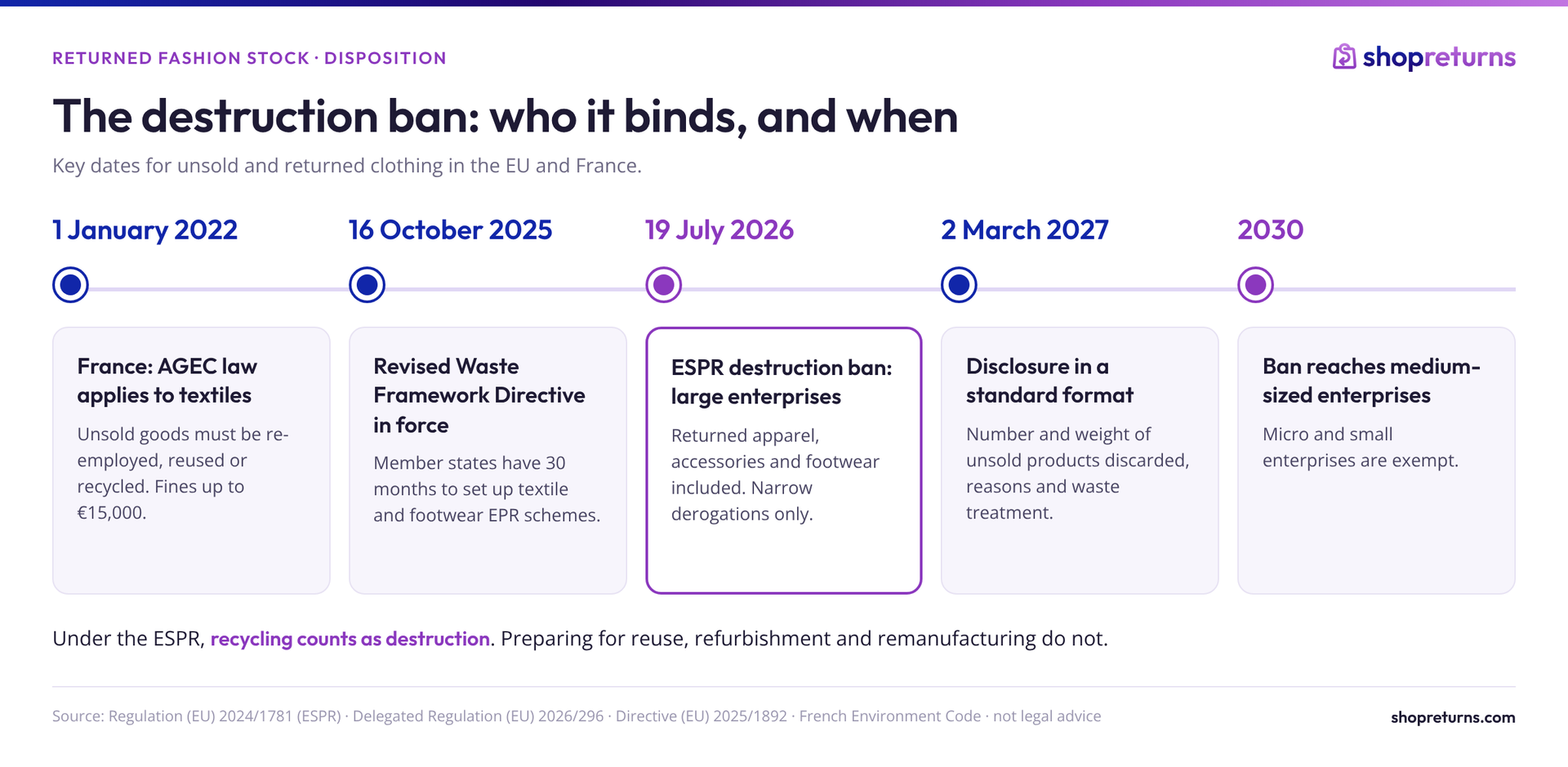
Under the EU Ecodesign for Sustainable Products Regulation (ESPR), restrictions on destroying unsold apparel, clothing accessories and footwear have applied to large enterprises since 19 July 2026, subject to specified exceptions. Medium-sized enterprises are scheduled to follow in 2030, while micro and small enterprises are exempt from this prohibition.
Returned products can fall within the regulation’s definition of unsold consumer products. This makes documenting product condition and the reasons for choosing a particular recovery route increasingly important.
At the same time, every additional transport stage, inspection delay or missed selling window can reduce the value recovered from a returned item.
Fashion brands therefore need a clear process for deciding what happens to each product, based on its condition, potential resale value and total recovery cost.
The disposition routes for a returned unit
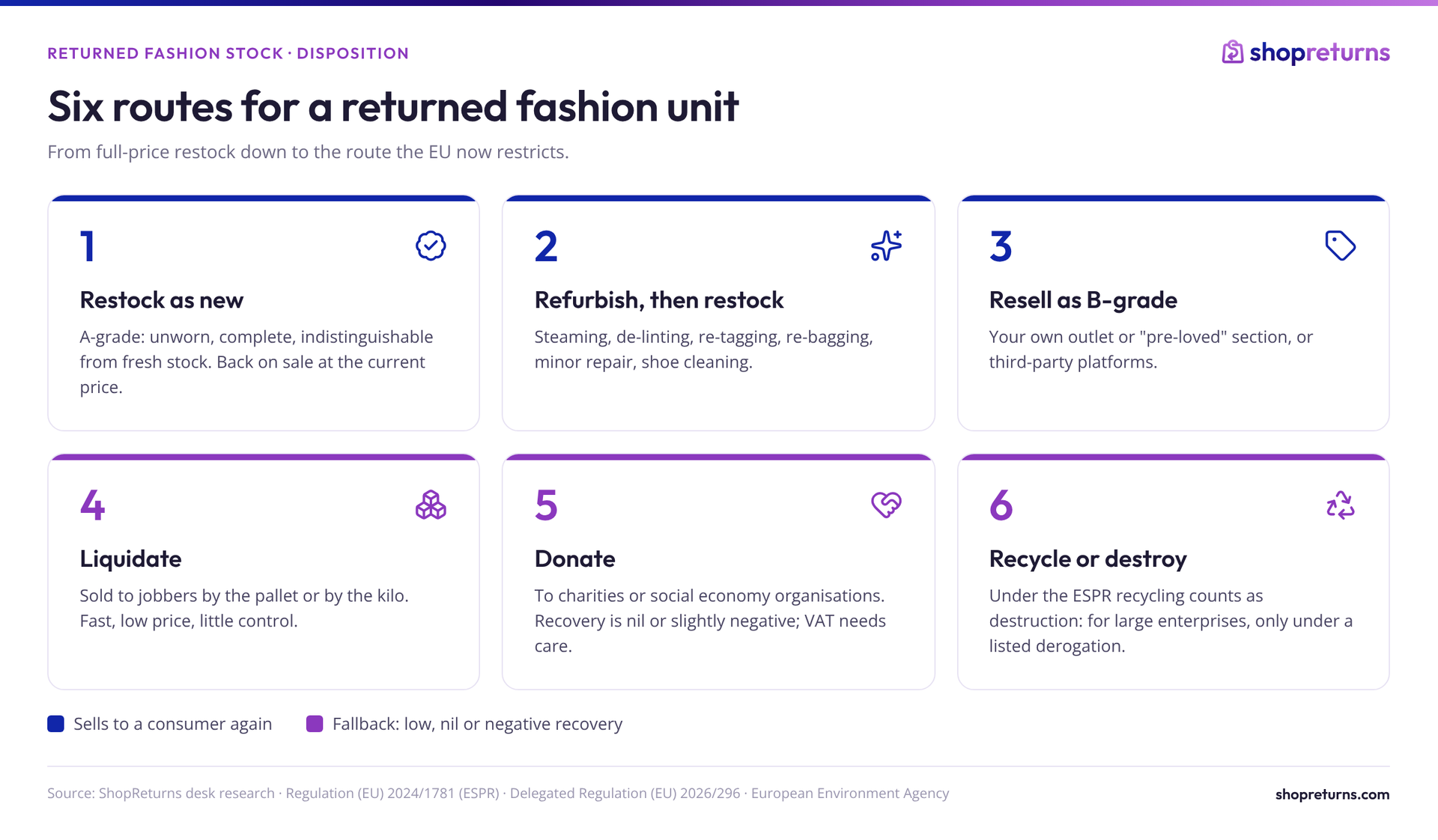
Restock as new (A-grade). The unit is unworn, complete and indistinguishable from fresh stock. It goes back into sellable inventory at the current price.
Refurbish, then restock. Steaming, de-linting, re-tagging, re-bagging, minor repair such as a loose button or hem, and shoe cleaning. The aim is to lift a unit to A-grade or a clean B-grade.
Resell as B-grade. Through your own outlet or “pre-loved” section, or through third parties. What exists in 2026: Zalando Pre-owned runs in 14 European markets and in May 2026 opened the category to an external partner for the first time (Vestiaire Collective, via the Partner Program), though its core supply is still customer trade-ins. Vinted Pro accepts sole traders, charities and registered companies in Italy, the Netherlands, France, Spain, Portugal, Luxembourg, Belgium and the UK. eBay has an “Imperfects” hub and a Brand Outlet, and has partnered with the re-commerce operator Reskinned.
Liquidate. Sale to jobbers or stock buyers by the pallet or by the kilo. Fast and low-touch, at a low price and with little control over where the product resurfaces.
Donate. To charities or social economy organisations. Recovery is nil or slightly negative, and VAT needs care.
Recycle or destroy. These routes require particular care under the ESPR. For businesses covered by the prohibition, recycling and disposal may fall within the regulation’s definition of destruction, meaning that a relevant legal exception must apply. The product’s condition, the reason for the decision and supporting evidence should be documented.
A grading standard: A, B, C, D
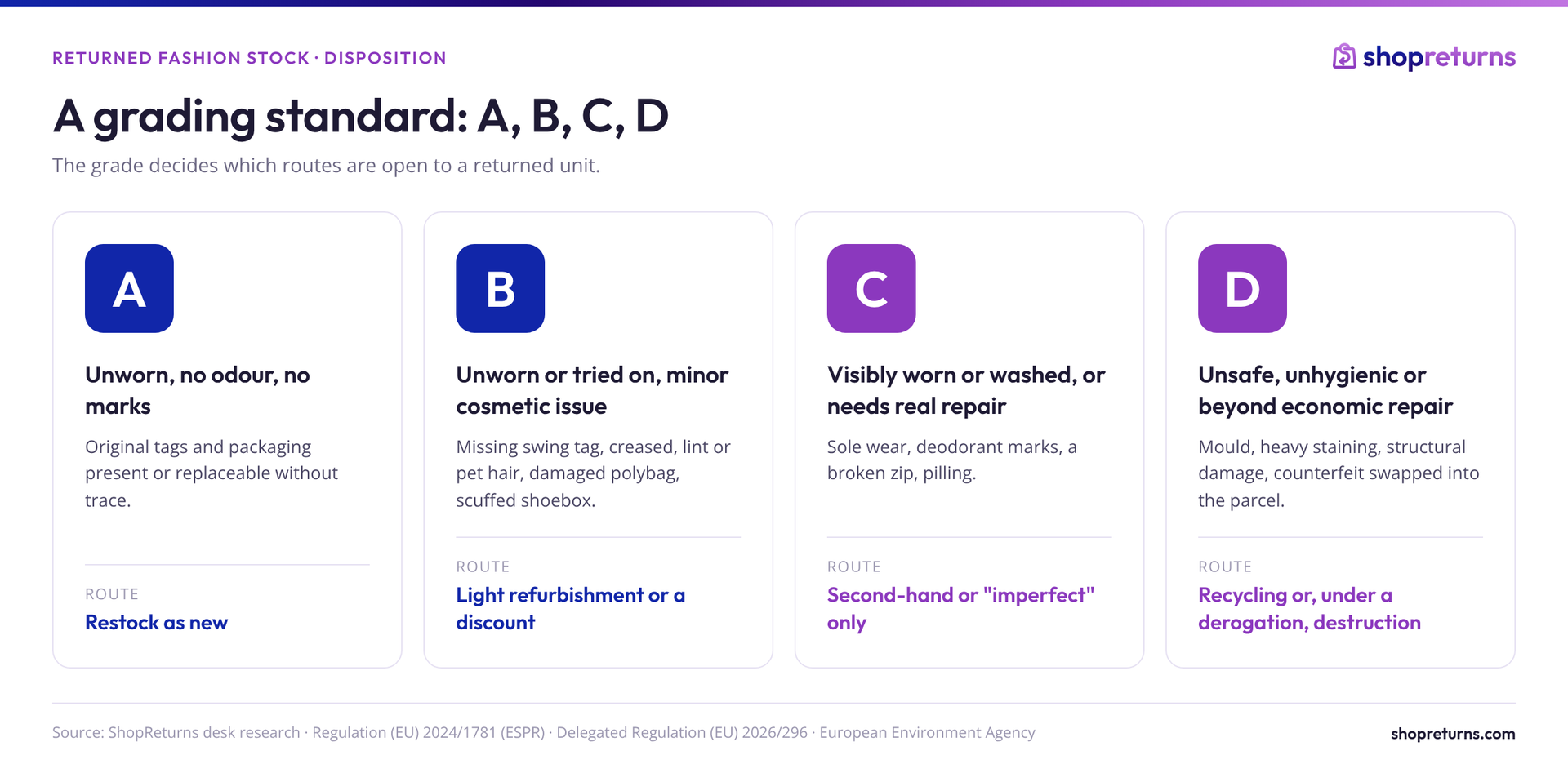
- Grade A: unworn, no odour, no marks, original tags and packaging present or replaceable without trace. Eligible for restock as new.
- Grade B: unworn or tried on, with a minor cosmetic issue that light refurbishment fixes or that a buyer will accept at a discount: missing swing tag, creased, lint or pet hair, damaged polybag, a scuffed shoebox.
- Grade C: visibly worn or washed, or a defect that needs real repair: sole wear, deodorant marks, a broken zip, pilling. Sellable only as second-hand or “imperfect”, clearly described.
- Grade D: unsafe, unhygienic or beyond economic repair: mould, heavy staining, structural damage, counterfeit swapped into the parcel. Candidates for recycling or, where a derogation applies, destruction.
Worth a mention: the grade also matters on the customer side. Under Article 14(2) of the Consumer Rights Directive the consumer is liable for diminished value from handling beyond what is needed to establish the nature and functioning of the goods. A photo-documented grade C is the evidence for any deduction from the refund.
What the rules do to each route
ESPR derogations are narrow and documented. Commission Delegated Regulation (EU) 2026/296, applicable from 19 July 2026, lists when destruction is still allowed. The ones that matter for returns: the product is dangerous; it is damaged or contaminated and repair and refurbishment are not technically feasible or cost-effective; or it was offered for donation to at least three suitable social economy entities in the Union, or on the company website for at least eight weeks, and nobody took it. Keep the evidence for five years.
Disclosure covers what you discard. Article 24 requires companies other than micro and small enterprises to disclose annually the number and weight of unsold consumer products discarded, the reasons and the waste treatment used, in a standard format from 2 March 2027.
Textile EPR is coming to every member state. The revised Waste Framework Directive, Directive (EU) 2025/1892, entered into force on 16 October 2025. Member states have 30 months from that date to set up extended producer responsibility schemes for textiles and footwear. UKFT notes that scope includes online sellers and non-EU entities placing textiles on the EU market.
France already bans it. Article L.541-15-8 of the Environment Code, introduced by the AGEC law, has applied to textiles since 1 January 2022. Unsold new non-food products must be re-employed (including by donation), reused or recycled, in that order. Fines run up to €15,000 for a legal entity. The French rule accepts recycling as a last resort, while the ESPR treats it as destruction.
Donation VAT varies by country. Under EU VAT rules a donation of goods is generally a deemed supply, so output VAT can fall due on stock you gave away, and reliefs differ by member state. In the UK, a VAT-registered business can zero-rate goods donated to a charity for sale, and since 1 April 2026 a further relief covers goods donated for onward distribution or the charity’s own non-business use, capped at £100 per item for most goods. Ensure local tax alignment before you set up a donation flow.
The decision model: net recovery per route
The goal is to identify which recovery route delivers the highest expected value after additional processing, shipping and selling costs.
A product with a higher potential selling price does not always generate a better return. If refurbishment takes too long or individual cross-border shipping is expensive, a faster resale or liquidation option may be more profitable.
Inputs per unit, all net of VAT. Original price P and landed cost. Grade. Weeks left in season, which drives the next two inputs. Expected discount d and expected sell-through s for the route within its selling window. Channel fee f (payment fees for your own site, commission for a marketplace). Outbound fulfilment cost of the resale, c_out. Refurbishment and handling cost, c_ref. Any route-specific inbound cost such as freight home across a border, c_in. Liquidation price per unit, L, and the handling cost of liquidating, c_liq.
The formula. For any route that sells to a consumer:
Net recovery = s × [P × (1 − d) × (1 − f) − c_out] + (1 − s) × L − c_ref − c_in
The term in square brackets is the margin on a unit that sells. Units that do not sell fall back to liquidation. For liquidation itself, net recovery = L − c_liq. Divide by landed cost to get a recovery ratio.
The threshold. A route beats liquidation when its sell-through exceeds:
s* = (c_ref + c_in − c_liq) ÷ (P × (1 − d) × (1 − f) − c_out − L)
How time enters. We found no reliable public figure for how fast a returned garment loses value per week in season, so we quote none. In the model, time appears as a higher d and a lower s, both estimated from your own markdown calendar.
Every figure in the three scenarios below is an illustrative assumption chosen to show the mechanics. None is client data or a market benchmark.
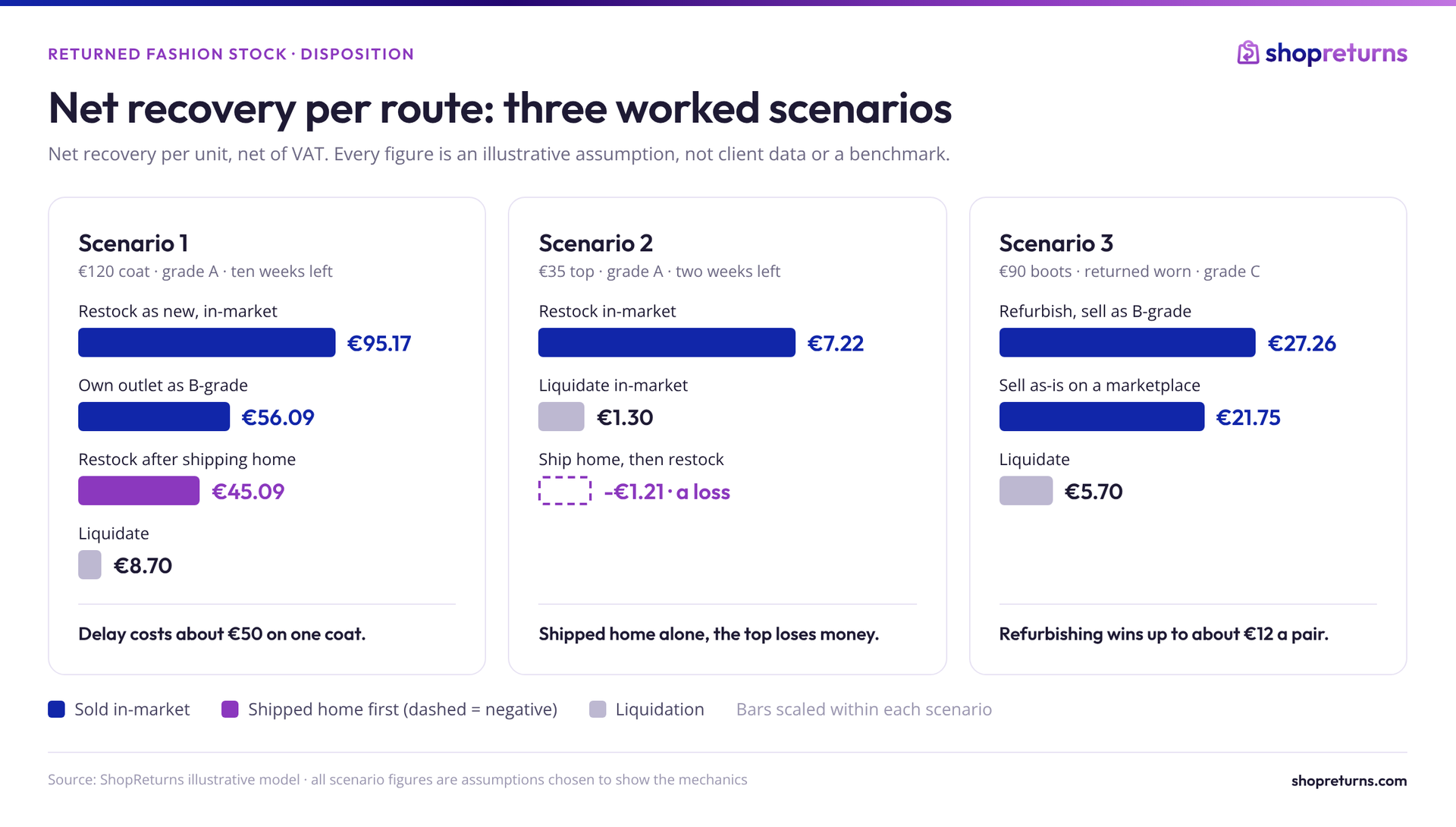
Scenario 1: a €120 coat, grade A, ten weeks of season left
Assumptions: P €120, landed cost €38, L €9, c_liq €0.30, c_out €4.50.
- Restock as new, processed in-market within days. d 5%, f 3%, s 90%, c_ref €1.20. Margin on a sold unit: €106.08. Net recovery: €95.17, or 2.50 times landed cost.
- Restock as new after shipping home. The unit travels home as a single parcel (c_in €3.50) and is back on sale five weeks later, into markdown: d 30%, s 60%. Net recovery: €45.09.
- Own outlet as B-grade. d 40%, f 3%, s 85%, c_ref €0.80. Net recovery: €56.09.
- Liquidate. €8.70.
The gap between the first two lines, about €50 on one coat, is the cost of delay. Restocking beats liquidation here at any sell-through above about 1%, so the question is only how fast.
Scenario 2: a €35 top, grade A, two weeks of season left
Assumptions: P €35, landed cost €9, L €1.50, c_liq €0.20, c_out €3.50.
- Restock in-market straight away. d 40%, f 3%, s 45%, c_ref €1.20. Margin on a sold unit: €16.87. Net recovery: €7.22, or 0.80 times landed cost.
- Ship home individually, then restock. c_in €2.80, arriving after the season: d 60%, s 15%. Net recovery: −€1.21.
- Liquidate in-market. €1.30.
Restocking in-market still beats liquidation as long as sell-through stays above about 7%. Once the unit has to cross a border on its own, the threshold jumps to about 44%, which a late-season top will not reach.
Scenario 3: €90 boots returned worn, grade C
Assumptions: P €90, landed cost €31, L €6, c_liq €0.30, c_out €5. Restock as new is closed by the grade.
- Refurbish, sell as B-grade in your own outlet. Cleaning, new insoles, re-boxing: c_ref €6.50. d 45%, f 3%, s 75%. Margin on a sold unit: €43.02. Net recovery: €27.26, or 0.88 times landed cost.
- Sell as-is on a marketplace, described as worn. d 55%, f 12%, s 70%, c_ref €1.50 for photos and listing. Net recovery: €21.75.
- Liquidate. €5.70.
Refurbishment wins here, and it keeps winning against the as-is route until refurbishment cost passes about €12 a pair. Against liquidation it needs a sell-through above roughly 17%.
Worth a mention: in all three scenarios the fallback value L barely moves the ranking. Speed and the cost of moving a single unit decide the route, so where you grade matters more than who buys your pallets.
What these scenarios show
The best recovery route depends on more than the product’s original price. Time remaining in the selling season, refurbishment costs and the location of the returned item can change the financial outcome significantly.
For fashion brands, faster product inspection and local recovery options can help preserve resale value and avoid unnecessary transport costs.
A decision rule for each route
- Restock as new: grade A and expected sell-through above s*. In season that is nearly always true if processing takes days.
- Refurbish: when the uplift in net recovery exceeds c_ref. Set a maximum spend per category.
- B-grade resale: grade B or C, where the margin on a sold unit after fees and fulfilment is clearly above L.
- Liquidate: when s* is out of reach, typically cheap items late in season or stock stranded in the wrong country.
- Donate: when every selling route nets zero or less and the unit is wearable. Model the VAT first.
- Recycle or destroy: grade D only, with the derogation and evidence recorded if you are in ESPR scope.
What this looks like inside the business
The Monday pallet. Returns from Germany reach the UK in a weekly mixed consignment and are graded ten days after posting. The coats behave like the second line of scenario 1.
The €35 problem. Finance notices that low-priced tops cost more to bring home and reprocess than they recover. Nobody had set a price below which a late-season unit stays in-market.
The boots argument. Customer service refunds in full for worn boots because the warehouse note says only “used”. Without photos and a grade there is no basis for a diminished-value deduction.
What to check before you scale
- Whether you are a large or medium-sized enterprise for ESPR purposes, and from which date the ban binds you
- A written A to D grading standard with photo examples per category
- Time from customer drop-off to graded and back on sale, in days, per market
- A maximum refurbishment spend per category, derived from the model
- Liquidation price per unit and per kilo from at least two buyers, with resale territory restrictions in the contract
- Donation partners in each market, the offer process and the established local VAT rules
- A disposition log capturing route, reason, weight and evidence for every unit, kept for five years
- The cost and customs treatment of moving a single returned unit across a border, against dispositioning it in-market
How ShopReturns helps
Choosing the right recovery route starts with knowing what has been returned, what condition it is in and how quickly it can be processed.
ShopReturns provides local return addresses in nine European markets, allowing customers to send products back domestically instead of shipping individual returns across borders.
At our Wrocław hub, returned items are verified within 48 hours using barcode scanning and photo-documented inspections. This gives fashion brands the information needed to assess product condition and decide what happens next.
Depending on the brand’s instructions, returned products can be restocked, prepared for resale, donated or disposed of where legally permitted. Consolidated transport is available when returning stock to the brand’s warehouse makes financial sense.
The result is a more structured returns process that helps brands reduce unnecessary logistics costs and make faster decisions about returned inventory.
FAQ
Can we still destroy returned clothing in the EU? Large enterprises cannot, since 19 July 2026, unless a derogation in Delegated Regulation (EU) 2026/296 applies. Medium-sized enterprises follow in 2030; micro and small enterprises are exempt.
What percentage of fashion returns can be resold as new? There is no single reliable figure. The EEA estimates about a third of returned online clothing in Europe is destroyed, and trade reporting suggests fewer than half of returned goods are resold at full price. Measure your own A-grade rate.
Is it better to liquidate returned stock or refurbish it? Refurbish when the extra net recovery exceeds the refurbishment cost, and liquidate when the break-even sell-through is out of reach. In our illustrative boots scenario, refurbishment won until it cost about €12 a pair.
Do we pay VAT when we donate returned stock? Often yes in principle, because EU VAT treats a donation of goods as a deemed supply, with reliefs that differ by country. Apply the applicable local statutory rules for each market.
Not sure what your current setup is costing you?
Send us your numbers and we'll run them against the new regime - where the duty is hitting twice, what your return freight actually costs against the goods you recover, and how much of it is avoidable. One working session, and you leave with the figures either way.
Keep reading
More from the knowledge base

Black Friday Returns Fraud and Abuse: Data, Schemes and EU Rules

How to Calculate Your Black Friday Returns Cost: A Step-by-Step Guide