Fashion Returns Peak 2026: How to Plan Capacity, Packaging and Costs
22.10.2026 · 12 min read

Navigation
- Why this matters nowThe seasonal shape of autumn/winter fashion returnsForecasting return volume from orders and lagged return curvesWeek-by-week playbook, October to end of JanuaryCross-border routing: EU returns for UK brandsReturn packaging: reusable versus single-use, and what the rules sayReturn-packaging cost calculatorWhat this looks like inside the businessWhat to check before the peakHow ShopReturns helpsFAQNot sure what your current setup is costing you?
For fashion brands, the busiest returns period doesn’t always happen during Black Friday or Christmas. It often arrives in January, when seasonal purchases start coming back.
Winter returns are particularly expensive. Coats, knitwear and boots take up more warehouse space, cost more to ship and can lose resale value quickly once seasonal discounts begin.
The challenge is preparing for that volume before it arrives.
This guide shows how to forecast the autumn/winter returns peak, plan warehouse capacity, calculate packaging costs and protect product value throughout the 2026/2027 season.
In this article:
- When to expect the autumn/winter fashion returns peak.
- How to forecast return volumes and plan warehouse capacity.
- A week-by-week returns plan from October to January.
- How packaging affects return shipping costs.
- Practical ways to reduce seasonal returns expenses.
Why this matters now
The 2026/2027 peak season brings two challenges for fashion brands: higher return shipping costs and a concentrated wave of returns after Christmas.
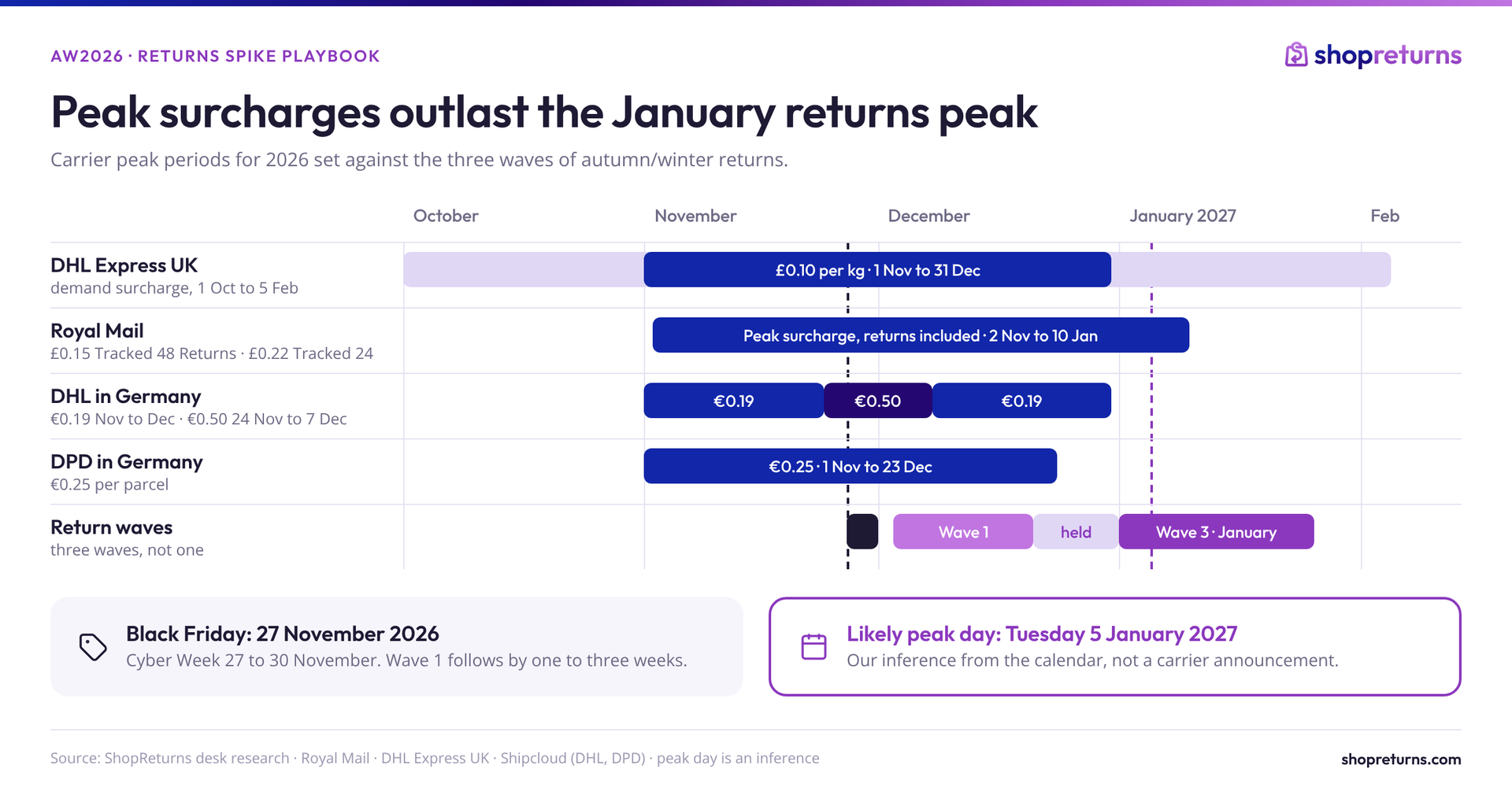
Royal Mail’s published peak surcharge period runs from 2 November 2026 to 10 January 2027, including additional charges of £0.15 for Tracked 48 Returns and £0.22 for Tracked 24 Returns. DHL Express and other carriers also apply seasonal demand surcharges on selected routes.
Capacity is another concern. According to ChannelX, Royal Mail plans to limit business collections during November and December based on customers’ usual collection volumes.
Meanwhile, extended Christmas return windows can shift large volumes of returned products into January. Royal Mail expected around 500,000 returns on its first major returns day of January 2026, illustrating how quickly warehouse demand can increase.
For cross-border sellers, customs procedures and additional transport stages can increase costs further.
Brands should therefore review carrier agreements, warehouse capacity and return processing workflows before the peak begins.
The seasonal shape of autumn/winter fashion returns
Autumn/winter returns typically arrive in three waves.
The first follows Cyber Week, when customers begin returning purchases made during Black Friday promotions. The second is quieter as Christmas gifts remain unopened or unused. The third arrives in January, when extended return windows allow customers to send back holiday purchases.
Based on the previous season’s pattern, the first full working week of January 2027 is a sensible period to prepare for increased return volumes. The exact peak day will depend on customer behaviour, carrier operations and each retailer’s return policy.
Extended windows move volume without removing it. Amazon accepted returns until 31 January 2026 on purchases from 1 November to 31 December 2025. Argos accepted returns until 31 January 2026 on purchases from 26 September to 25 December 2025. A similar policy turns a December problem into a January one.
The AW mix raises the cost of every return. A coat or a pair of boots takes more shelf, inspection time and billable weight than a T-shirt, is worth more, and has a short full-price season. Green Fulfilment puts the average gap between return initiation and resale readiness at nearly ten days. In January that gap often spans the start of markdown.
Worth a mention: carriers bill the larger of actual and volumetric weight. The common formula is length × width × height in centimetres divided by 5,000, though some carriers divide by 4,000. A 1.4 kg coat in a 40 × 30 × 15 cm carton is billed as 3.6 kg.
Forecasting return volume from orders and lagged return curves
The method. Take dispatched units per week, multiply by the expected return rate for that week’s mix, and spread the result over the following weeks using a lag curve built from last season’s data.
Instead of assuming that all returns arrive shortly after purchase, this method estimates how many items will come back in each future week. It helps brands schedule warehouse staff, allocate inspection space and prepare for the January peak.
The formula. Returns arriving in week w = sum over k of (Orders in week w−k × Return rate for week w−k × Lag share k), where the lag shares add up to 1. For an extended window, take a held share out of the affected weeks and add it back in the weeks when you expect it to be released.
Illustrative worked example. Every figure below is an assumption, not customer data.
- Units dispatched per week: 4,000 (w/c 26 October), 4,000, 4,500, 5,000, 12,000 (w/c 23 November), 9,000, 7,000, 6,000, 3,000 (w/c 21 December), 5,000, 4,000 (w/c 4 January)
- Return rate: 30% in every week
- Lag shares for weeks 0 to 5 after dispatch: 5%, 30%, 30%, 20%, 10%, 5%
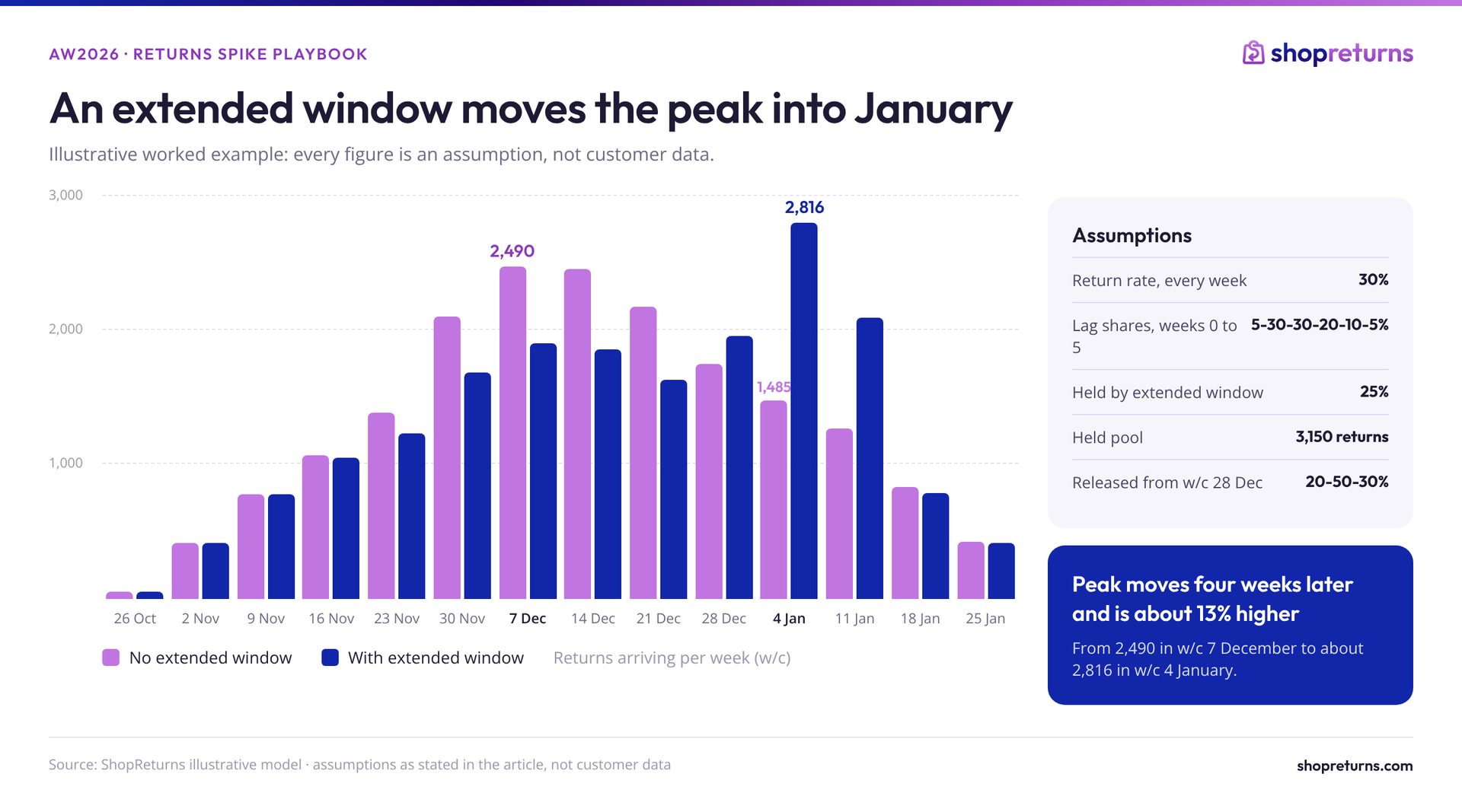
- Extended window: 25% of returns from orders dispatched from w/c 16 November to w/c 21 December are held, then released 20% in w/c 28 December, 50% in w/c 4 January and 30% in w/c 11 January
Held pool: 42,000 units × 30% × 25% = 3,150 returns. Normal arrivals in w/c 4 January come to 1,241. Adding 50% of the pool (1,575) gives about 2,816 returns that week. Without the extended window, the peak is 2,490 in w/c 7 December and w/c 4 January sees 1,485. Here the policy moves the peak four weeks later and makes it about 13% higher.
Week-by-week playbook, October to end of January
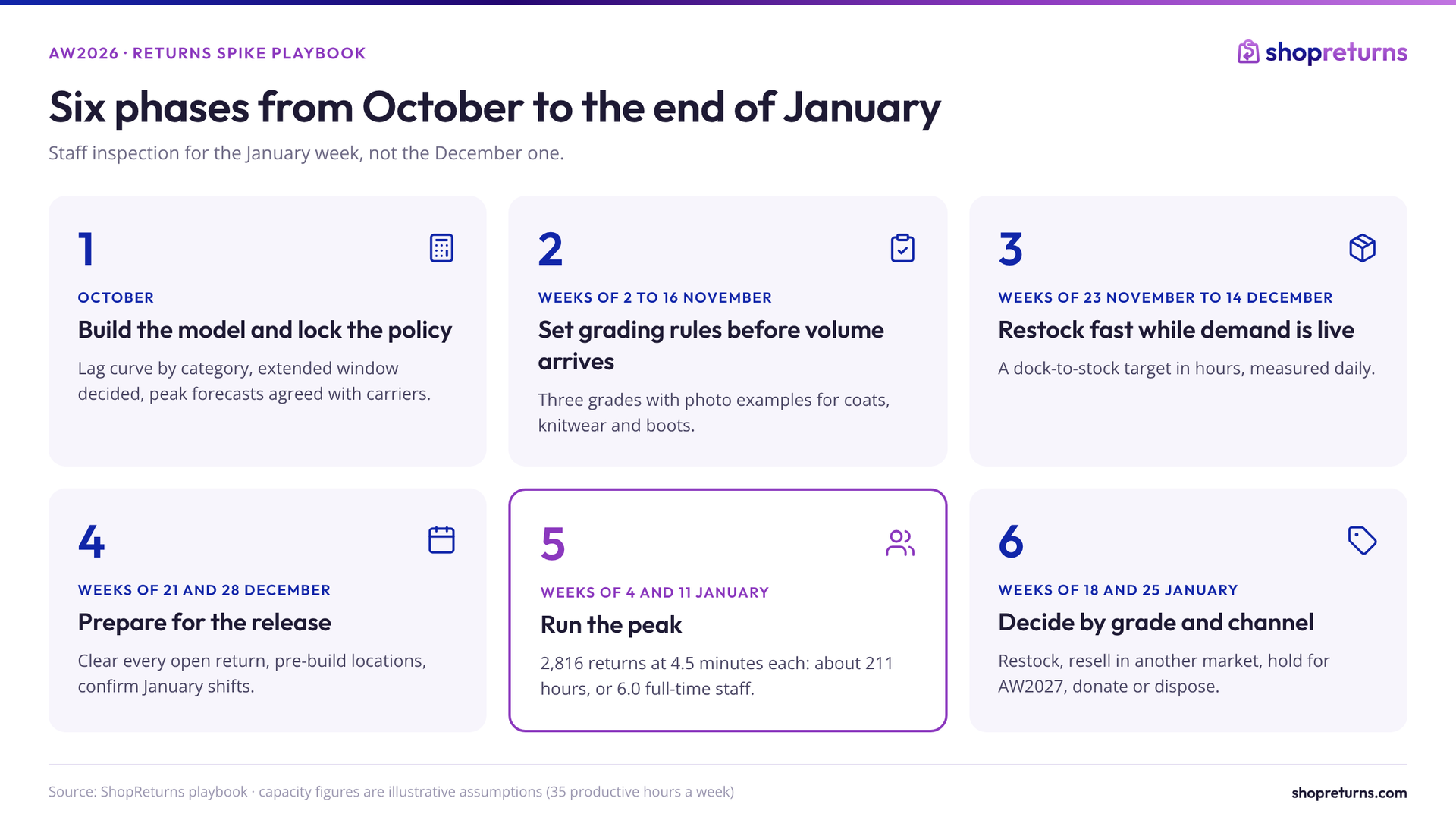
October: build the model and lock the policy. Pull last season’s lag curve by category, decide the extended window, and agree peak forecasts with carriers.
Weeks of 2 to 16 November: set grading rules before volume arrives. Write three grades with photo examples for coats, knitwear and boots: resale as new, resale after rework (lint, steam, re-bag, re-box), and not for resale. State who decides on a deduction for diminished value under Article 14(2) of the Consumer Rights Directive, and what evidence is kept.
Weeks of 23 November to 14 December: restock fast while demand is live. Cyber Week returns come back while full-price demand still exists. Set a dock-to-stock target in hours and measure it daily.
Weeks of 21 and 28 December: prepare for the release. Clear every open return, pre-build locations and confirm January shifts.
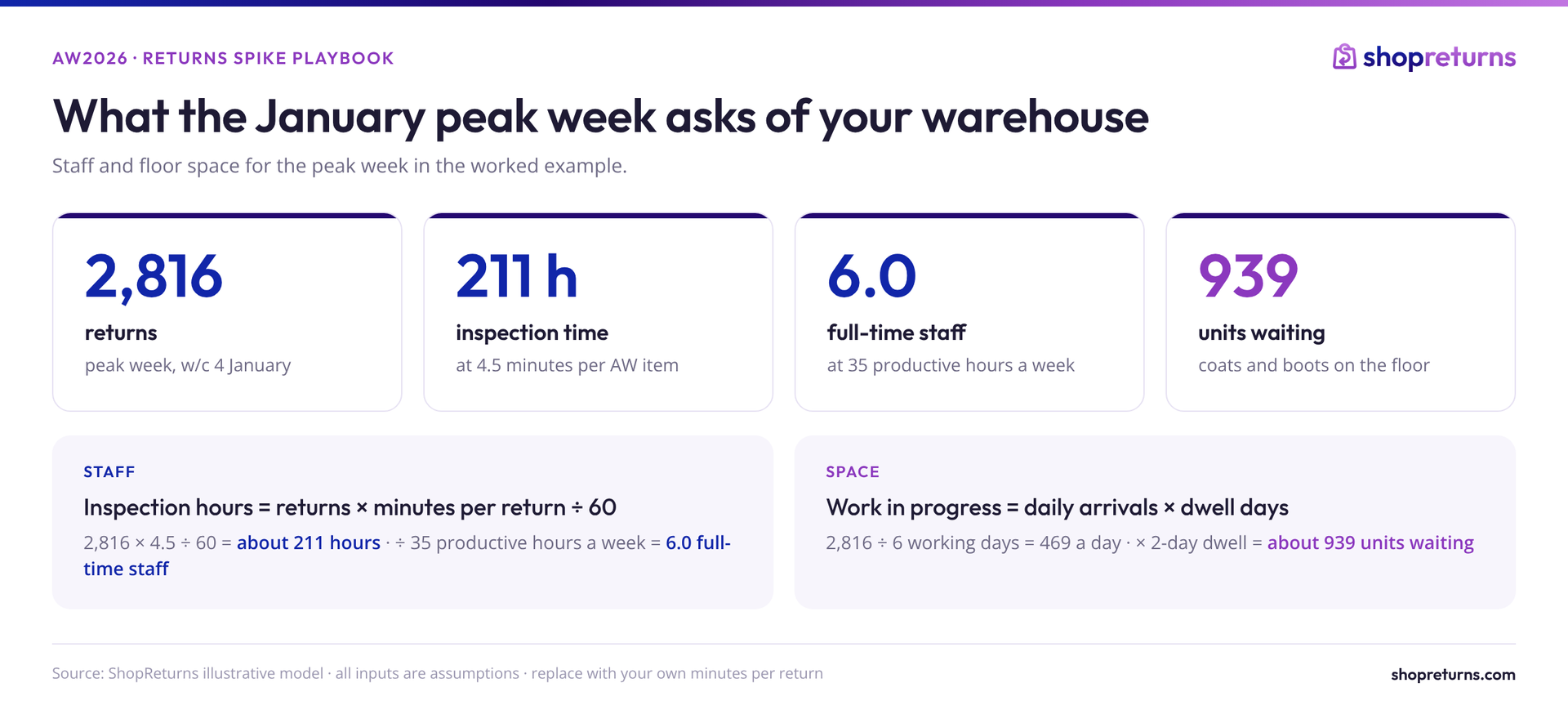
Weeks of 4 and 11 January: run the peak. Capacity formula: inspection hours = returns × minutes per return ÷ 60. With an assumed 4.5 minutes per AW item, 2,816 returns need about 211 hours, or 6.0 full-time staff at 35 productive hours a week. Space: work in progress = daily arrivals × dwell days. At 469 a day over six days and a two-day dwell, that is about 939 units of coats and boots waiting.
Weeks of 18 and 25 January: decide by grade and channel. Decide per SKU whether to restock, resell in another market, hold for AW2027, donate or dispose.
Worth a mention: Article 13 of the Consumer Rights Directive requires the refund within 14 days of being told about the withdrawal, and lets the trader withhold it only until the goods are back or the consumer has shown proof of sending. A parcel stuck in customs does not stop that clock.
Cross-border routing: EU returns for UK brands
Count the borders on the return leg. An EU customer returning to a UK warehouse means an EU export, a UK import and carrier clearance in the busiest weeks of the year. The outbound €3 duty per declaration line is already spent: a coat and a scarf on separate lines cost €6, and none of it comes back.
Design the withdrawal function into the flow. The function must be labelled “withdraw from contract here” or equivalent, stay available through the withdrawal period, and be followed by an acknowledgement on a durable medium. Each submission is also a forecasting signal, days ahead of the carrier scan.
Return packaging: reusable versus single-use, and what the rules say
Resealable mailers suit soft, bulky items. A second adhesive strip lets the customer send a coat or jumper back in the pack it arrived in. That usually means less billable volume than a carton. Boots still need a box that protects the shoebox.
PPWR dates, verified. Regulation (EU) 2025/40 has applied in general since 12 August 2026. The e-commerce empty-space rule is later: a maximum empty space ratio of 50% for grouped, transport and e-commerce packaging from 1 January 2030, with filling materials such as paper cuttings and air cushions counted as empty space. Some commentary describes a 40% empty-space cap from August 2026. We could not find that in the Regulation.
UK packaging EPR. Large producers (turnover of £2 million or more and over 50 tonnes of packaging a year) pay disposal fees. Year 2 illustrative fees published in December 2025 are £190, £210 and £250 per tonne for green, amber and red paper and board, and £415, £455 and £545 for plastic. As noted by the House of Commons Library, where final Year 2 fees remain pending, illustrative fees should be retained for modeling purposes.
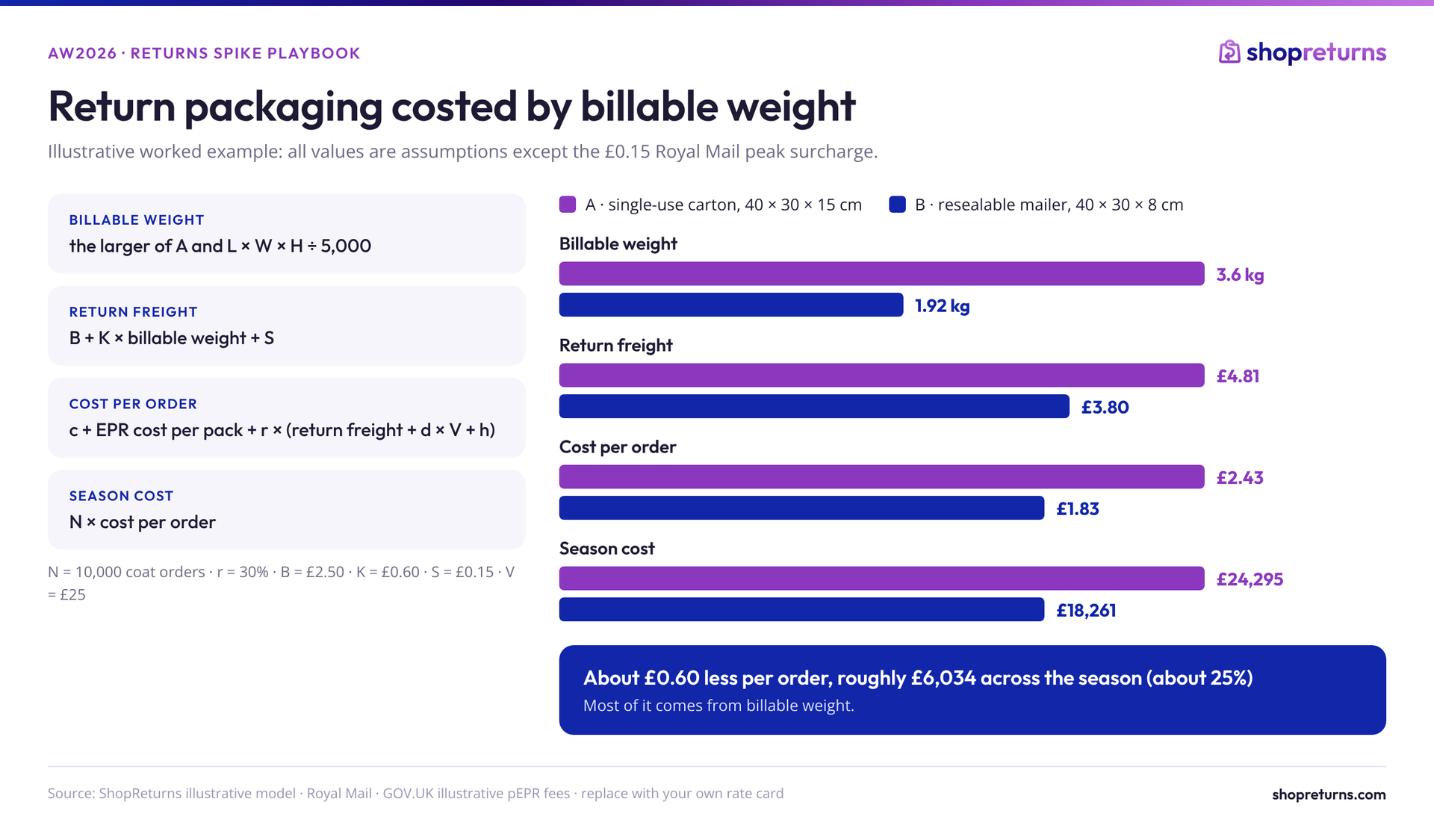
Return-packaging cost calculator
Inputs. Orders (N); return rate (r); pack unit cost (c); pack weight in kg (w); EPR fee per tonne (f); pack dimensions in cm (L, W, H); actual shipped weight in kg (A); return base rate (B); rate per billable kg (K); peak surcharge per return (S); damage rate on returns (d); value lost per damaged item (V); repack cost per return (h).
Formulas.
- Volumetric weight = L × W × H ÷ 5,000
- Billable weight = the larger of A and volumetric weight
- Return freight = B + K × billable weight + S
- EPR cost per pack = w × f ÷ 1,000
- Cost per order = c + EPR cost per pack + r × (return freight + d × V + h)
- Season cost = N × cost per order
Worked example. All values are illustrative assumptions, except S (Royal Mail Tracked 48 Returns peak surcharge) and f (illustrative amber pEPR fees). N = 10,000 coat orders, r = 30%, B = £2.50, K = £0.60, S = £0.15, V = £25.
Option A, single-use carton: c = £0.55, w = 0.150 kg, f = £210, 40 × 30 × 15 cm, A = 1.4 kg, d = 4%, h = £0.35. Volumetric weight 3.6 kg, so billable weight 3.6 kg. Return freight = 2.50 + 2.16 + 0.15 = £4.81. EPR = £0.0315. Cost per order = 0.55 + 0.0315 + 0.30 × (4.81 + 1.00 + 0.35) = £2.4295. Season cost £24,295.
Option B, resealable mailer: c = £0.38, w = 0.045 kg, f = £455, 40 × 30 × 8 cm, A = 1.25 kg, d = 3%, h = £0.20. Volumetric weight 1.92 kg, billable 1.92 kg. Return freight = 2.50 + 1.152 + 0.15 = £3.802. EPR = £0.0205. Cost per order = 0.38 + 0.0205 + 0.30 × (3.802 + 0.75 + 0.20) = £1.8261. Season cost about £18,261.
The difference is about £0.60 per order, or roughly £6,034 across the season (about 25%). Most of it comes from billable weight. Replace every assumption with your own rate card and damage data.
What this means for fashion brands
The cheapest packaging option is not necessarily the one with the lowest purchase price. Package dimensions affect billable shipping weight, while material choice can influence damage rates, repacking costs and environmental fees.
Before choosing a return packaging format, compare the total cost across the entire returns process rather than looking at packaging prices alone.
What this looks like inside the business
The operations lead rebuilds the rota in October because the model shows the peak in w/c 4 January, when half the temporary team was due to finish.
The merchandiser asks for a daily list of returned coats by size, so restocked units can be held back from the first markdown wave.
The finance manager finds that the peak surcharge on return labels and the unrecoverable €3 duty were missing from the Q4 margin forecast.
What to check before the peak
- Lag curve by category from last AW season, not an annual average
- Extended window dates agreed and modelled, with the held share stated
- Peak surcharge dates and amounts on your own contracts, for return labels as well as outbound
- Minutes per return measured separately for coats, knitwear and boots
- Written grading rules with photos, and a named owner for diminished-value decisions
- Dock-to-stock target for December and for January
- Refund trigger that meets the 14-day duty when a parcel is delayed
- Billable weight of each return pack format checked against the 5,000 divisor, or your carrier’s own
How ShopReturns helps
During the autumn/winter peak, every extra day in the returns process can reduce the opportunity to resell seasonal products at their original price.
ShopReturns helps fashion brands manage returns across European markets through local return addresses in nine countries. Customers can return products domestically, while brands avoid organising individual international return shipments.
At our Wrocław hub, returned items are verified within 48 hours using barcode scanning and photo-documented inspection. This gives brands visibility into product condition and supports decisions about restocking, resale or other recovery options.
Depending on the brand’s instructions, items can be returned to stock, prepared for resale, donated or disposed of. Consolidated bulk transportation is available where financially justified.
For fashion businesses preparing for the January returns peak, the priority is simple: keep products moving, maintain inventory visibility and reduce unnecessary cross-border logistics costs.
FAQ
When is the returns peak after Christmas 2026? Based on the January 2026 pattern, the first full working week of the year, starting Monday 4 January 2027. Royal Mail’s peak day in 2026 was the Tuesday of that week.
How do I forecast fashion return volume for peak season? Multiply weekly dispatched units by the expected return rate and spread the result over later weeks with a lag curve from last season. Move a held share into January if you offer an extended window.
When does the PPWR 50% empty-space rule apply to e-commerce parcels? From 1 January 2030, under Article 24 of Regulation (EU) 2025/40. The Regulation itself has applied in general since 12 August 2026.
Is the €3 EU duty refunded when a customer returns the item? Commission guidance says it cannot be reimbursed through invalidation of the declaration when goods are returned after release.
Not sure what your current setup is costing you?
Send us your numbers and we'll run them against the new regime - where the duty is hitting twice, what your return freight actually costs against the goods you recover, and how much of it is avoidable. One working session, and you leave with the figures either way.
Keep reading
More from the knowledge base

Black Friday Returns Fraud and Abuse: Data, Schemes and EU Rules

How to Calculate Your Black Friday Returns Cost: A Step-by-Step Guide