What an Order From Your Own Store Really Costs Under the €3 Duty
30.07.2026 · 9 min read

Marketplace sellers had this handled for them, whether they liked the terms or not. The platform is the deemed importer, its Import One-Stop Shop registration rides on the parcel, and the seller finds out what it cost by reading a fee statement.
Sell from your own store and nobody handled it. The charge lands wherever your carrier and your checkout settings put it. If those settings were wrong in June, your customers have been paying at the door ever since, and you've been losing orders you never saw.
Here's what one order actually costs now, line by line, and which three settings decide most of the bill.
In this article:
- One €48 basket from a UK store to Germany, priced line by line - and why three items means €9, not €3
- The three settings that decide most of the bill: your Incoterms, your HS codes, and how your bundles are built
- The line most stores haven't priced - what happens to the duty when the customer sends it back
The order
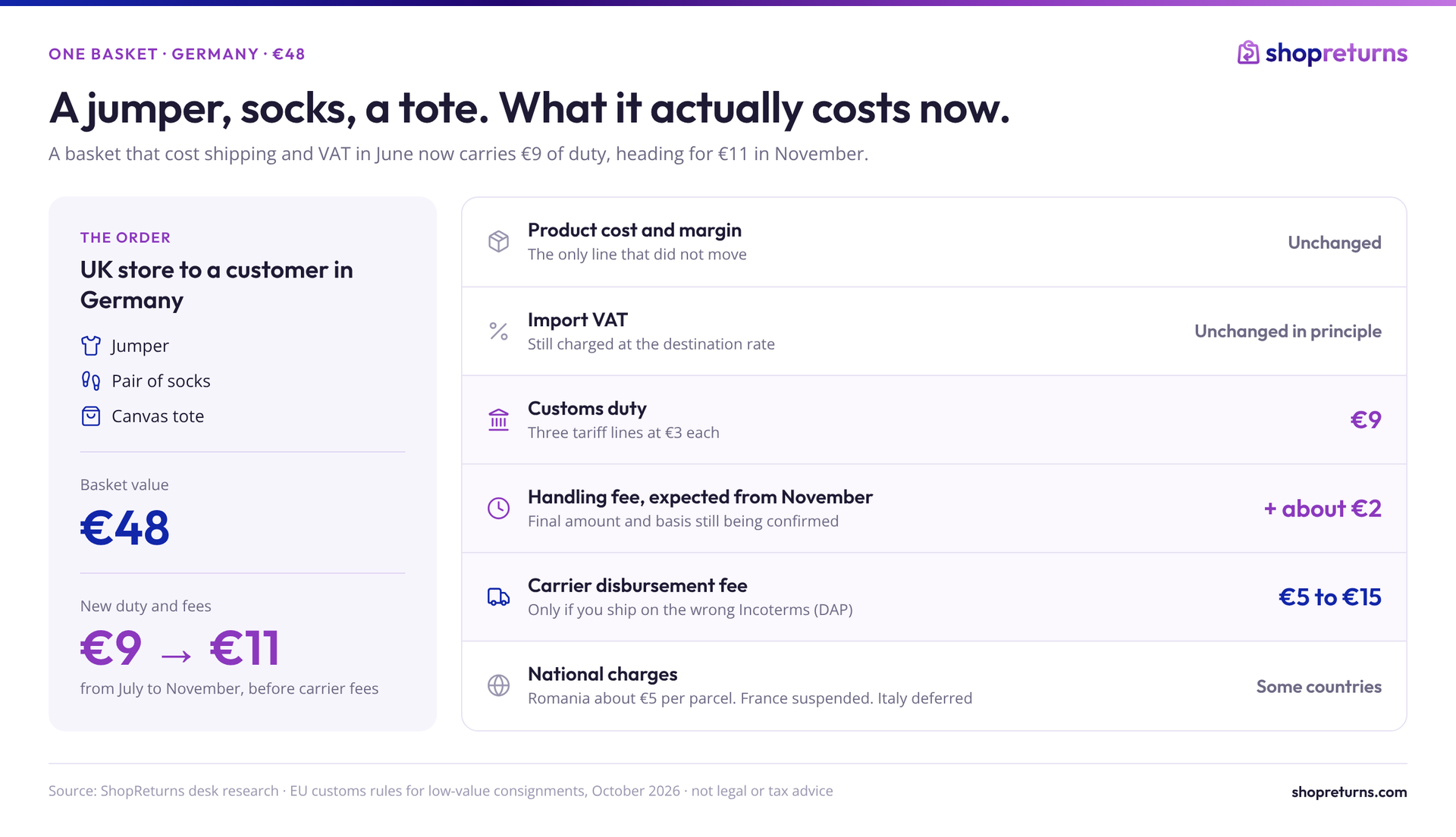
A customer in Germany buying from a UK store. Basket of €48: a jumper, a pair of socks, a canvas tote.
Product cost and margin. Unchanged. The only line that didn't move.
Import VAT. Unchanged in principle, still charged at the destination rate. If you handled it correctly before July, you still do.
Customs duty: €9. Three product categories, three tariff lines, €3 each.
This is where most brands mispriced, because they budgeted a flat €3 per parcel. A line is goods sharing the same tariff classification, description and country of origin. Five identical pairs of socks is one line and one charge. Socks plus a jumper plus a tote is three. Quantity is free. Categories are not.
Handling fee: around €2, expected from November. Alongside mandatory Product Identifiers on 1 November 2026, an EU handling fee of roughly €2 is expected, taking the combined charge to about €5. The final amount and basis are still being confirmed, so plan for it rather than bank it.
Carrier disbursement fee: €5 to €15, but only if you got the shipping terms wrong. Ship delivered-at-place and the carrier fronts the duty, bills your customer, and adds its own fee for the service.
National charges, in some countries. Romania has run a logistics tax of about €5 per low-value non-EU parcel since January 2026. France ran a €2 charge from March and suspended it on 1 July so it wouldn't stack with the EU duty. Italy legislated one and keeps deferring it.
So a basket that cost you shipping and VAT in June now carries €9 of duty, heading for €11 in November, plus potentially €5 to €15 of carrier fees and a refused parcel if your Incoterms are wrong.
Setting 1: your Incoterms, and what they're actually costing you
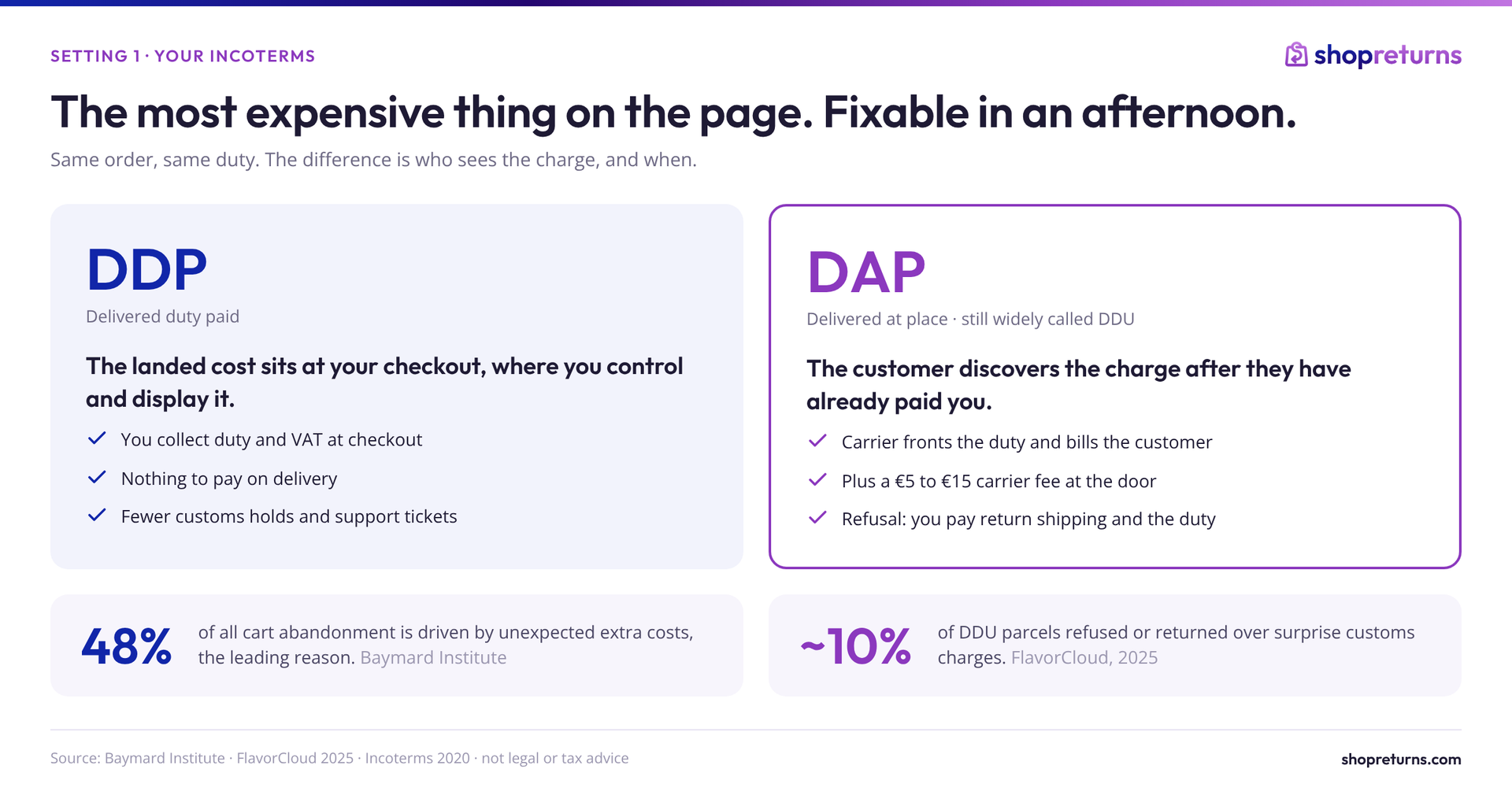
This is binary, it takes an afternoon to change, and it's the most expensive thing on the page.
Ship delivered duty paid and the full landed cost sits at your checkout, where you control and display it. Ship delivered at place, still widely called DDU even though the term was retired from Incoterms in 2010, and your customer discovers the charge after they've already paid you.
The research on what that does is unambiguous. Baymard Institute found that unexpected additional costs are the leading reason shoppers abandon carts, accounting for 48% of all abandonment. Retail Economics research from 2024 similarly puts hidden charges and unexpected duties among the strongest conversion deterrents in cross-border ecommerce.
Those figures are about checkout. The delivery-stage version is worse, because the customer has already converted and you've already shipped. FlavorCloud's 2025 data put roughly 10% of DDU parcels as refused or returned because of surprise customs charges, a number they expected to climb as de minimis thresholds fall globally, which is exactly what happened on 1 July.
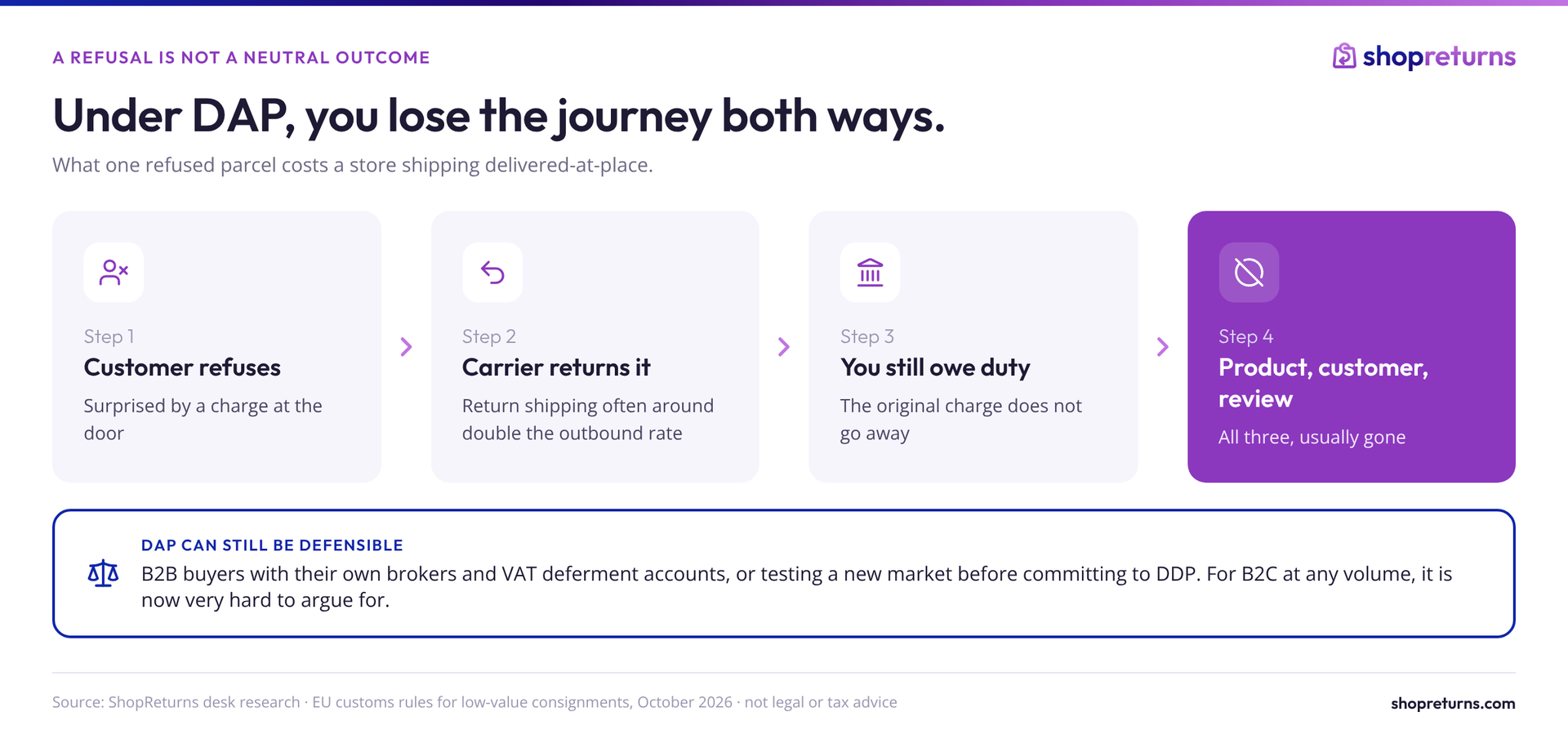
And a refusal isn't a neutral outcome. Under DAP, when a customer refuses to pay, the carrier bills you the return shipping, often around double the outbound rate, plus the original duties. You lose the product's journey both ways, the duty, the customer and frequently the review.
You'll see much bigger claims in circulation, along the lines of DDP lifting conversion by 30%. Treat those with caution: they come from vendor blogs without published methodology. The Baymard abandonment finding is the solid one, and it's more than enough to justify the change.
The one caveat worth knowing. DAP isn't always wrong. It can be defensible for B2B buyers, who typically have their own brokers and VAT deferment accounts and prefer to import themselves, and when testing a new market before committing to DDP infrastructure. For B2C at any volume, it is now very hard to argue for.
Setting 2: your HS codes
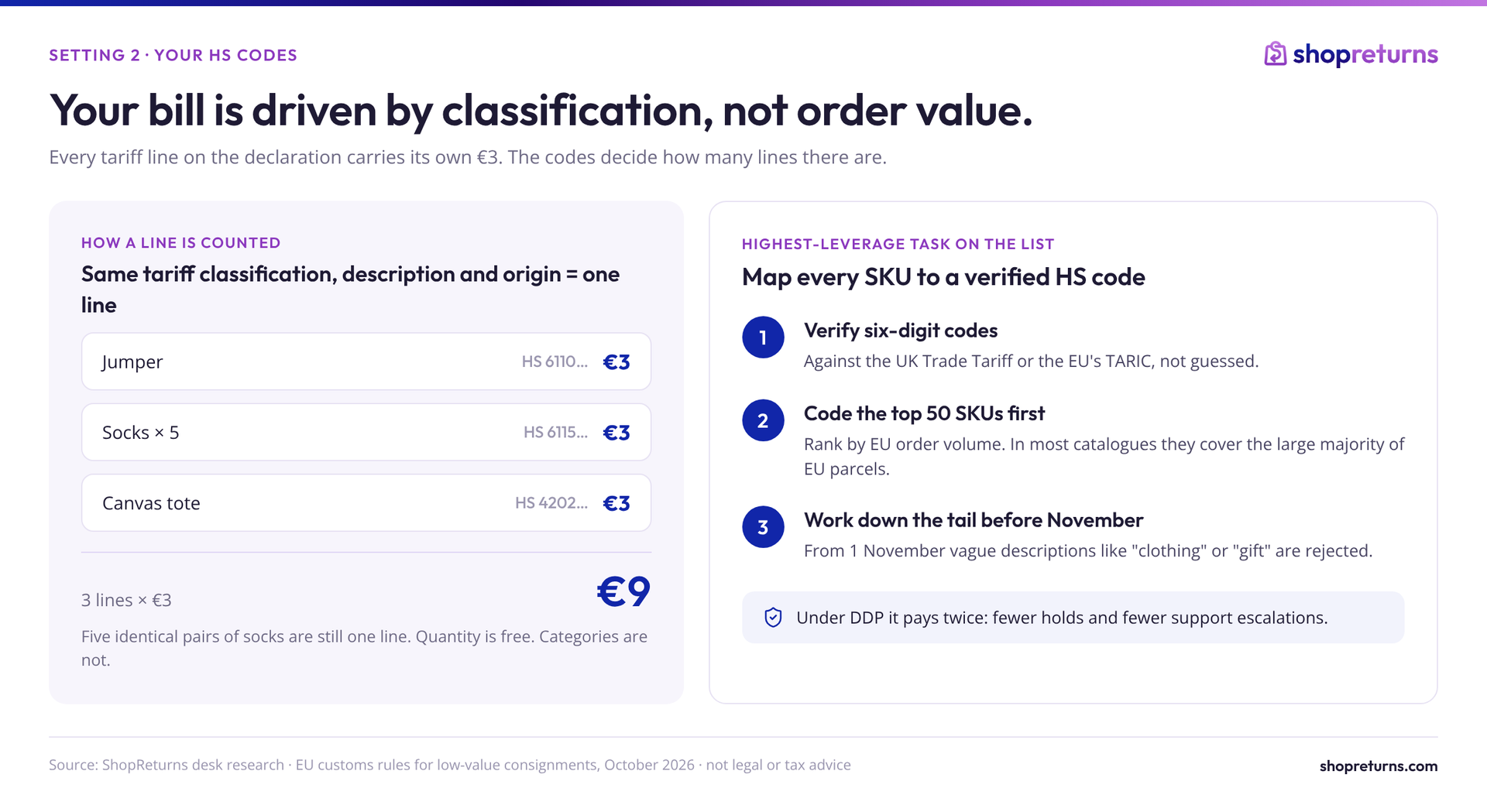
Your bill is driven by classification, not order value.
If your SKUs carry guessed codes, or descriptions like "clothing" or "gift", you have no control over how many lines the declaration produces, and from 1 November vague descriptions get rejected outright rather than waved through.
Verified six-digit codes checked against the UK Trade Tariff or the EU's TARIC are the highest-leverage thing on this list. Hundreds of SKUs? Rank by EU order volume and code the top 50 first, because in most catalogues those appear in the large majority of EU parcels. Work down the tail before November.
Under DDP this matters twice over: you're the one managing classification and clearance, so getting it right also means fewer holds and fewer support escalations.
Setting 3: how your bundles are built
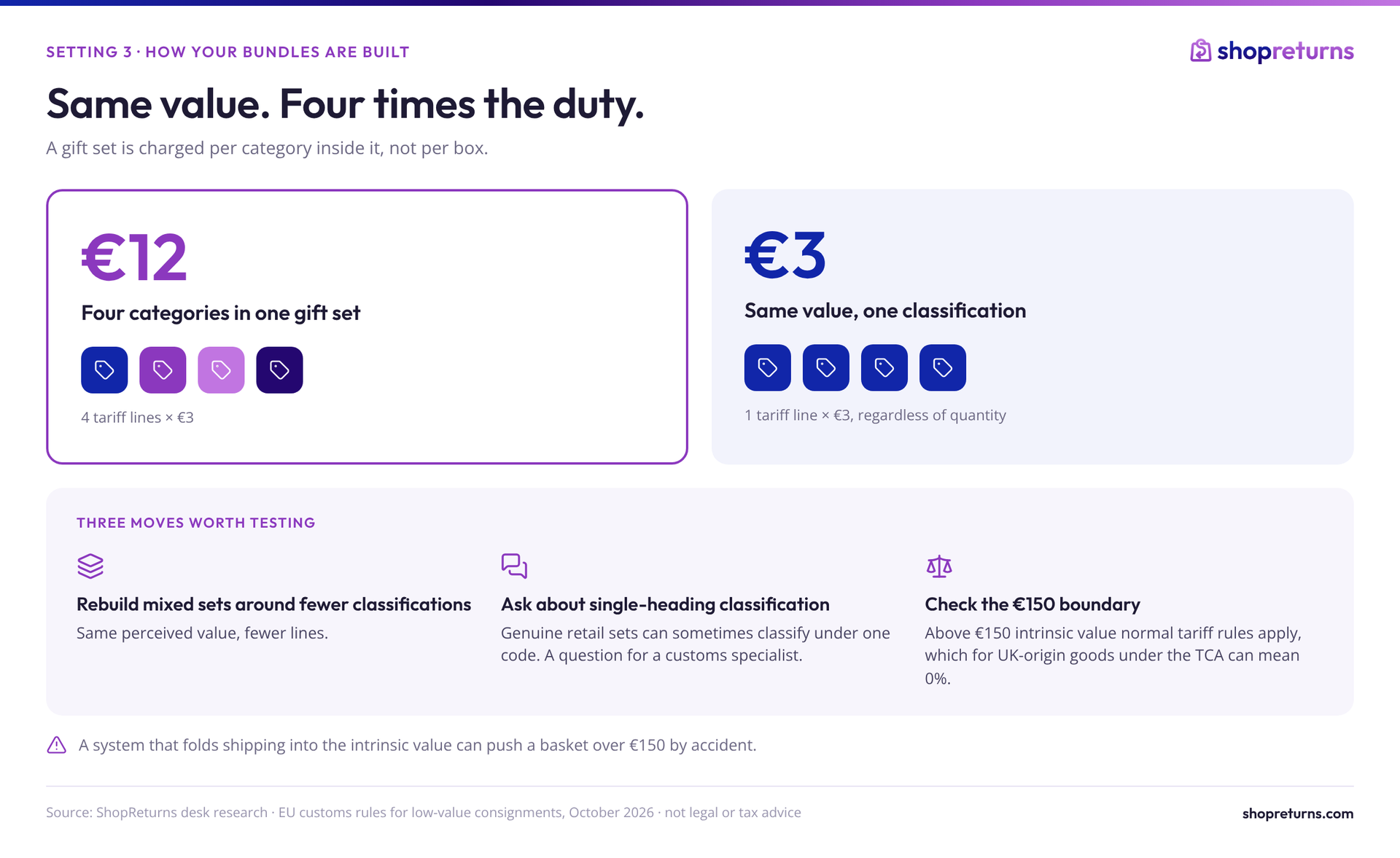
A gift set assembled from four categories costs €12 in duty. The same value delivered as four units of one category costs €3.
Three moves worth testing:
Rebuild mixed sets around fewer classifications. Same perceived value, fewer lines.
Ask about single-heading classification. Genuine retail sets can sometimes classify under one code. That's a question for a customs specialist against your actual products, not something to assume either way.
Look at the €150 boundary. Above €150 intrinsic value the flat rate doesn't apply and normal tariff rules take over, which for genuinely UK-origin goods under the UK-EU Trade and Cooperation Agreement can mean 0%. Some baskets really are cheaper ten euros bigger. Note that intrinsic value is the goods themselves, with separately invoiced transport and insurance excluded, so a system that folds shipping into the value can push a basket over the line by accident.
The line most stores haven't priced: returns
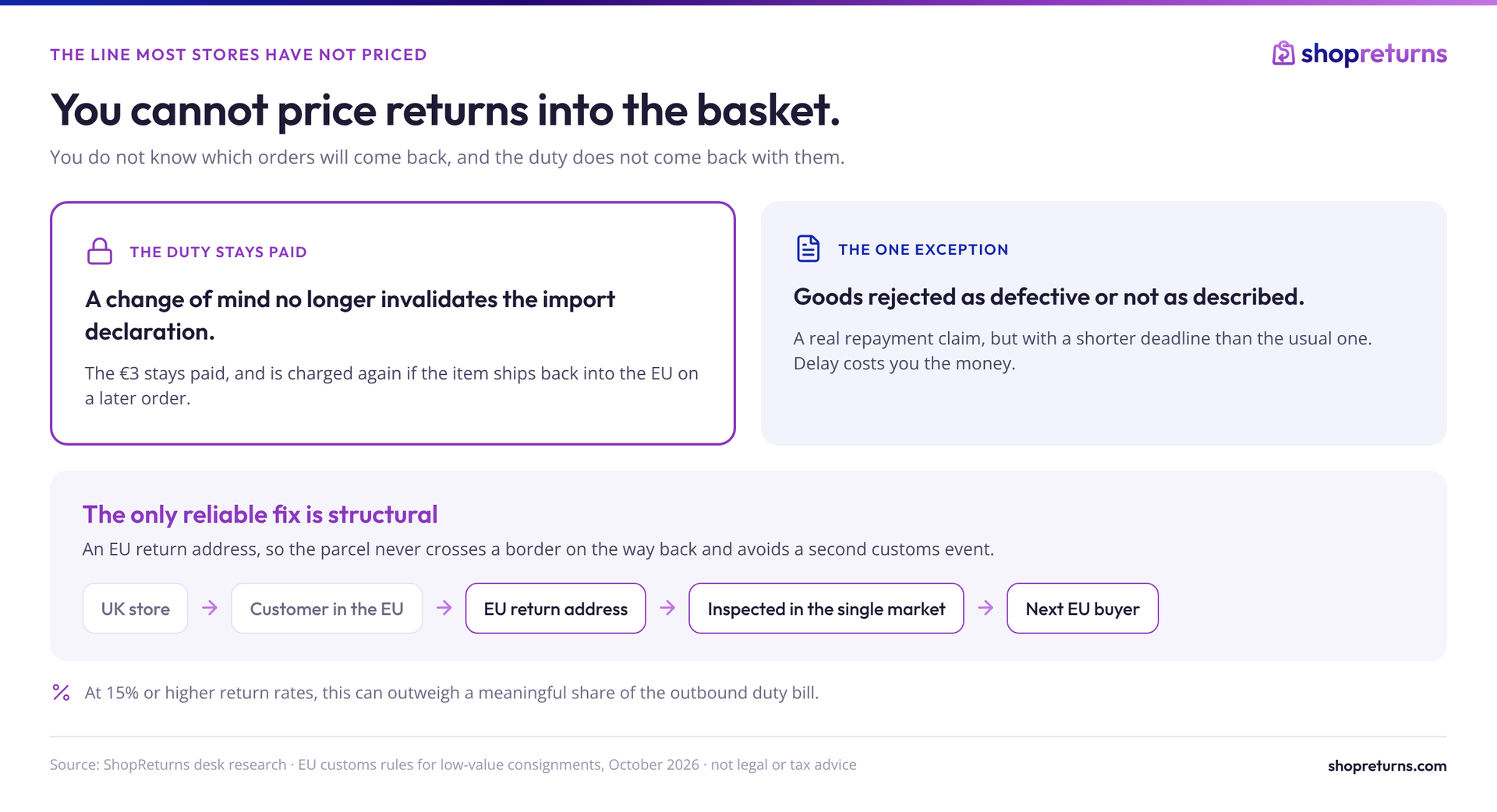
When goods come back after release, you can no longer ask customs to invalidate the import declaration simply because the customer changed their mind. The rules that arrived with the duty removed that route for low-value distance sales. The €3 stays paid, and it's charged again if the item ships back into the EU on a later order.
The general grounds for repaying customs duty still exist, but a change of mind doesn't fit any of them. The one exception is goods rejected as defective or not as described, which is a real claim with a shorter deadline than the usual one, so it's the category where delay costs you the money.
For a store running 15% or higher return rates, this can outweigh a meaningful share of the outbound duty bill. And unlike the outbound charge, you can't price it into the basket, because you don't know which orders will come back.
The only reliable fix is structural: an EU return address, so the parcel never crosses a border on the way back, is inspected inside the single market, and reaches the next EU buyer without a second customs event.
What to do this month
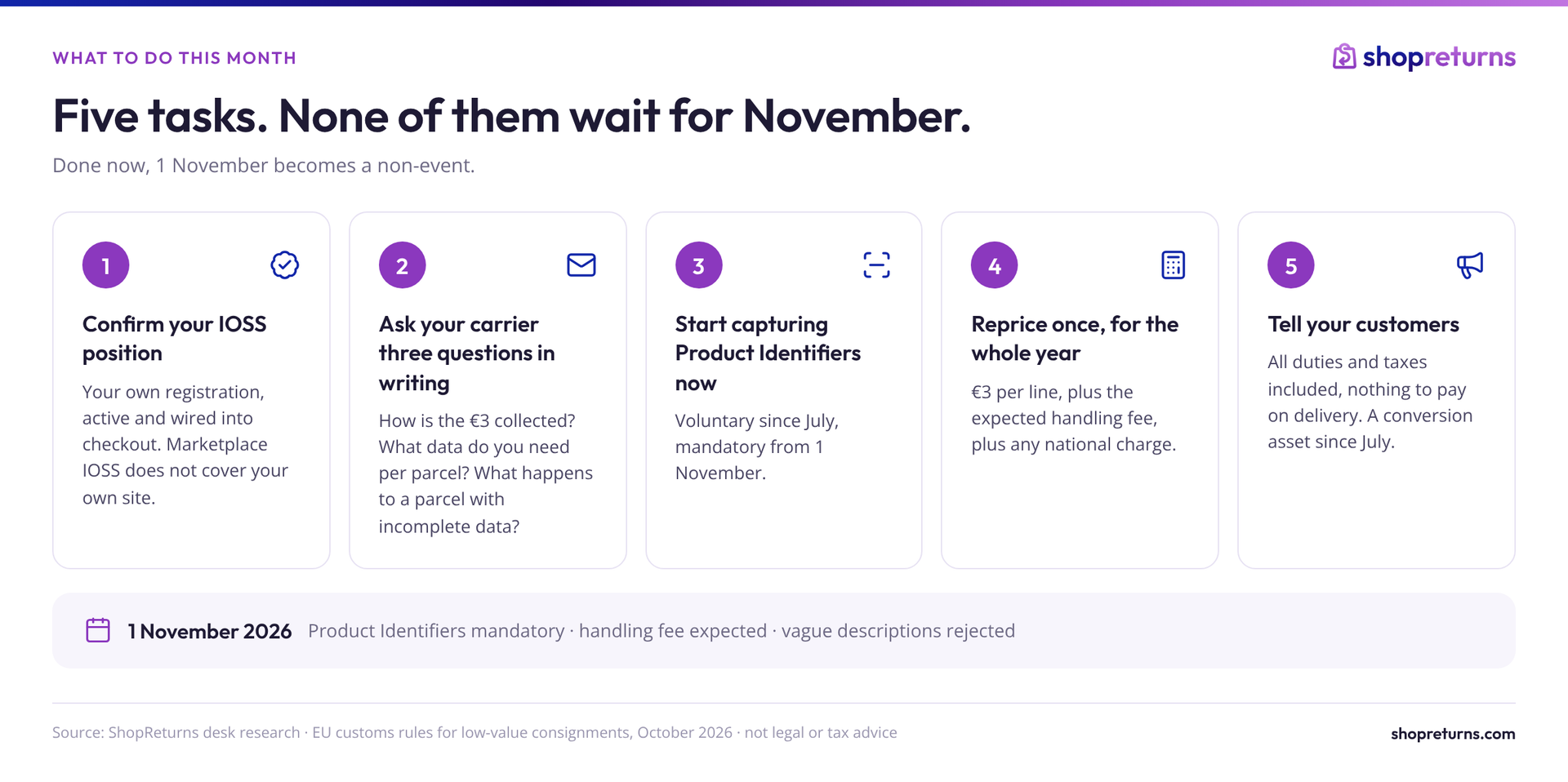
Confirm your IOSS position. Own-site sellers need their own Import One-Stop Shop registration, active and wired into checkout. It isn't a way around the duty, and since 1 October the Commission has been monitoring monthly for sellers diverting away from IOSS, with a mandate to propose extending the charge to non-IOSS flows.
Ask your carrier three questions in writing. How are you collecting and remitting the €3 on our shipments? What data do you need per parcel? What happens to a parcel with incomplete data? Carriers can only file what you feed them.
Start capturing Product Identifiers now. Voluntary since July with no penalties in the window, mandatory from 1 November. Doing it in August makes November a non-event.
Reprice once, for the whole year. €3 per line, plus the expected handling fee, plus any national charge on the countries you ship to.
Then tell your customers. All duties and taxes included, nothing to pay on delivery. Since July that's a conversion asset, because plenty of your competitors' customers are getting cards from the postman.
The number to write down
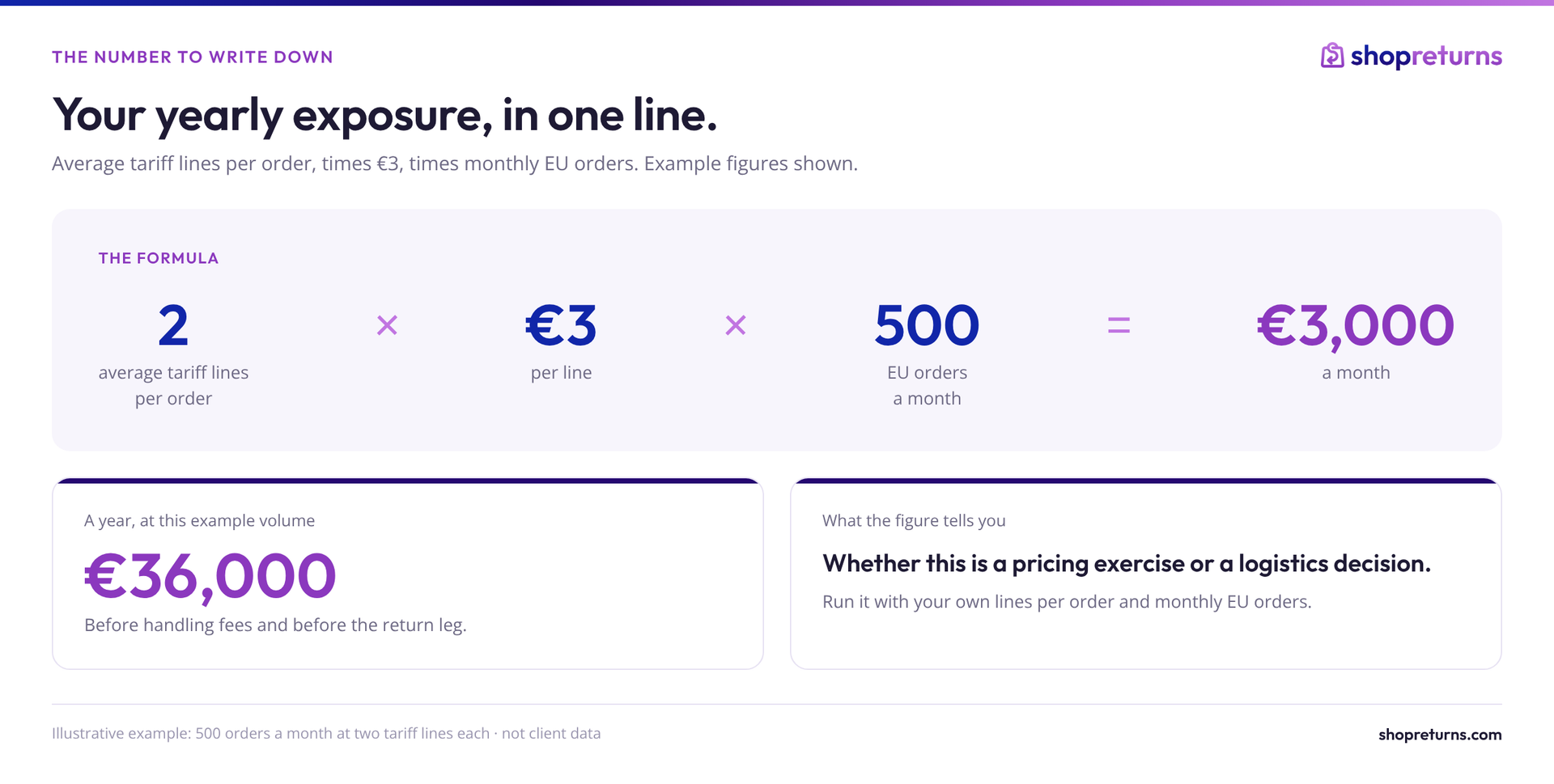
Average tariff lines per order, times €3, times monthly EU orders.
Five hundred orders at two lines each is €3,000 a month, €36,000 a year, before handling fees and before the return leg. That figure tells you whether this is a pricing exercise or a logistics decision.
FAQ
Is it €3 per parcel or per item? Per item type, meaning per line on the customs declaration. Goods sharing tariff classification, description and origin sit on one line and carry one €3 charge regardless of quantity. Different categories create separate lines. Five identical items is €3; five different categories is €15.
Should I ship DDP or DAP to EU customers? DDP for B2C, in almost all cases. Baymard Institute found unexpected additional costs drive 48% of all cart abandonment, and FlavorCloud's 2025 data put around 10% of DDU parcels as refused or returned over surprise charges. Under DAP a refusal also means the carrier bills you return shipping, often around double the outbound rate, plus the original duties. DAP remains defensible for B2B buyers with their own brokers, or when testing a new market.
Can I just absorb the €3 and move on? On single-category orders with healthy margin, yes. As a whole-business policy, no. Mixed baskets already cost €6 to €12 per order, with a handling fee expected and standard tariffs queued for 2028.
Do I need my own IOSS registration? For your own store, yes, if you want duties and VAT handled at checkout rather than at the customer's door. Marketplace sales are covered by the platform's registration; your own site is not.
Can I get the €3 back when a customer returns something? Not for a change of mind. The route of invalidating the import declaration was removed for low-value distance sales returned after release. Goods rejected as defective or not as described are a separate claim with a shorter deadline, so those move first if you have them.
What if my basket is just under €150? Worth modelling. Above €150 intrinsic value the flat rate doesn't apply and normal tariff rules take over, which for qualifying UK-origin goods under the TCA can mean 0%. Check that your system isn't folding shipping into the intrinsic value, because that can push a basket over the threshold unintentionally.
What happens on 1 November? Product Identifiers become mandatory on every declaration, and the roughly €2 handling fee is expected around the same time. Vague product descriptions that cleared in August will be rejected.
What's the single highest-leverage task? Mapping every SKU to a verified six-digit HS code. That one dataset drives your duty cost, your declarations, your classification and your November compliance.
Not sure what your current setup is costing you?
Send us your numbers and we'll run them against the new regime - where the duty is hitting twice, what your return freight actually costs against the goods you recover, and how much of it is avoidable. One working session, and you leave with the figures either way.
Keep reading
More from the knowledge base

Resale vs refurbish vs liquidate: what to do with returned fashion stock

Zalando vs ASOS vs About You: returns terms compared for sellers