Amazon Returns Fees in Europe 2026: Complete Cost Guide for Sellers
13.11.2026 · 13 min read

Navigation
- Why this matters nowsThe Amazon fees that apply to a returned fashion unit The cost model: inputs and assumptionsRoute 1: FBA with EU stock, everything left to AmazonRoute 2: FBA with unfulfillable units removed to a third-party hubRoute 3: cross-border FBM, parcel returns to the non-EU warehouseRoute 4: cross-border FBM with a local EU return addressThe returnless-refund rule for low-value cross-border FBM itemsWhat this looks like inside the businessWhat to check before you scaleHow ShopReturns helpsFAQNot sure what your current setup is costing you?
A return doesn’t end when the customer sends a product back. For sellers, the real cost depends on what happens next.
Should you leave the product with Amazon, send it to an external returns hub, or handle the return locally? Each option comes with different costs, and the cheapest solution isn’t always the most profitable.
To understand the difference, we compared four return scenarios across Europe using Amazon’s 2026 fees and clearly defined cost assumptions.
The results show where third-party returns processing can reduce costs, when Amazon FBA remains the better option, and how much a local return address can save cross-border sellers.
In this article:
- The Amazon fees that apply to a returned fashion unit in Europe in 2026, with sources
- A worked cost per returned unit for four routes, and the break-even landed cost for pulling FBA returns to a third-party hub
- Where returnless refunds apply to cross-border FBM, and when they are the cheaper option
Why this matters nows
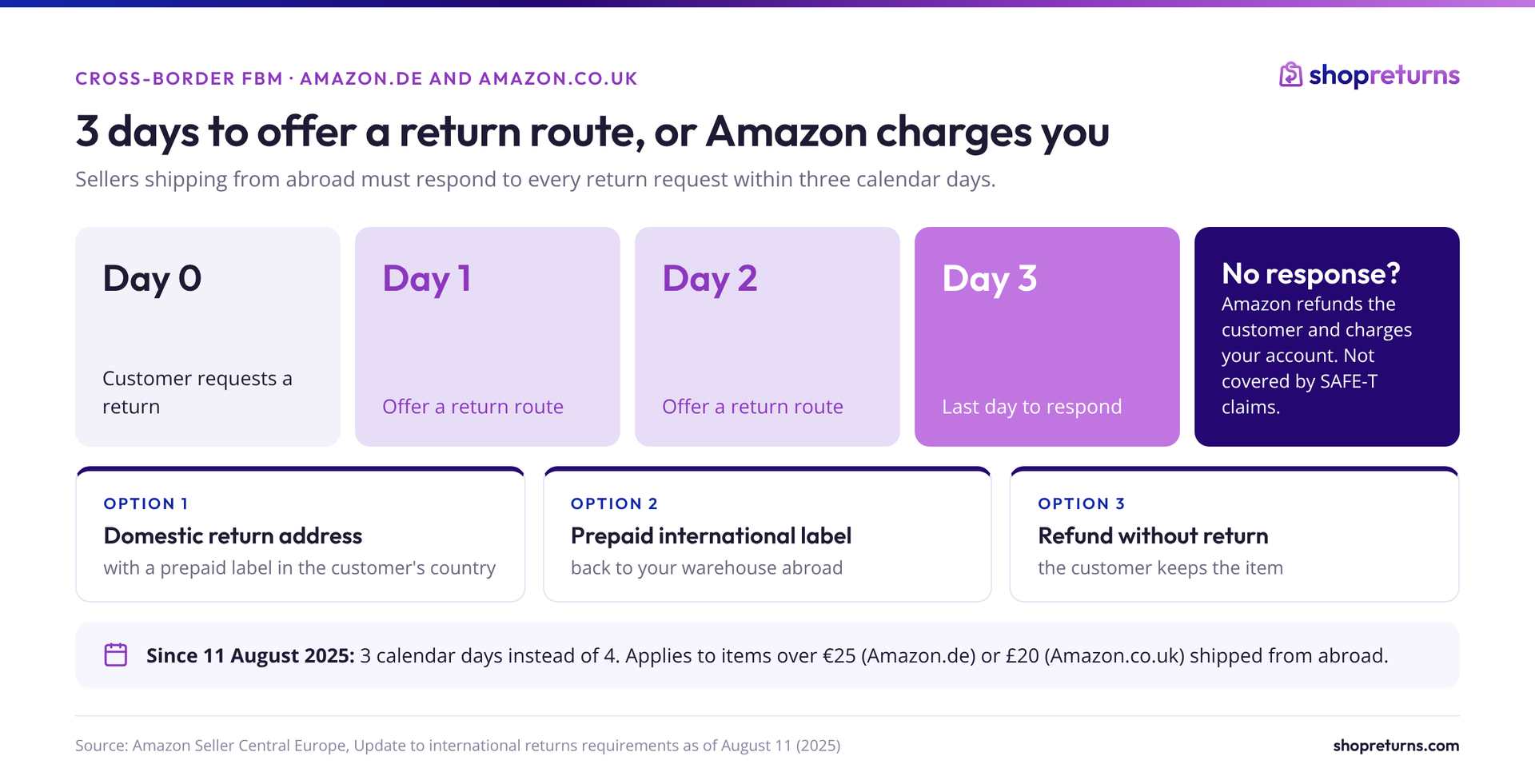
Cross-border FBM: you now have 3 days to offer a return, or Amazon charges you
Since 11 August 2025, sellers shipping into Amazon.de or Amazon.co.uk from abroad have three calendar days, down from four, to respond to a return request on items over €25 or £20. Within those three days you must offer the customer one of three options: a domestic return address with a prepaid label, a prepaid international label, or a refund without return.
If you do not respond in time, Amazon refunds the customer and charges your account. You cannot recover that charge through a SAFE-T claim. For a seller without a return address in the customer’s country, this is the rule that decides the cost of every cross-border return.
Why did Amazon’s return fees change in 2026? Amazon’s European FBA rate card was reissued three times this year, with versions effective 1 February, 17 April and 1 July 2026. The July card states that from 17 April 2026 a 1.5% fuel and logistics surcharge applies to FBA fulfilment fees in the UK, France, Germany, Italy, Spain, Poland, Sweden, the Netherlands, Ireland and Belgium. For fashion, the returns processing fee is a percentage of the fulfilment fee, so it rises too.
Why does the EU €3 duty matter for returns? The Council approved new rules on 11 February 2026: since 1 July 2026, a flat €3 customs duty applies per item category on small parcels entering the EU, replacing duty-free treatment below €150. Our understanding is that it is not repaid on an ordinary change-of-mind return, so the model below treats it as a lost cost for a UK seller shipping into Germany.
The Amazon fees that apply to a returned fashion unit
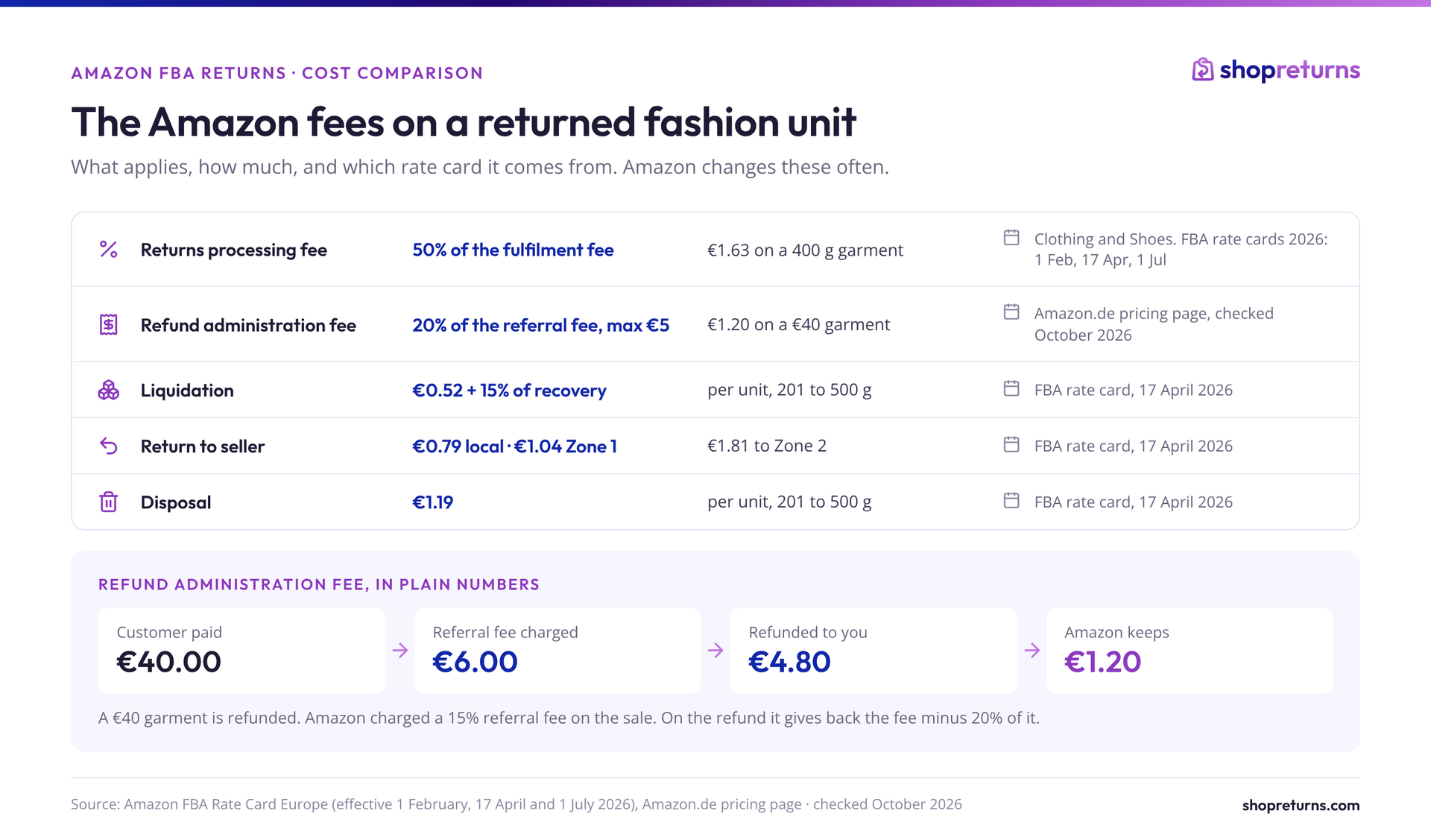
Amazon changes these fees often, so each one below shows the date of the rate card or page it comes from.
Returns processing fee (FBA rate cards effective 1 February, 17 April and 1 July 2026). For Clothing and Shoes, Amazon charges 50% of the item’s fulfilment fee every time it is returned. Amazon also has a separate high-return-rate fee table, charged by size tier, but it excludes clothing, accessories and footwear, so it does not apply to fashion.
Refund administration fee (Amazon.de pricing page, checked October 2026). When you sell an item, Amazon charges you a referral fee. When the customer gets a refund, Amazon gives that referral fee back, but keeps part of it as a refund administration fee: 20% of the referral fee, up to a maximum of €5.00.
Example: a €40 garment. The referral fee for clothing above €20 is 15%, so Amazon charged you €6.00 on the sale. On the refund, Amazon returns €4.80 and keeps €1.20. For reference, clothing and accessories referral fees on Amazon.de are 5% up to €15, 10% between €15 and €20, and 15% above €20.
What happens to unfulfillable units (FBA rate card effective 17 April 2026). When Amazon grades a returned unit as unfulfillable, you pay one of these per-unit fees for a standard-size item of 201 g to 500 g:
- Liquidation: €0.52 (£0.49), plus a 15% referral fee on the gross recovery value
- Local return-to-seller: €0.79 (£0.71)
- Cross-border return-to-seller: €1.04 to Zone 1, €1.81 to Zone 2
- Disposal: €1.19 (£1.15)
Zone 1 includes Germany, Poland, France, Italy, Spain and the Netherlands. Returns within the Central European programme are charged as local. These fees are the same in the February and April 2026 rate cards. We could not find this table in the July card.
Worth a mention: the rate card carries a footnote saying cross-border returns from the UK are currently disabled. Stock in UK fulfilment centres cannot be removed to an EU address, so route 2 below only works for stock held in the EU, or for UK stock sent to a UK address.
The cost model: inputs and assumptions
Every figure below is either a published Amazon fee or a labelled assumption, to be replaced with your own numbers. Outbound fulfilment and marketing costs are excluded because they are spent on every route.
Published inputs
- Fulfilment fee: clothing sits in Amazon’s “selected categories” parcel table. For Small Parcel 2 under the Central European programme, the July 2026 card gives €3.08 for the first 100 g plus €0.06 per additional 100 g. For a 400 g garment that is €3.26.
- Returns processing fee: 50% of €3.26 = €1.63.
- Refund administration fee: referral fee of 15% on €40 is €6.00; 20% of that is €1.20
- Removal, disposal and liquidation fees as listed above
Assumptions (ours, not Amazon’s)
- The unit: a 400 g garment sold on Amazon.de at €40 including VAT, landed cost €12
- Amazon grades 60% of returned units sellable and 40% unfulfillable
- Liquidation recovers 7.5% of the selling price. Amazon has said sellers typically recover about 5% to 10% of average selling price through FBA Liquidations; that statement is several years old and not specific to Europe
- A third-party regrade recovers 50% of the units Amazon marked unfulfillable as resaleable
- Third-party processing fee: €2.50 per unit
- Re-inbound to FBA for a recovered unit: €0.50
- A resaleable unit is valued at its landed cost; an unrecovered unit is a full write-off of landed cost
- For FBM: 80% of returns are resaleable under the seller’s own or a hub’s grading; international prepaid return label Germany to UK €12.00; domestic German return label €4.50; in-house handling €1.50; UK re-import administration €1.00; consolidated bulk transport home €0.80 per resaleable unit
Route 1: FBA with EU stock, everything left to Amazon
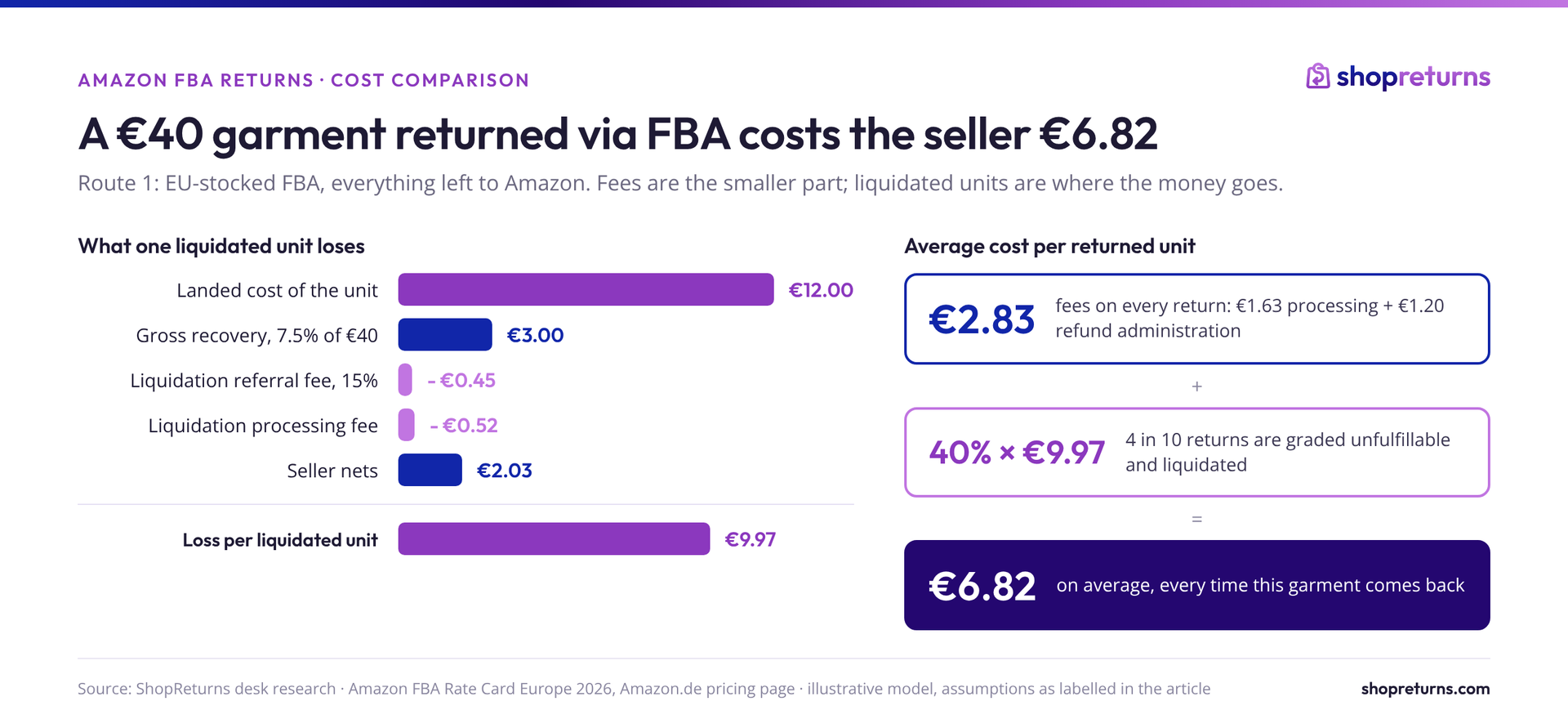
The fees on every return are the returns processing fee and the refund administration fee: €1.63 + €1.20 = €2.83.
The loss on unfulfillable units is where the money goes. Liquidating a unit recovers 7.5% of €40, which is €3.00 gross. Less the 15% liquidation referral fee (€0.45) and the €0.52 processing fee, the seller nets €2.03. Against a €12 landed cost, each liquidated unit loses €9.97.
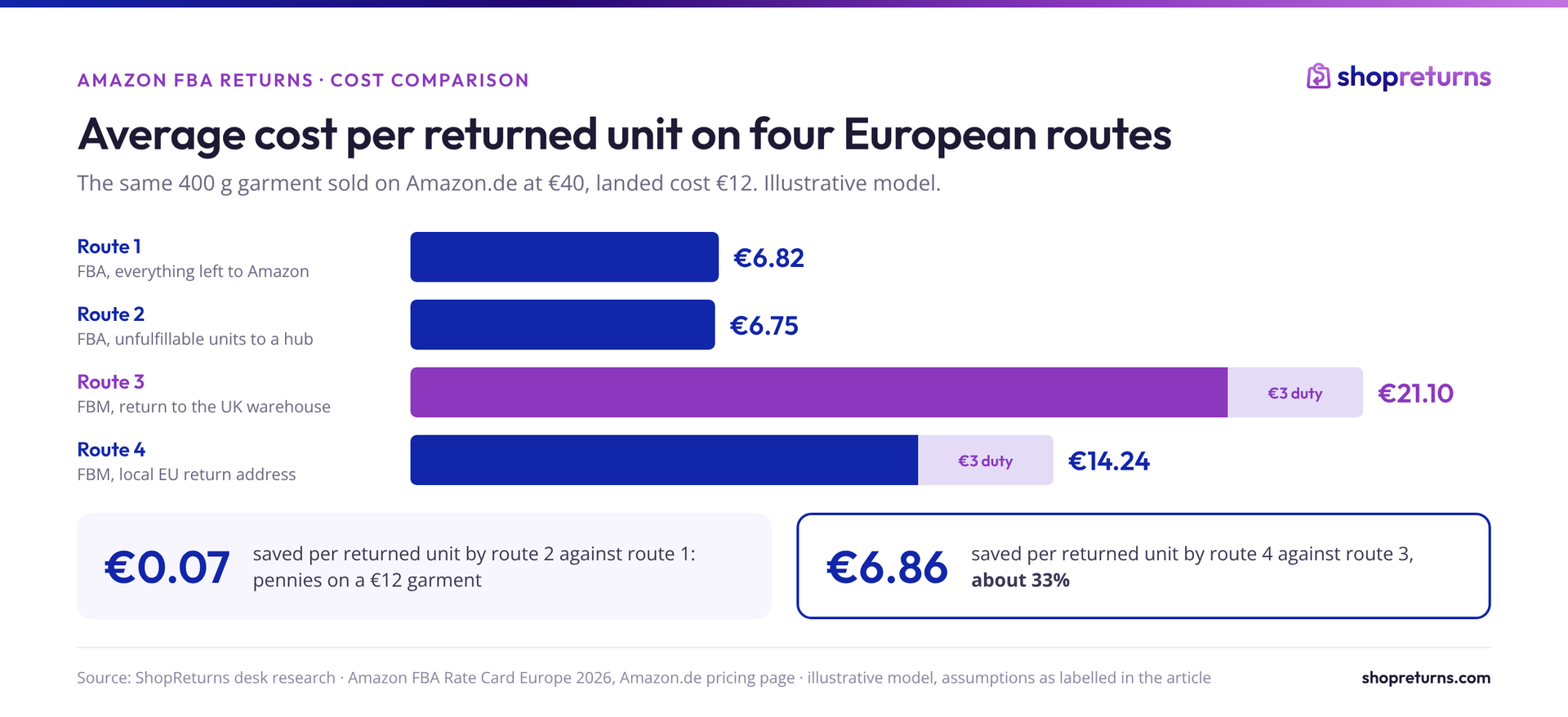
Cost per returned unit: €2.83 + (40% × €9.97) = €6.82.
Route 2: FBA with unfulfillable units removed to a third-party hub
The fees on every return stay at €2.83. Amazon still grades the parcel; only the fate of the 40% marked unfulfillable changes.
Per unfulfillable unit, the seller pays the Zone 1 cross-border return-to-seller fee (€1.04), the regrade (€2.50), and €0.50 re-inbound on the half that is recovered (€0.25 average). The half that cannot be recovered is written off at €6.00 average. Total: €9.79, against €9.97 for liquidation.
Cost per returned unit: €2.83 + (40% × €9.79) = €6.75.
The saving is €0.07 per returned unit. At 1,000 returns a month that is about €860 a year, which will not pay for the project management.
The break-even landed cost for route 2
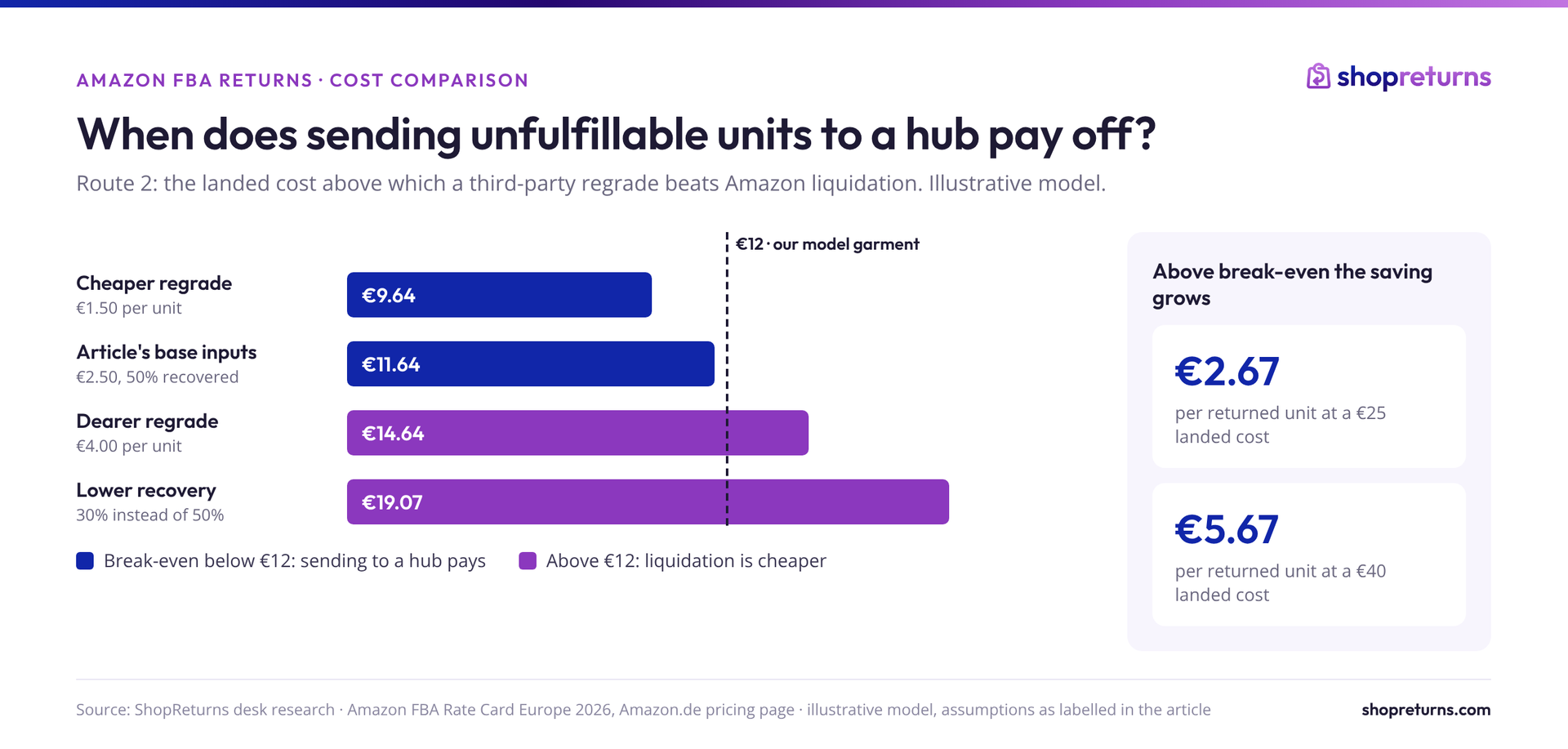
The formula. Route 2 beats liquidation when landed cost exceeds (removal fee + regrade fee + recovery share × re-inbound cost + net liquidation proceeds) ÷ recovery share. With our inputs that is (€1.04 + €2.50 + €0.25 + €2.03) ÷ 0.5 = €11.64, so the €12 garment sits just above break-even.
How it moves:
- Regrade fee €1.50 instead of €2.50: break-even falls to €9.64
- Regrade fee €4.00: break-even rises to €14.64
- Recovery share 30% instead of 50%: break-even rises to €19.07
Above break-even the gap widens quickly. At a €25 landed cost the saving is €6.68 per unfulfillable unit, or €2.67 per returned unit. At €40 it is €14.18 and €5.67. Route 2 is a premium-product decision, and the recovery share is the number to test first.
Worth a mention: liquidation proceeds depend on selling price, while the write-off depends on landed cost. A high-margin item (low cost, high price) is therefore the worst candidate for removal.
Route 3: cross-border FBM, parcel returns to the non-EU warehouse
A UK seller ships the same €40 garment to a German customer. Above €25, Amazon accepts a domestic German return address with a prepaid label, a prepaid international label, or a full refund without return. Route 3 is the international label.
Per returned unit:
- International prepaid return label: €12.00 (assumption)
- Refund administration fee: €1.20
- In-house handling in the UK: €1.50 (assumption)
- UK re-import administration: €1.00 (assumption)
- EU €3 duty paid on the outbound leg, not recovered: €3.00
- Write-off on the 20% that is not resaleable: 20% × €12 = €2.40
Cost per returned unit: €21.10, or €18.10 before the sunk duty. That is more than the garment’s landed cost, and Amazon states that return costs are always the seller’s responsibility under this option.
Route 4: cross-border FBM with a local EU return address
The same sale, but the customer returns to a German address with a domestic label.
Per returned unit:
- Domestic prepaid return label: €4.50 (assumption)
- Refund administration fee: €1.20
- Third-party processing: €2.50 [TO CONFIRM: ShopReturns price]
- EU €3 duty paid on the outbound leg, not recovered: €3.00
- Write-off on the 20% not resaleable: €2.40
- Consolidated bulk transport home for the 80% resaleable: 80% × €0.80 = €0.64
Cost per returned unit: €14.24, or €11.24 before the sunk duty.
The saving against route 3 is €6.86 per returned unit, about 33%. At 1,000 returns a month that is roughly €82,000 a year. Almost all of it comes from one line: a domestic label instead of an international one. The model leaves out benefits we cannot price honestly here, such as faster refunds and in-market resale.
The returnless-refund rule for low-value cross-border FBM items
The rule. For seller-fulfilled orders shipped from abroad into Amazon.co.uk, Amazon.de, Amazon.fr, Amazon.es and Amazon.it, Amazon requires a default domestic return address for items at or under £20 or €25 including VAT. Without one, Amazon automatically refunds in-policy returns without asking for the item back. Shipping charges do not count towards the threshold. The rule dates from 5 October 2021.
A different, cheaper example. The €40 garment in the routes above is too expensive for this rule. So here we use a cheaper item: a €20 top that cost the seller €6 to make and ship to the EU (its landed cost). The referral fee at 10% is €2.00, so the refund administration fee is €0.40.
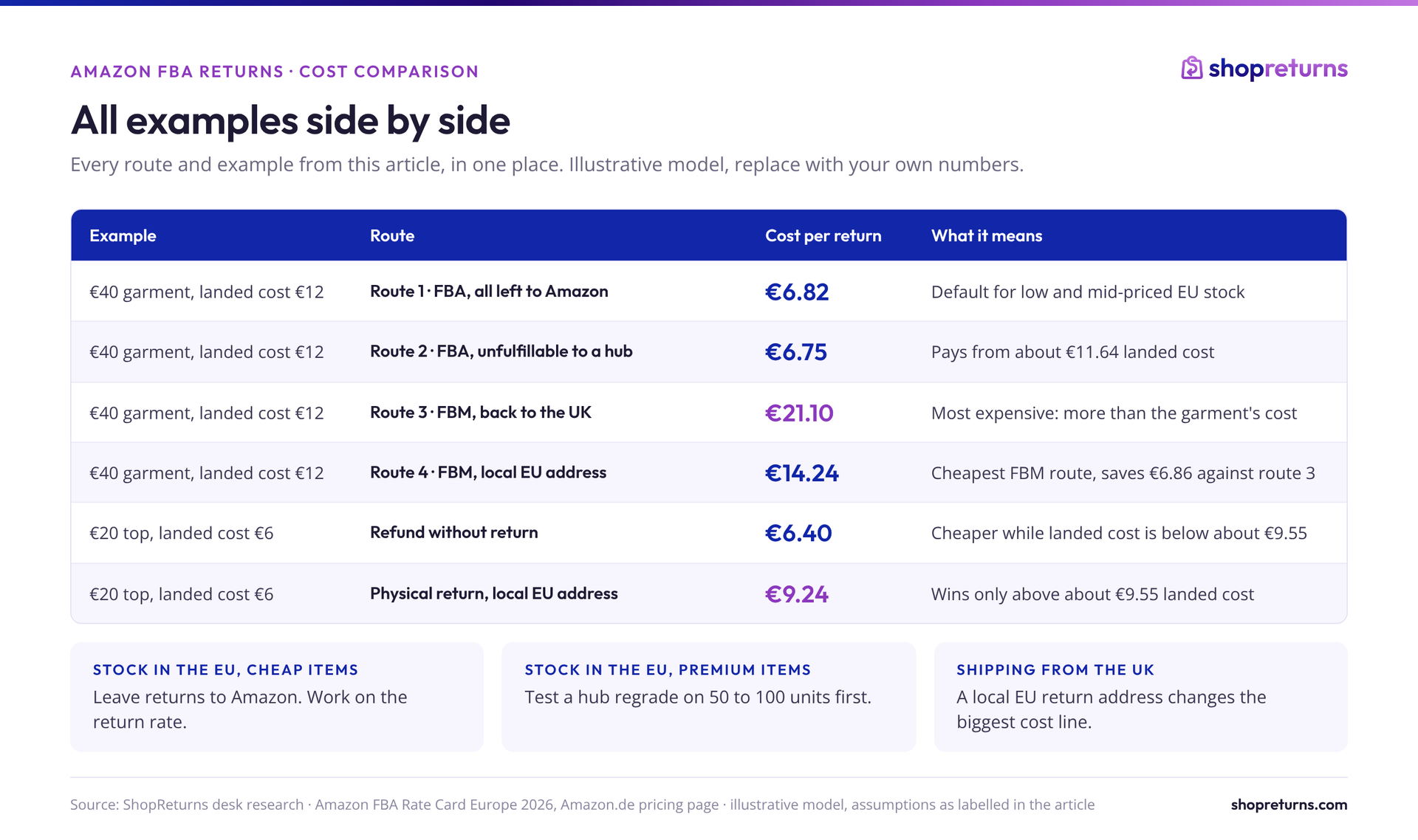
Option A: the customer keeps the top. You lose the €6 top and pay the €0.40 fee. Cost: €6.40.
Option B: the top comes back to a local EU address. On the route 4 assumptions: €4.50 label + €0.40 fee + €2.50 processing + €1.20 write-off on the 20% not resaleable + €0.64 transport home = €9.24.
The €9.55 line. €9.55 is not an order value. It is the landed cost at which both options cost the same. If an item cost you less than about €9.55 to make and ship, letting the customer keep it is cheaper. If it cost more, getting it back pays. For an item priced at €25 or less, a landed cost above €9.55 is unusual, so a refund without return is usually the cheaper option.
Worth a mention: this calculation assumes the return rate stays the same. Customers who learn that an item is refunded without return may behave differently. A domestic return address lets you set the rule by product, instead of Amazon applying refunds without return to everything under the threshold.
What this looks like inside the business
The EU-stocked FBA basics brand. Landed costs of €6 to €10, 100% FBA from German and Polish fulfilment centres. Under the assumptions used in this model, removing these units for regrading is not financially justified. Liquidation appears to be the more cost-effective option, while reducing the return rate should remain the priority.
The premium outerwear seller on Pan-EU FBA. Landed cost €45. Every unfulfillable unit liquidated is a loss above €40. Under our model assumptions, third-party regrading becomes financially attractive for higher-value products, provided the expected recovery rate is confirmed through a test batch.
The UK brand selling FBM into Germany. Dresses at €40 to €80 returning to the UK on international labels. A German return address changes the largest line in the model.
What it means. For cheap items stocked in the EU, leaving returns to Amazon is usually the cheapest option, and the priority is lowering the return rate. For premium items stocked in the EU, sending unfulfillable units to a hub starts to pay above about €11.64 landed cost, so test it on 50 to 100 units first. For UK brands shipping into the EU, a local EU return address is the biggest saving in this model: €6.86 per returned unit, about 33%.
What to check before you scale
- Your actual fulfilment fee per SKU, since the fashion returns processing fee is half of it
- The share of FBA returns Amazon grades unfulfillable, by ASIN, from the FBA returns report
- Your real liquidation recovery in Europe over the last six months, net of the 15% referral fee
- A test regrade of 50 to 100 unfulfillable units before assuming any recovery share
- Whether the stock is in UK fulfilment centres, where cross-border removal is disabled
- The landed-cost threshold below which returnless refunds are cheaper for you
- Whether your return route can be offered within Amazon’s three-day response window
- Who decides between restock, in-market resale, donation and disposal
How ShopReturns helps
ShopReturns covers routes 2 and 4 of this comparison. We provide local return addresses in nine European markets, so the customer returns domestically with a carrier they already use and no customs border is crossed on the return leg. Every item is verified in our Wrocław hub within 48 hours with a barcode scan and a photo-documented check, giving you an independent grade to set against a marketplace’s unfulfillable decision. Items then go back into stock, are resold in-market, donated or disposed of as you decide, and only consolidated bulk travels home, when it makes financial sense.
FAQ
Is third-party returns processing cheaper than FBA returns? For EU-stocked FBA, usually only for higher-value items. Amazon’s fees apply either way, so the saving comes from recovering units that would otherwise be liquidated. On our assumptions the break-even landed cost is about €11.64.
How much is the Amazon FBA returns processing fee for clothing in Europe? The 2026 rate card sets it at 50% of the total fulfilment fee for products in the Clothing and Shoes categories. For a 400 g garment in our example that is €1.63.
What is Amazon’s refund administration fee in Europe? It is the lesser of €5.00 or 20% of the applicable referral fee, kept by Amazon when an order is refunded. On a €40 clothing item with a 15% referral fee, that is €1.20.
Do I need a local return address to sell FBM on Amazon.de from the UK? For items at or under €25 including VAT you need a domestic address or Amazon applies returnless refunds. Above €25 you must offer a domestic address with a prepaid label, a prepaid international label or a returnless refund within three calendar days.
Not sure what your current setup is costing you?
Send us your numbers and we'll run them against the new regime - where the duty is hitting twice, what your return freight actually costs against the goods you recover, and how much of it is avoidable. One working session, and you leave with the figures either way.
Keep reading
More from the knowledge base

Amazon Returns Fees in Europe 2026: Complete Cost Guide for Sellers

Resale vs refurbish vs liquidate: what to do with returned fashion stock