Amazon Returns Fees in Europe 2026: Complete Cost Guide for Sellers
09.11.2026 · 12 min read

Navigation
- Amazon Returns Fees at a GlanceAmazon FBA Returns Processing Fees in 2026Amazon Refund Administration FeeNon-Refundable FBA Fulfilment FeesWho pays for the customer’s return labelAmazon Disposal and Liquidation FeesAmazon Storage and Aged Inventory FeesAmazon FBM Returns: What Sellers Need to KnowAdditional Changes Affecting Amazon Sellers in 2026What Does an FBA Return Actually Cost?How to Reduce Amazon Returns CostsHow ShopReturns Helps European SellersFAQNot sure what your current setup is costing you?
A customer returns a product on Amazon. The refund is issued, but the seller’s costs don’t necessarily end there.
Depending on the marketplace, product category and fulfilment model, a single return can involve processing fees, non-refundable fulfilment costs, removal charges and additional storage fees.
For businesses selling across multiple European markets, these charges can have a direct impact on profitability.
In this guide, we break down Amazon’s 2026 returns fees across Europe, explain the differences between FBA and FBM, and show how sellers can better understand and manage the cost of returns.
In this article:
- Amazon FBA and FBM returns fees across Europe in 2026.
- A breakdown of processing, removal, disposal and storage costs.
- The real cost of a return and its impact on profitability.
- Practical ways to reduce returns costs.
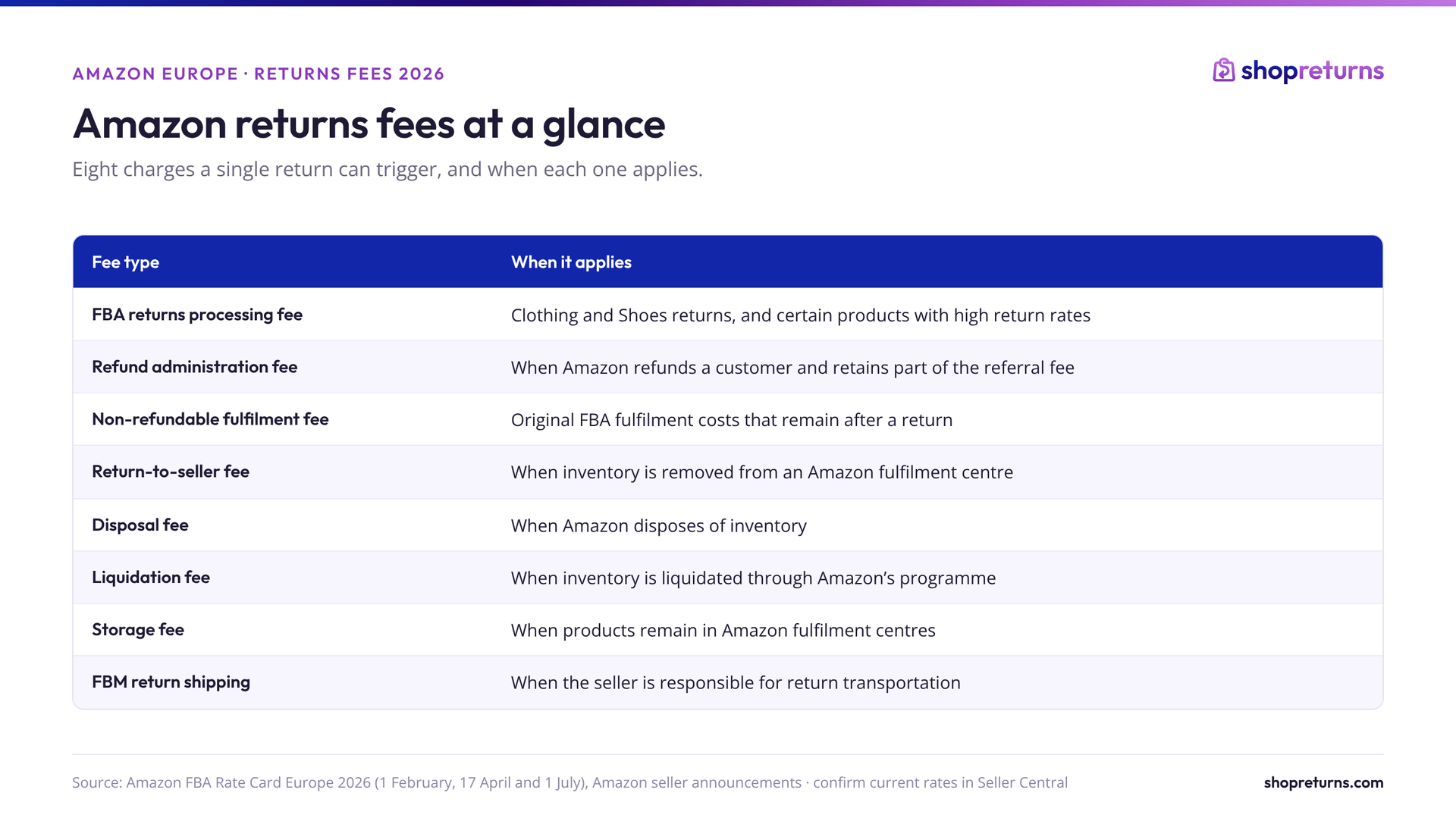
Amazon Returns Fees at a Glance
Not every Amazon return generates the same charges. The total cost depends on how the order was fulfilled, where the inventory is stored and what happens to the product after the return.
The key distinction: FBA and FBM sellers face different return cost structures. Understanding which fees apply to your business is the first step towards calculating your actual return costs.
Amazon FBA Returns Processing Fees in 2026
Amazon charges returns processing fees differently depending on the product category.
Clothing and Shoes
For products in the Clothing and Shoes categories, the returns processing fee equals 50% of the total fulfilment fee for the returned unit.
This applies across Amazon’s European marketplaces, including the UK, Germany, France, Italy, Spain, the Netherlands, Sweden, Poland, Belgium and Ireland.
The amount depends on the product’s weight, dimensions and fulfilment programme.
For example, if a product has a total fulfilment fee of €4.00, the returns processing fee would be €2.00.
This is charged in addition to the original fulfilment fee.
Other product categories
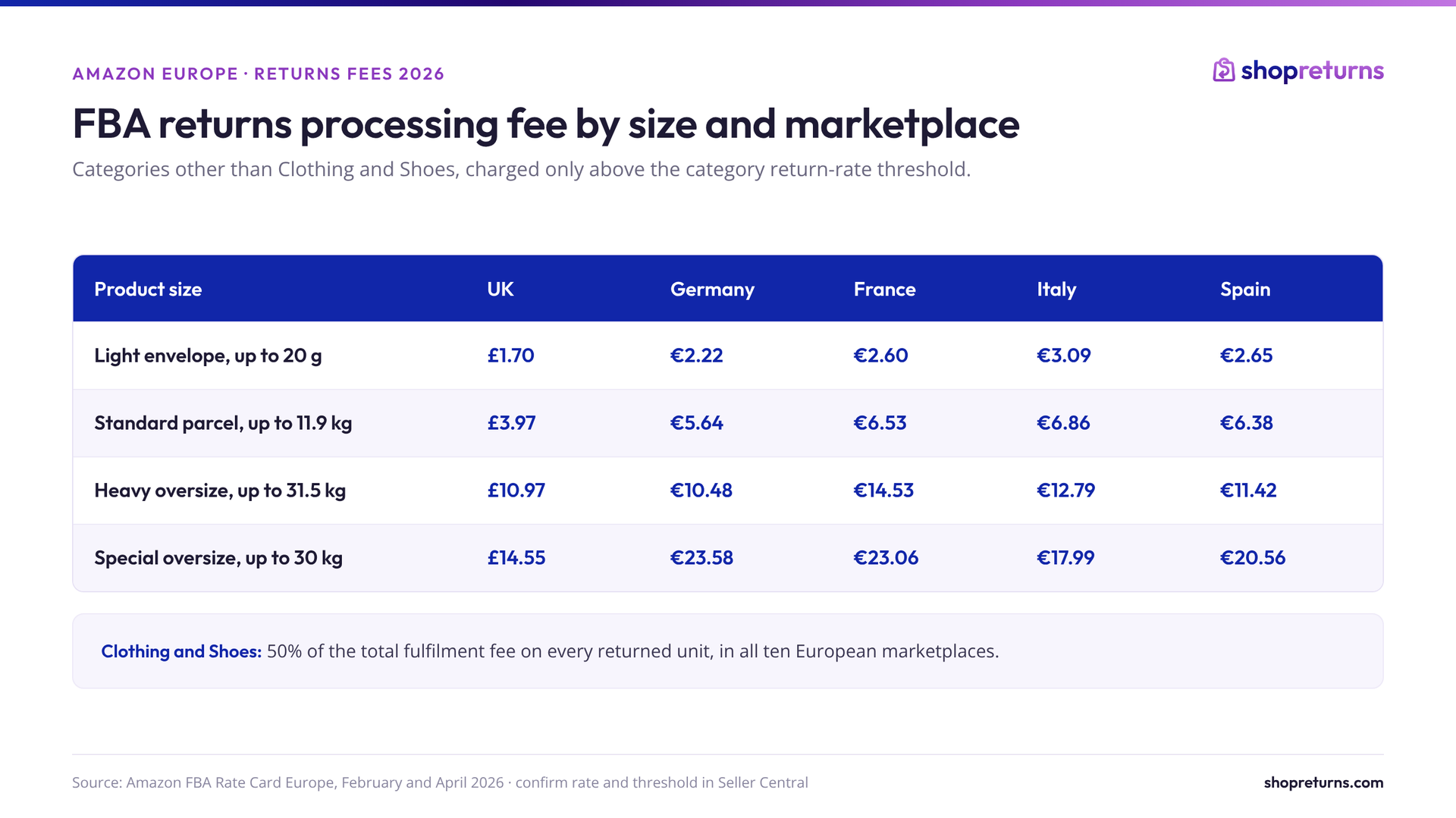
For categories outside Clothing and Shoes, Amazon generally charges a returns processing fee only when a product’s return rate exceeds a category-specific threshold.
The return rate is calculated using units shipped during a calendar month and returned during that month or the following two months.
Selected published fees include:
These figures come from the February and April 2026 rate cards. Sellers should confirm the applicable rate and return-rate threshold in Seller Central.
What this means for sellers
A product with a high return rate can become significantly less profitable, even when its sales volume remains strong.
Monitoring return rates at the individual product level is therefore important, particularly in categories with frequent customer returns.
Amazon Refund Administration Fee
When Amazon refunds a customer, it generally reimburses the referral fee minus a refund administration fee.
The administration fee is the lower of:
- €5.00 or 20% of the applicable referral fee in euro-denominated marketplaces.
- £5.00 or 20% of the applicable referral fee in the UK.
Example
A customer receives a €40 refund for a product with a 15% referral fee.
Original referral fee: €6.00.
Refund administration fee: 20% × €6.00 = €1.20.
Amazon refunds €4.80 of the original referral fee and retains €1.20.
Although this charge may appear small on an individual order, it becomes more significant across hundreds or thousands of returns.
Non-Refundable FBA Fulfilment Fees
One cost sellers should not overlook is the original outbound fulfilment fee.
When a customer returns an FBA order, the fulfilment fee paid for shipping the product to the customer is generally not refunded.
This means the seller may face several costs connected to the same transaction:
- The original outbound fulfilment fee.
- Any applicable returns processing fee.
- The refund administration fee.
- Additional costs associated with storing, removing or disposing of the returned inventory.
For sellers calculating product profitability, looking only at the returns processing fee can therefore underestimate the financial impact of a return.
Who pays for the customer’s return label
It depends on the fulfilment model.
FBA: Amazon issues the return label to the customer and the parcel goes back to an Amazon fulfilment centre. The seller does not buy that label separately. For Clothing and Shoes, the seller pays for returns through the returns processing fee, 50% of the fulfilment fee, described in section 2.
FBM: the seller pays for the return label in every case. With Amazon’s prepaid return label, the seller is charged when the carrier scans the return parcel. Sellers on a Professional plan can provide their own prepaid label instead, if it meets Amazon’s requirements. Amazon does not publish one public price table for its prepaid return labels. Sellers see the charge for each return in Seller Central.
Return-to-seller fees (FBA only)
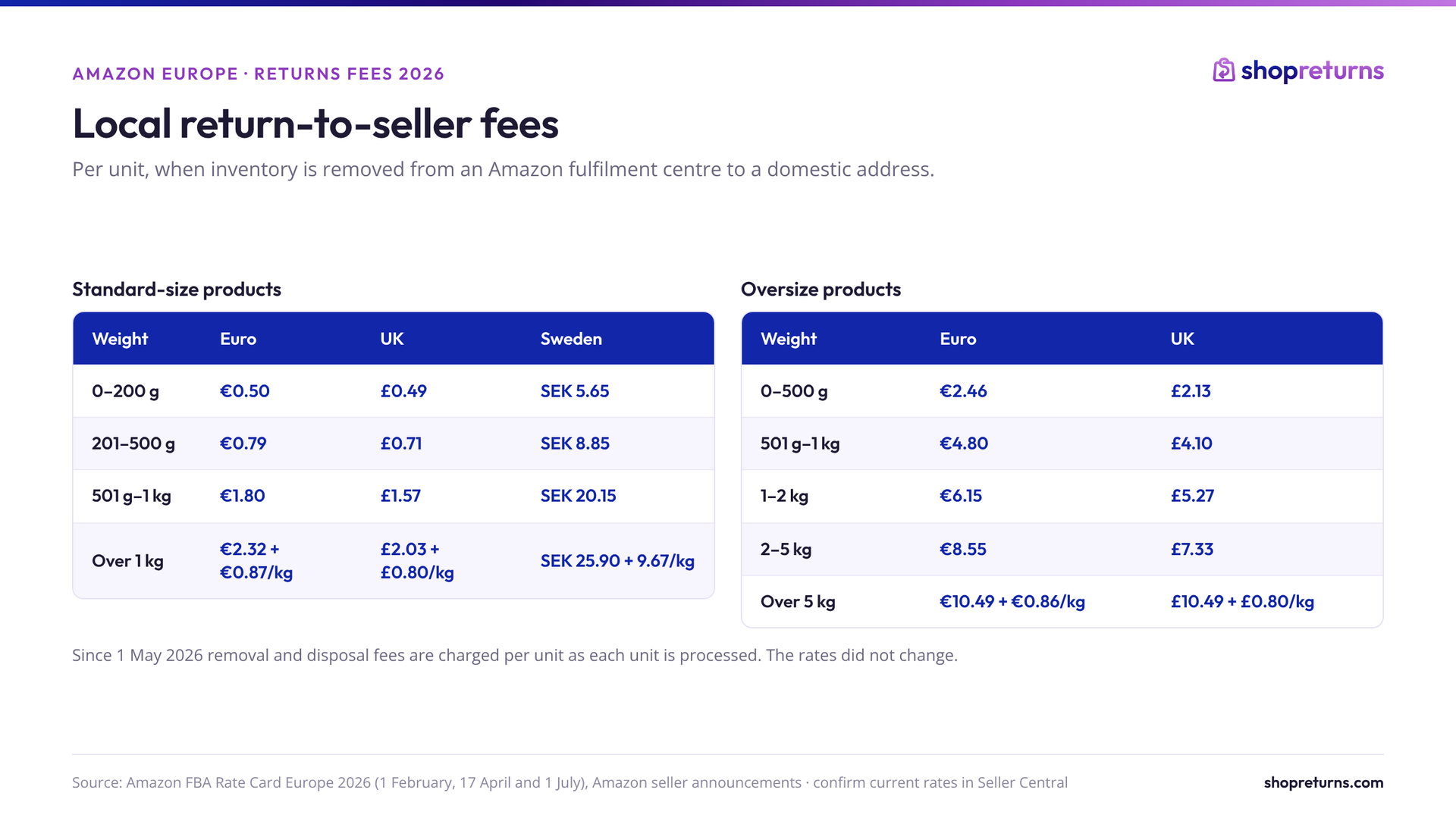
When FBA sellers want inventory shipped out of an Amazon fulfilment centre, Amazon charges a removal fee. These fees depend on the product’s size, weight and whether the shipment is domestic or cross-border.
Cross-border return-to-seller fees
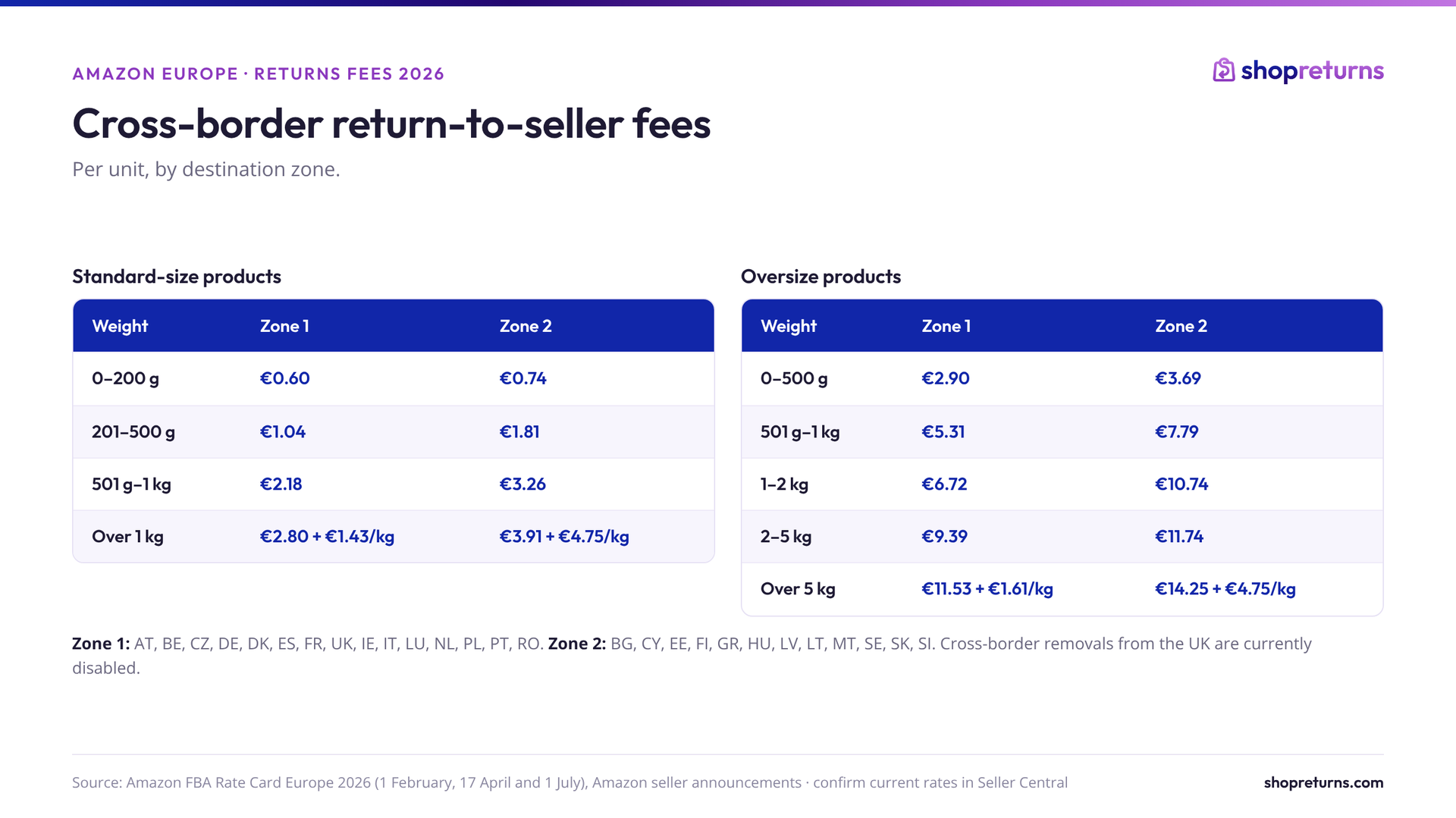
Cross-border removal charges vary depending on the destination zone.
Zone 1 includes Austria, Belgium, the Czech Republic, Germany, Denmark, Spain, France, the UK, Ireland, Italy, Luxembourg, the Netherlands, Poland, Portugal and Romania.
Zone 2 includes Bulgaria, Cyprus, Estonia, Finland, Greece, Hungary, Latvia, Lithuania, Malta, Sweden, Slovakia and Slovenia.
Cross-border removals from the UK are currently disabled under the conditions described in the source rate card. Returns within the Central European programme may qualify for local rates.
Important 2026 change
Since 1 May 2026, Amazon has charged removal and disposal fees per unit as each unit is processed, rather than waiting for the entire removal order to be completed.
The change affects billing timing, not the published fee rates.
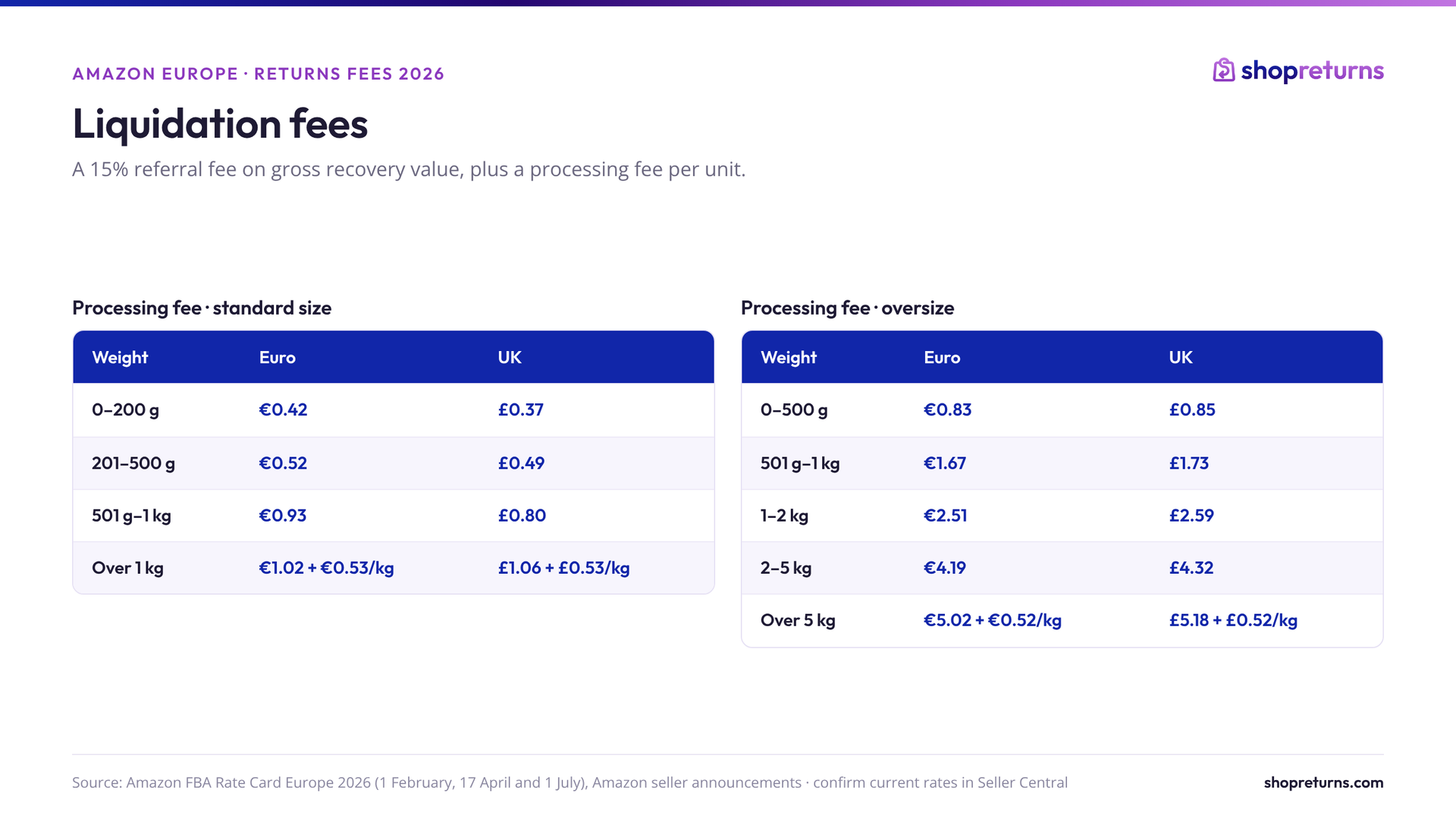
Amazon Disposal and Liquidation Fees
Not every returned product can be resold.
When inventory is damaged, unsuitable for resale or no longer economically viable to store, sellers may consider disposal or liquidation.
Liquidation fees
Amazon’s FBA Liquidations programme applies two types of charges:
- A 15% liquidation referral fee on the gross recovery value.
- A processing fee based on product size and weight.
Which option makes more financial sense?
The lowest processing fee does not automatically mean the best financial outcome.
Before deciding whether to remove, liquidate or dispose of a product, sellers should consider its remaining resale value, condition, storage costs and the expense of recovering the inventory.
For products that can be resold, recovering their value may be more beneficial than disposing of them immediately.
Amazon also offers Grade and Resell in eligible European markets. Availability and programme conditions should be checked for the relevant inventory location.
Amazon Storage and Aged Inventory Fees
Returned inventory can continue generating costs while it remains in Amazon’s fulfilment network.
Monthly storage charges depend on the marketplace, product category, size and season.
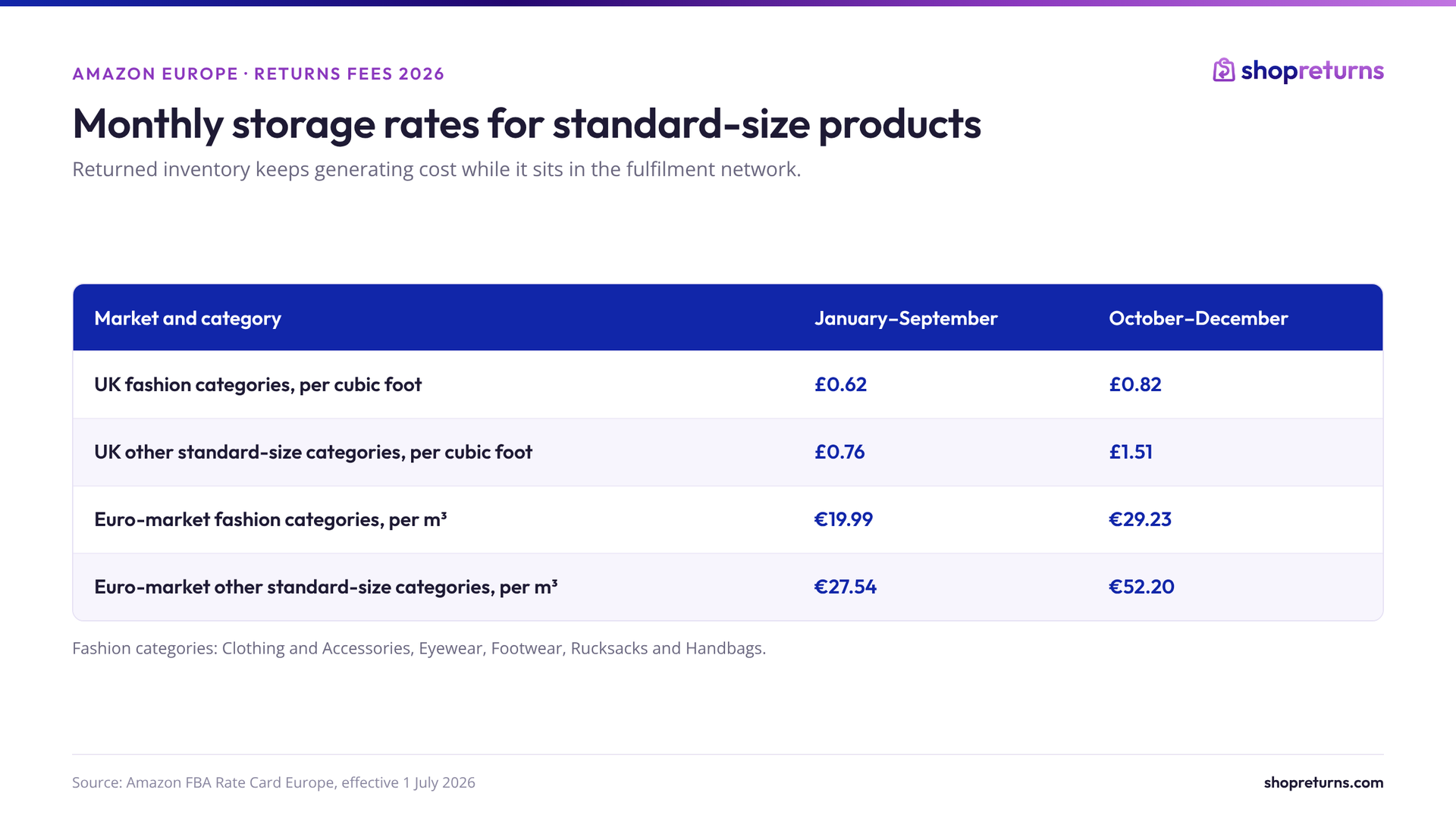
Monthly storage rates
Selected standard-size rates from the July 2026 rate card:
Fashion categories include Clothing and Accessories, Eyewear, Footwear, Rucksacks and Handbags.
Aged inventory surcharges
Additional charges can apply when inventory remains in storage for extended periods.
Selected published euro-denominated rates include:
The 241–270-day band has category exclusions, and the exact applicability of rates varies by marketplace.
Why this matters
A returned product that remains unsold for months can gradually lose profitability through storage and aged inventory charges.
This makes inventory visibility and timely decisions about returned products important parts of returns management.
Amazon FBM Returns: What Sellers Need to Know
Sellers using Fulfilled by Merchant (FBM) are responsible for organising fulfilment themselves.
Their return costs depend on shipping arrangements, the customer’s location and Amazon’s return policies.
Prepaid return labels
Amazon’s prepaid return label programme applies to eligible seller-fulfilled returns in the UK and European marketplaces.
Returns may be automatically authorised, with the seller charged when the carrier scans the return parcel.
Certain product categories and programmes are exempt.
International returns without a local return address
For sellers shipping internationally without a domestic return address, Amazon applies specific requirements.
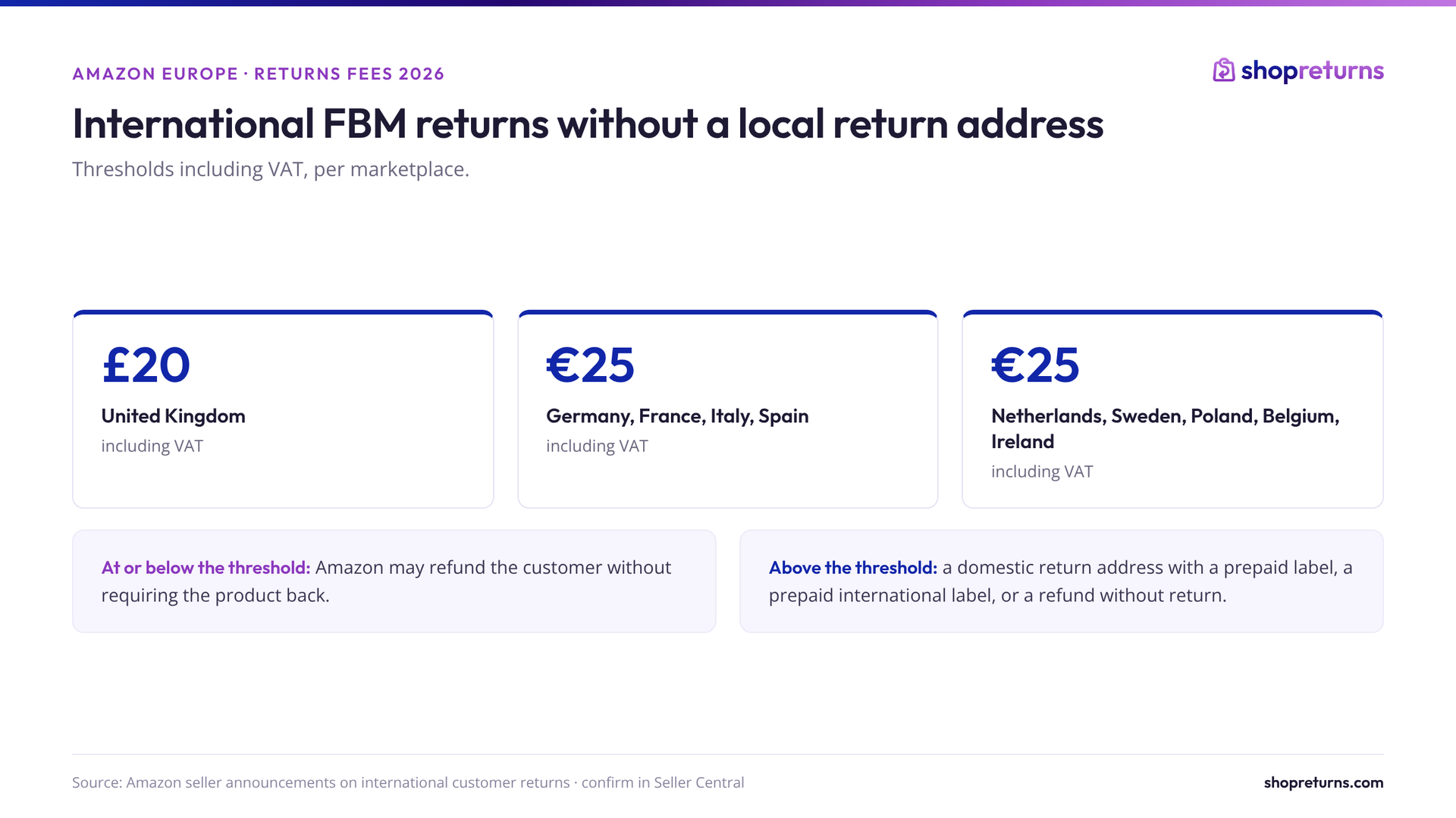
The source guidance identifies the following thresholds:
For qualifying orders at or below the applicable threshold, Amazon may issue a refund without requiring the customer to return the product.
Above the threshold, the seller generally needs to provide an eligible domestic return address with a prepaid label, a prepaid international return label, or a refund without return.
If the seller does not provide a compliant solution within the required period, Amazon may refund the customer and charge the seller.
Example: A UK seller shipping to Germany
A customer in Germany returns a €24 product purchased from a UK-based seller.
If the seller has no eligible German return address, the applicable policy may result in a refund without the product being returned.
The seller loses the sale and does not recover the item.
For businesses selling internationally, this is one reason why local return arrangements can matter.
Additional Changes Affecting Amazon Sellers in 2026
Fuel and logistics surcharge
From 17 April 2026, Amazon introduced a 1.5% fuel and logistics-related surcharge on FBA fulfilment fees across ten European marketplaces.
The surcharge applies to outbound fulfilment fees, not removal, disposal or liquidation fees.
EU customs duty on low-value consignments
The source material describes a temporary €3 customs duty introduced on 1 July 2026 for qualifying low-value consignments entering the EU.
This is a customs charge rather than an Amazon returns fee.
It should therefore be considered separately when calculating cross-border order economics.
The precise application and non-refundable treatment of the duty should be checked against current customs guidance before publication.
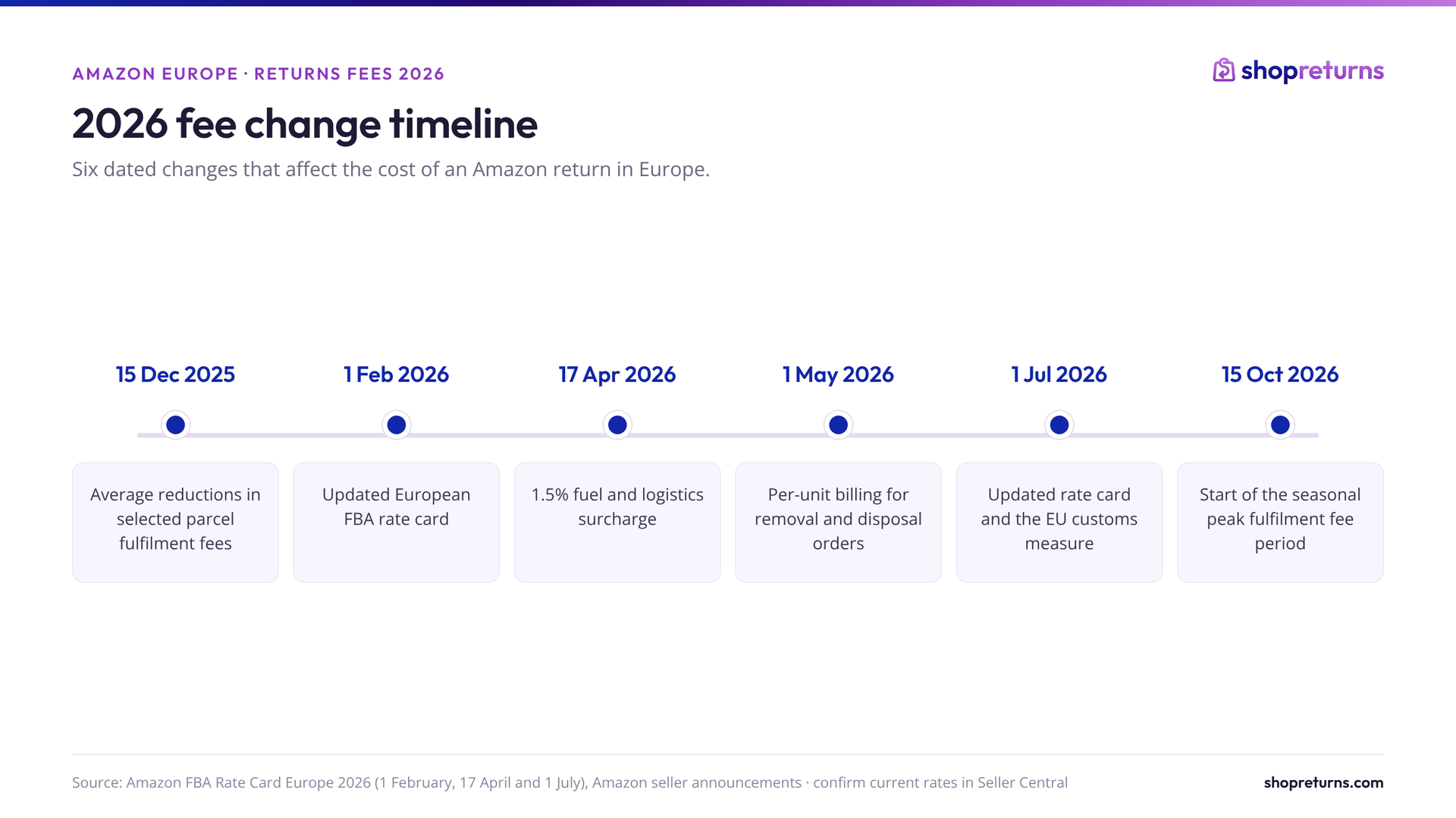
2026 fee change timeline
What Does an FBA Return Actually Cost?
Looking at individual fee tables is useful, but sellers also need to understand how several charges can affect the same order.
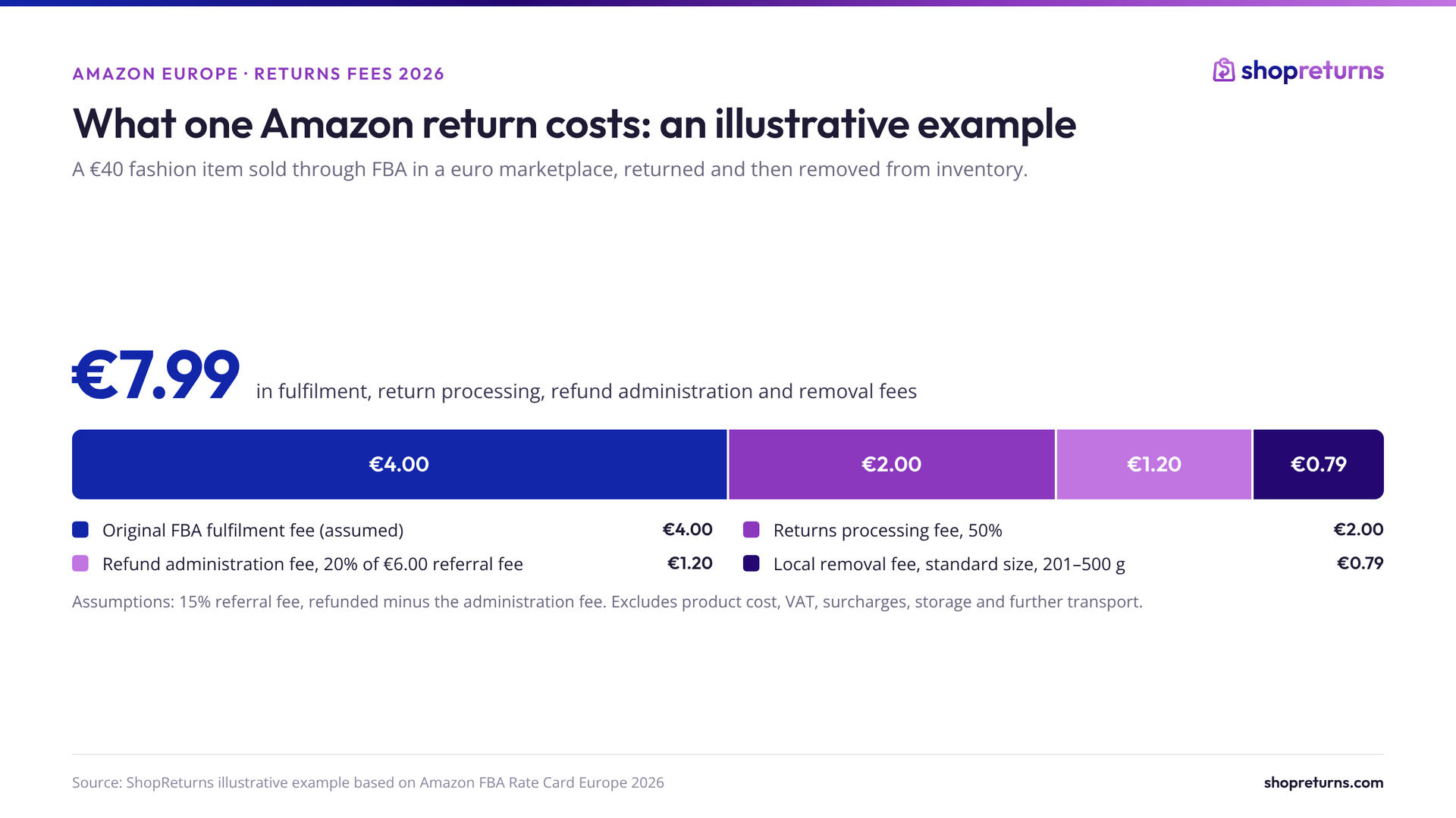
The example below is for FBA only: a fashion product stored and shipped by Amazon in a euro-denominated marketplace. FBM sellers pay different costs, mainly the return label, as described in section 8.
Illustrative FBA scenario
If the customer returns the item and the seller subsequently removes it from FBA inventory, the illustrated charges total:
€7.99 in fulfilment, return processing, refund administration and removal fees.
This example assumes the listed fees apply to the same transaction. It excludes product cost, VAT, applicable surcharges, storage, further transportation and any other expenses.
The €6.00 original referral fee is not counted in full because the example assumes Amazon refunds it minus the €1.20 administration fee.
The product may still have resale value, but recovering that value can involve additional handling or transportation costs.
For a seller processing hundreds of returns, understanding these costs at the product and marketplace level can reveal where margins are being lost.
How to Reduce Amazon Returns Costs
Not every Amazon fee can be avoided. However, sellers can improve the way they manage returned inventory and make more informed decisions about recovery costs. What you can change depends on your fulfilment model.
For both FBA and FBM
Monitor return rates by product. Identify products with unusually high return rates and assess whether product descriptions, sizing information, quality or customer expectations are contributing to returns.
For FBA sellers
Review inventory removal decisions. Compare the cost of continued storage, liquidation, disposal and return-to-seller before deciding what to do with returned inventory.
Recover resale value where possible. Returned products are not always unsellable. Inspection and condition assessment can help you decide which units are worth recovering instead of liquidating or disposing of them.
For FBM sellers
Compare your return label costs. Check what Amazon charges you per return label in Seller Central and compare it with a local label from a carrier in the customer’s country.
Check local return requirements. For international FBM sellers, a local return address helps avoid cross-border return shipping and meets Amazon’s requirements for items above £20 or €25.
Consolidate return transportation. Consolidating returned goods can reduce the need to ship individual parcels internationally. The financial benefit depends on shipment volumes, product characteristics and the cost of the returns solution.
How ShopReturns Helps European Sellers
Managing returns across multiple European markets does not have to mean shipping every returned product individually back to its country of origin.
ShopReturns helps e-commerce brands organise local returns and manage returned inventory across Europe. Our services matter most for FBM sellers, who pay for every return themselves.
Local return labels with the best carrier. Instead of Amazon’s prepaid return label, FBM sellers can give customers a local label with the best carrier in each market. The seller knows the price per return in advance, from the ShopReturns price list, and can compare it with what Amazon charges in Seller Central.
Local return addresses in nine European markets. Customers return domestically instead of sending parcels across borders. For international FBM sellers, this also meets Amazon’s local return requirements.
Local verification. At the ShopReturns hub in Wrocław, returned products are verified within 48 hours through barcode scanning and photo-documented inspection.
Depending on the brand’s instructions and product condition, returned inventory can then be:
- Returned to available stock.
- Prepared for resale.
- Donated.
- Disposed of.
- Consolidated for bulk transportation when economically justified.
Coming soon: Amazon return label integration. We are testing an integration that reads the parcel number from the Amazon return label, checks what is inside, and sends the result to Amazon, which then refunds the customer automatically. No manual work on each return.
The objective is not simply to process a return, but to understand what should happen to the product next.
For FBA inventory, Amazon’s own fees still apply. ShopReturns does not remove fees charged by Amazon for inventory processed within FBA.
FAQ
How much does an Amazon FBA return cost in Europe in 2026?
The cost depends on the product category, size, weight, marketplace and fulfilment programme. Clothing and Shoes returns generally incur a processing fee equal to 50% of the total fulfilment fee. Additional charges may apply.
Does Amazon refund FBA fulfilment fees when a customer returns an item?
The original outbound FBA fulfilment fee is generally not refunded when an order is returned.
What is Amazon’s refund administration fee?
Amazon generally retains the lower of €5.00 or 20% of the applicable referral fee in euro-denominated marketplaces, or £5.00 or 20% in the UK.
How much does it cost to remove inventory from Amazon FBA?
According to the referenced 2026 rate cards, local standard-size removal fees start at €0.50 or £0.49 per unit for products weighing up to 200 g.
Can Amazon sellers avoid international return shipping?
Depending on the fulfilment model and marketplace rules, local return addresses can provide an alternative to shipping individual returned parcels internationally. Sellers must still meet Amazon’s return policy requirements.
What happens to returned products that cannot be resold?
Depending on product condition and programme eligibility, sellers may choose removal, liquidation, disposal or other available recovery options.
Can ShopReturns reduce Amazon FBA fees?
For FBM sellers, yes. ShopReturns provides local return labels with the best carrier in each market, local return addresses in nine European markets and local verification of every returned item, so returns do not have to travel back across borders. For FBA inventory, Amazon’s own fees still apply and are not removed by ShopReturns.
Not sure what your current setup is costing you?
Send us your numbers and we'll run them against the new regime - where the duty is hitting twice, what your return freight actually costs against the goods you recover, and how much of it is avoidable. One working session, and you leave with the figures either way.
Keep reading
More from the knowledge base

Amazon Returns Fees in Europe 2026: Complete Cost Guide for Sellers

Resale vs refurbish vs liquidate: what to do with returned fashion stock