UK Fashion Brands: €3 Duty's Effect on EU Return Rates
03.07.2026 · 7 min read

The new EU customs duty doesn't raise your return rate. It lowers the return rate you can afford, and it lands hardest on exchanges.
British fashion is entering a new phase.
In September, the British Fashion Council will launch Fashion Britain, its biggest initiative in years to build fashion businesses beyond London. At the same time, Make it British is returning to the industry's calendar, Italy has made its largest investment in more than a decade to showcase fashion brands in the UK, and the latest trade figures show British exports approaching £1 trillion, with almost 295,300 UK businesses now selling internationally.
The message is clear: Britain's next generation of fashion brands is expected to grow internationally.
Yet just as overseas expansion becomes a strategic priority, the economics of selling into Europe have quietly changed. Since 1 July, every low-value parcel entering the EU has been subject to new customs rules that increase the cost of serving European customers. For fashion retailers, where returns are part of the business model rather than an exception, the biggest impact isn't the €3 customs duty itself. It's what that €3 reveals about the cost of operating across borders.
What actually changed
The EU removed the €150 de minimis customs duty relief and replaced it with a temporary flat customs duty of €3 per tariff heading on B2C distance sales of imported goods with an intrinsic value of €150 or less. It runs under Council Regulation (EU) 2026/382 until 1 July 2028, when the EU Customs Data Hub is expected to come online and normal tariffs take over.
Four details matter more than the headline number.
It's per classification, not per parcel and not per unit. Three t-shirts under one heading pay €3 once. A dress, a pair of shoes and a belt are three headings and pay €3 each. Grouping items under the highest applicable heading, normally permitted under Article 177 UCC, is explicitly not allowed where the €3 duty applies.
Intrinsic value is the goods alone. Shipping and insurance don't count towards the €150, provided they're itemised separately on the invoice.
The seller pays, not the customer. The duty falls on the business: seller, importer, or their representative. It isn't collected at the door, which means it lands silently in your margin rather than loudly in your support inbox.
Direction is everything. The duty applies to goods entering the EU. A parcel travelling from an EU customer back to your UK warehouse is a UK import, governed by UK rules such as Returned Goods Relief and UK import VAT, not by this duty.
That last point is where most coverage gets it backwards, and getting it backwards leads brands to solve the wrong problem.
The number nobody is quoting
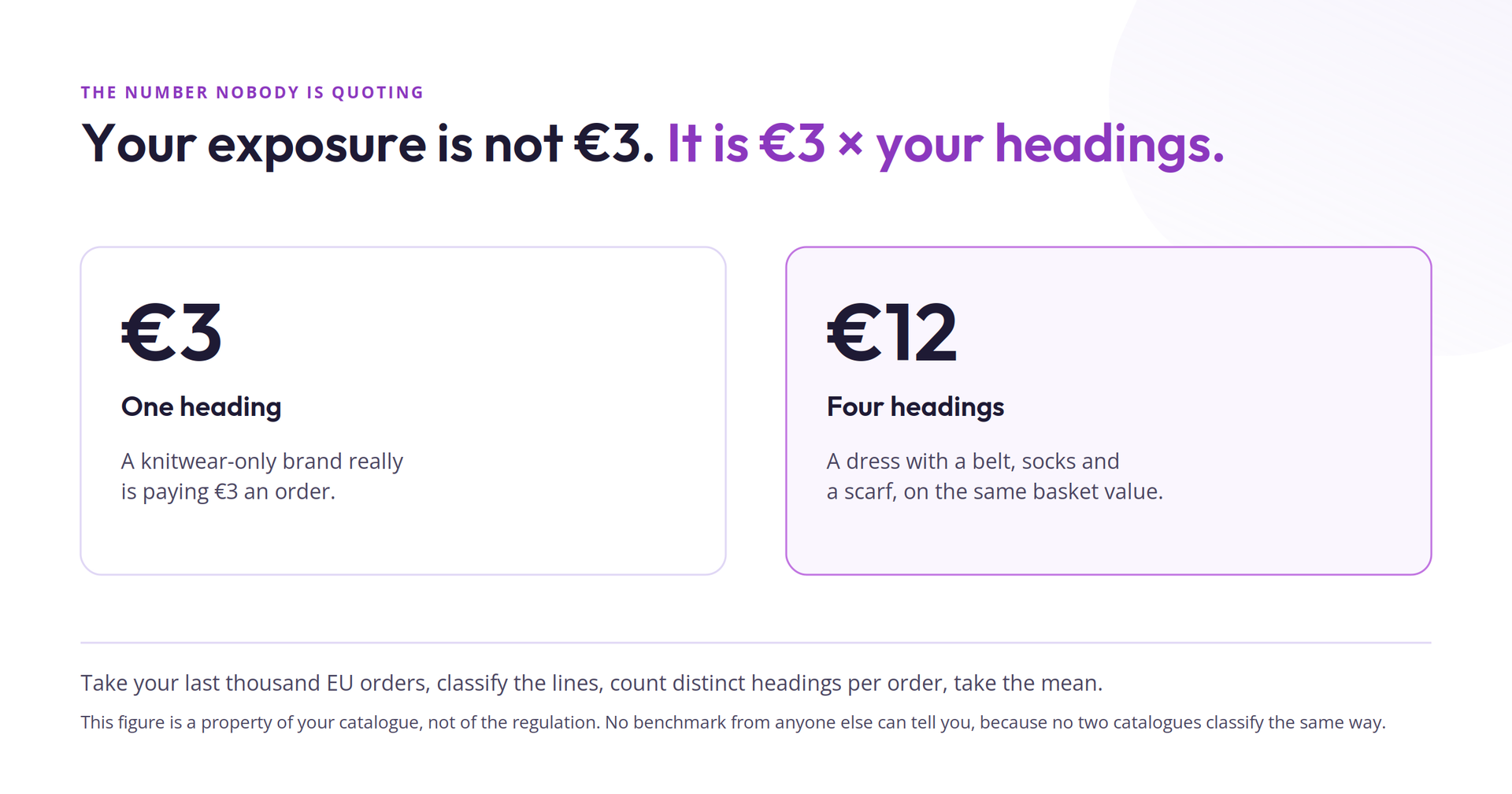
Everyone is writing about €3. Almost nobody is writing about the multiplier.
Your real exposure is €3 × the average number of distinct tariff headings per order, and that figure is a property of your catalogue, not of the regulation. A single-category brand selling only knitwear may genuinely be paying €3 an order. A brand whose customers routinely add a belt, a pair of socks and a scarf to a dress is paying three or four times that on the same basket value.
Pull this number before you do anything else. Take your last thousand EU orders, classify the lines, count distinct headings per order, take the mean. That single figure tells you whether this change is a rounding error or a category-level margin problem, and no benchmark from anyone else can tell you, because no two catalogues classify the same way.
Then follow one order all the way through.
Where the duty actually bites
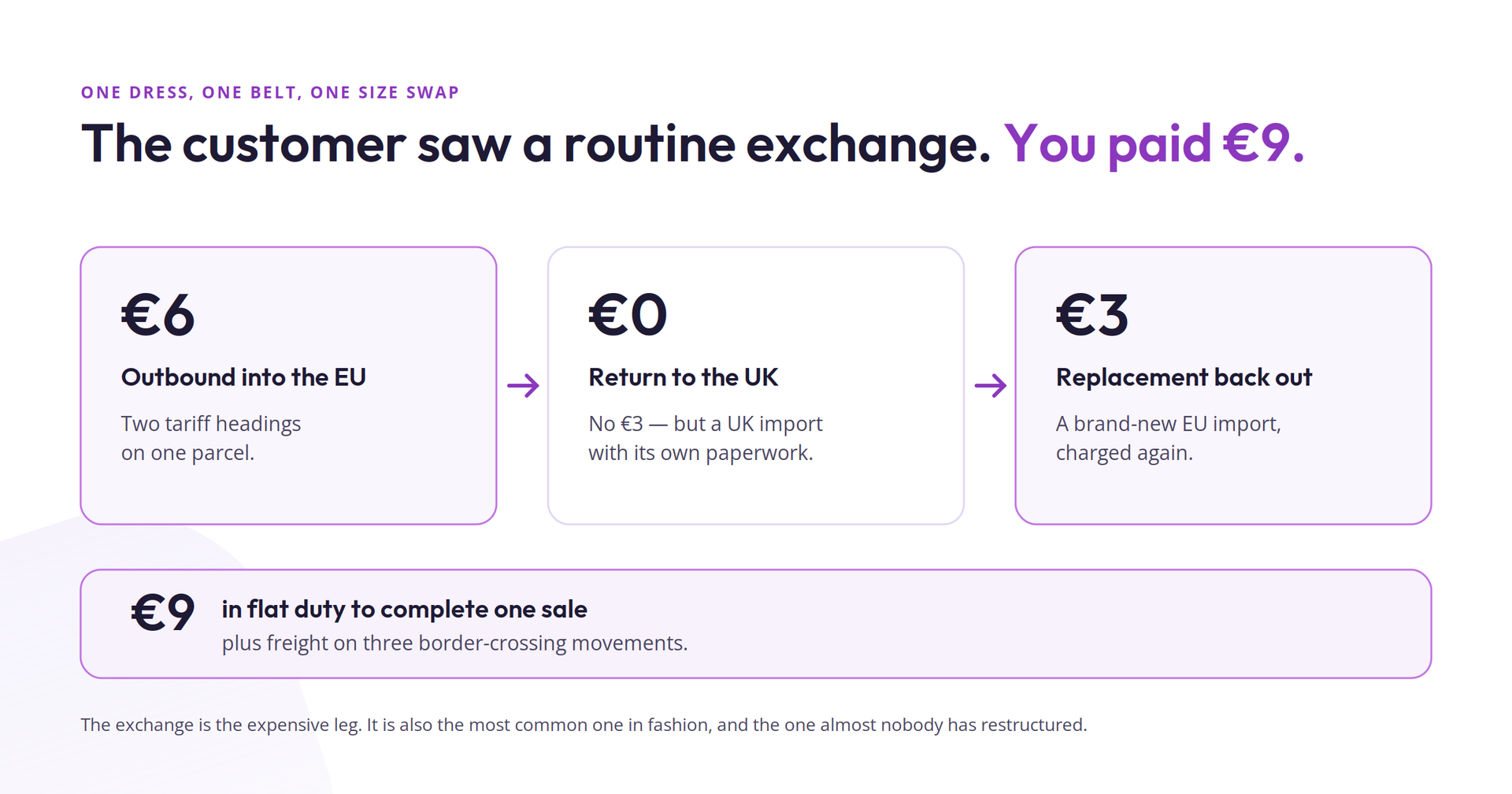
Here is the sequence for a German customer who orders a dress and a belt, keeps the belt, and wants the dress in a different size.
- Outbound order into the EU. Two tariff headings. €6 in duty.
- Return travels to the UK. No €3, because this is a UK import. But it carries reverse-logistics cost, customs paperwork, and potentially UK import VAT and duty unless Returned Goods Relief is correctly claimed.
- Replacement dress ships from the UK back into the EU. A brand-new EU import. €3 again.
You paid €9 in flat duty to complete one sale of one dress and one belt, plus freight on three border-crossing movements. The customer experienced this as a routine size swap.
The exchange is the expensive leg. It is also the most common one, and it's the one almost nobody has restructured.
Why fashion wears this worse than anyone
Two structural features of the category compound the charge.
Fashion baskets are multi-heading by nature. Very few categories routinely put three or four distinct classifications in one parcel. Fashion does it as standard: outerwear, footwear, accessories and hosiery all classify separately. The duty is priced around parcel composition, and fashion has the worst possible composition.
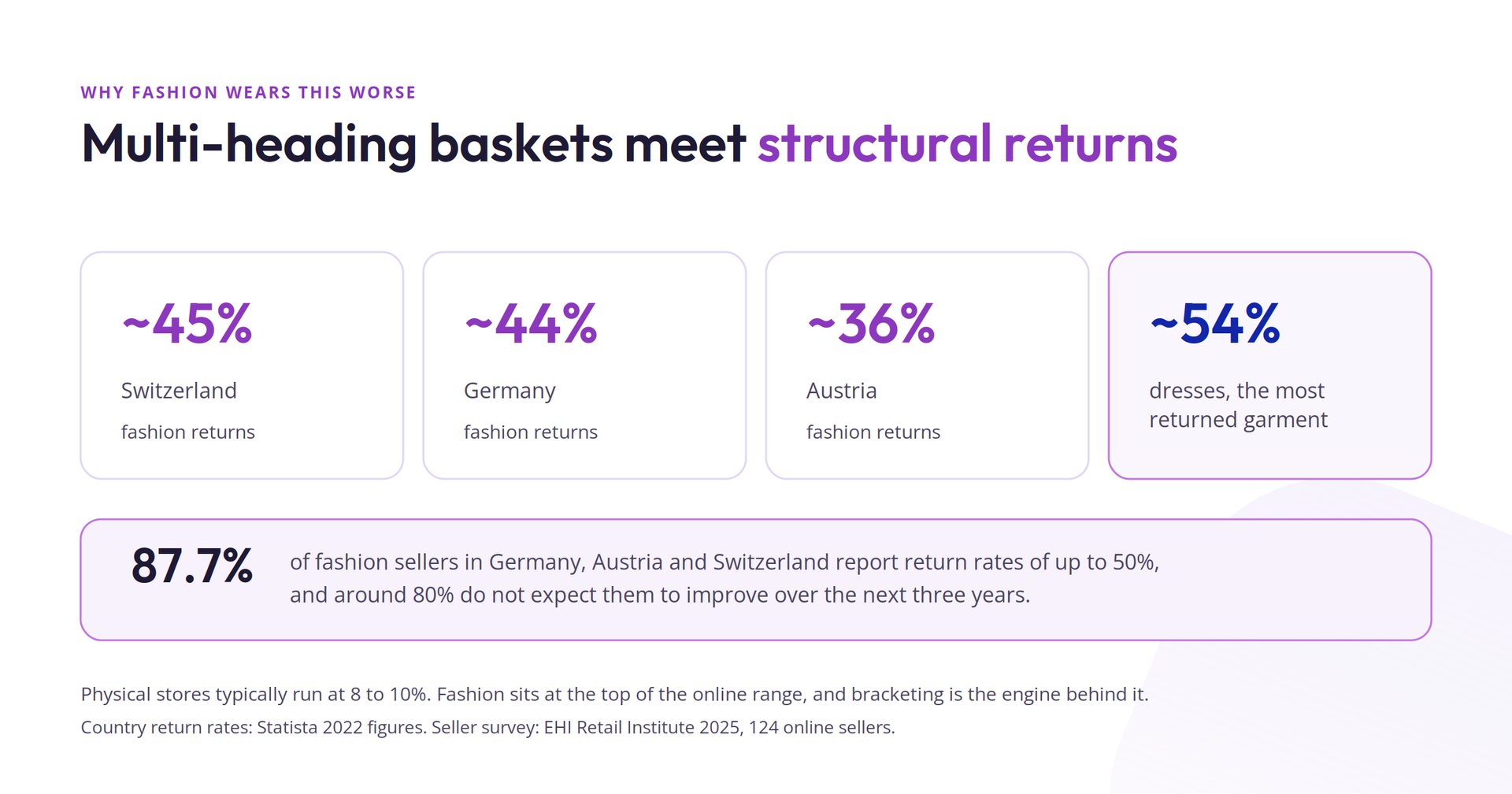
Returns are structural, not exceptional. European online return rates run far above the 8 to 10% typical of physical stores, and fashion sits at the top of the range. Statista's central EU estimate puts apparel around 30%, with the Landmark Global / IPC 2025 Returns Report as high as 46%. Inside fashion the spread widens again: on 2022 Statista figures, Switzerland led European fashion returns at roughly 45%, with Germany near 44% and Austria near 36%, and dresses were the most-returned garment at around 54%, with skirts near 47%.
Germany is the case that breaks models. A 2025 EHI Retail Institute survey of 124 online sellers across Germany, Austria and Switzerland found 87.7% of fashion sellers reporting return rates of up to 50%, and around 80% of sellers in the region did not expect returns to improve over the next three years. At the item level, German online fashion runs above 50% once bracketing is counted.
Bracketing is the engine, and it is deliberate. Somewhere between 58% and 63% of online apparel shoppers admit to ordering multiple sizes intending to return what doesn't fit. Germany's statutory 14-day right of withdrawal, invoice and buy-now-pay-later payment, and free prepaid labels combine into a system that trains the behaviour rather than discouraging it.
And fit is the reason that won't go away. In Coresight Research's 2023 survey of 100 US apparel decision-makers, 53% named size and fit as the top driver of online returns, ahead of colour at 16% and damage at 10%. McKinsey puts the fit-related share closer to 70%. Note the shape of that statistic before you quote it: it's a survey of decision-makers naming a top reason, not an audited share of all returns. The direction is unambiguous even where the precision isn't.
Three places the money leaks
Bracketing meets a per-heading charge. Bracketing inflates outbound volume by design. Every bracketed order pays duty on items the customer never intended to keep, and the duty isn't recovered when they come back.
The season clock, which costs more than the duty. Roughly 48% of returned apparel resells at full price. A garment that leaves Munich, clears UK customs and lands back in sellable stock three weeks later has often missed its window entirely. 2026 modelling puts processing a returned apparel item near $30 — run that on your own ASP rather than the headline.
Returnless refunds on marketplaces. Amazon and Zalando increasingly expect returns handled locally. Without a local EU return address you risk automatic refunds where the money leaves and the garment never comes back - a recurring write-off with no inventory recovered and no evidence to dispute it with.
What it adds up to
None of these three is a customs problem. The €3 duty just put a price tag on all three at once, and charges again on every replacement shipped from outside the Union. The fix is keeping the garment inside the single market: a local return address per market, inspection fast enough to catch the season, exchanges fulfilled from EU stock.
Not sure what your current setup is costing you?
Send us your numbers and we'll run them against the new regime - where the duty hits twice, what return freight costs against the goods you recover, and how much is avoidable.
Keep reading
More from the knowledge base

Are Free Returns Really Driving Growth - or Destroying Your Margins?

The First Black Friday Under the €3 Customs Rules