IOSS vs OSS: Which Covers the €3 Customs Duty?
22.06.2026 · 11 min read

Navigation
- What each scheme is forWhat the import lane costs in 2026And one data requirementWhat that adds up toWhat the intra-EU lane costsThree things sellers still get wrongWhen switching actually paysThe cost most sellers forget: the return legFAQWhat this means in practiceNot sure what your current setup is costing you?
Since 1 July 2026, every parcel imported into the EU carries customs duty. The €150 duty-free allowance is gone, replaced by a flat €3 per item under Council Regulation (EU) 2026/382. That change turns "which VAT scheme should I use?" into a more practical question: how much does each route cost per parcel, and at what volume does it stop making sense?
The short version is this. IOSS is a VAT mechanism, so it does nothing about the €3. That is customs duty, and it is owed by whoever declares the goods, which normally means you. OSS sales ship from stock already inside the EU, so there is no import at parcel level and no €3 at all. The rest of this article is about what that difference costs in practice.
What each scheme is for
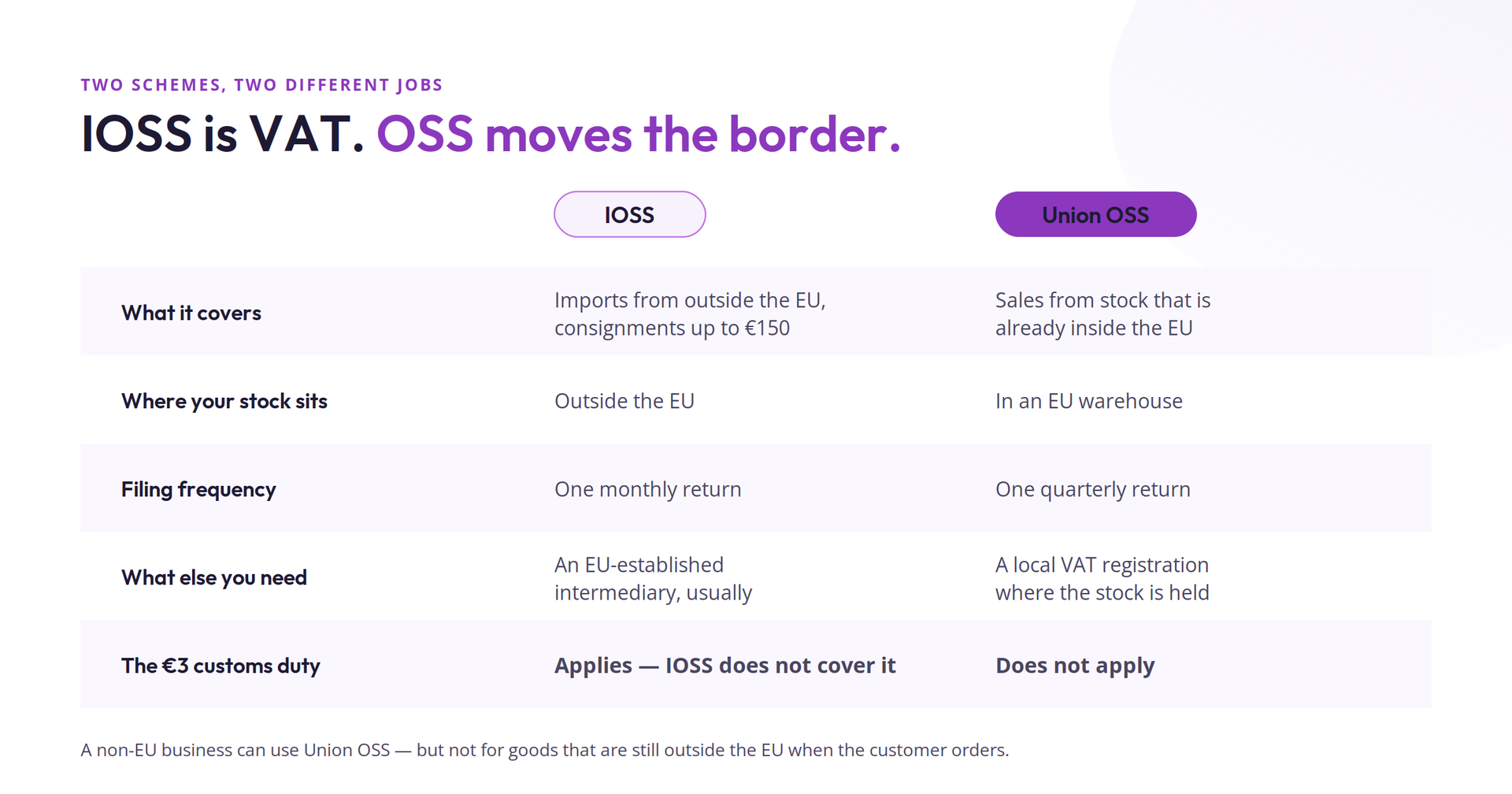
IOSS (Import One-Stop Shop) covers distance sales of goods imported from outside the EU in consignments worth up to €150. You charge VAT at the customer's local rate at checkout and report it in one monthly return, so nothing is collected at the door. Non-EU businesses generally need an EU-established intermediary, who is jointly liable for the VAT.
Union OSS (One-Stop Shop) covers B2C sales of goods that are already inside the EU, typically shipped from your warehouse in one member state to customers in others. You charge the customer's local rate and report it in one quarterly return. No intermediary is needed, but you do need a normal VAT registration in the country where the stock sits.
A non-EU business can use Union OSS. What it cannot do is use OSS for goods that are still outside the EU when the customer orders.
One point worth clearing up, because it causes confusion: monthly filing for IOSS and quarterly filing for OSS are set in the VAT Directive itself, at Article 369s for IOSS and Articles 364 and 369f for the OSS schemes. The return and the payment are due by the end of the following month. Neither frequency is a choice. What does vary is the ordinary domestic VAT return in the country where your stock is held, which may be monthly or quarterly depending on the country and your turnover. That return is separate from OSS and should not be confused with it.
What the import lane costs in 2026
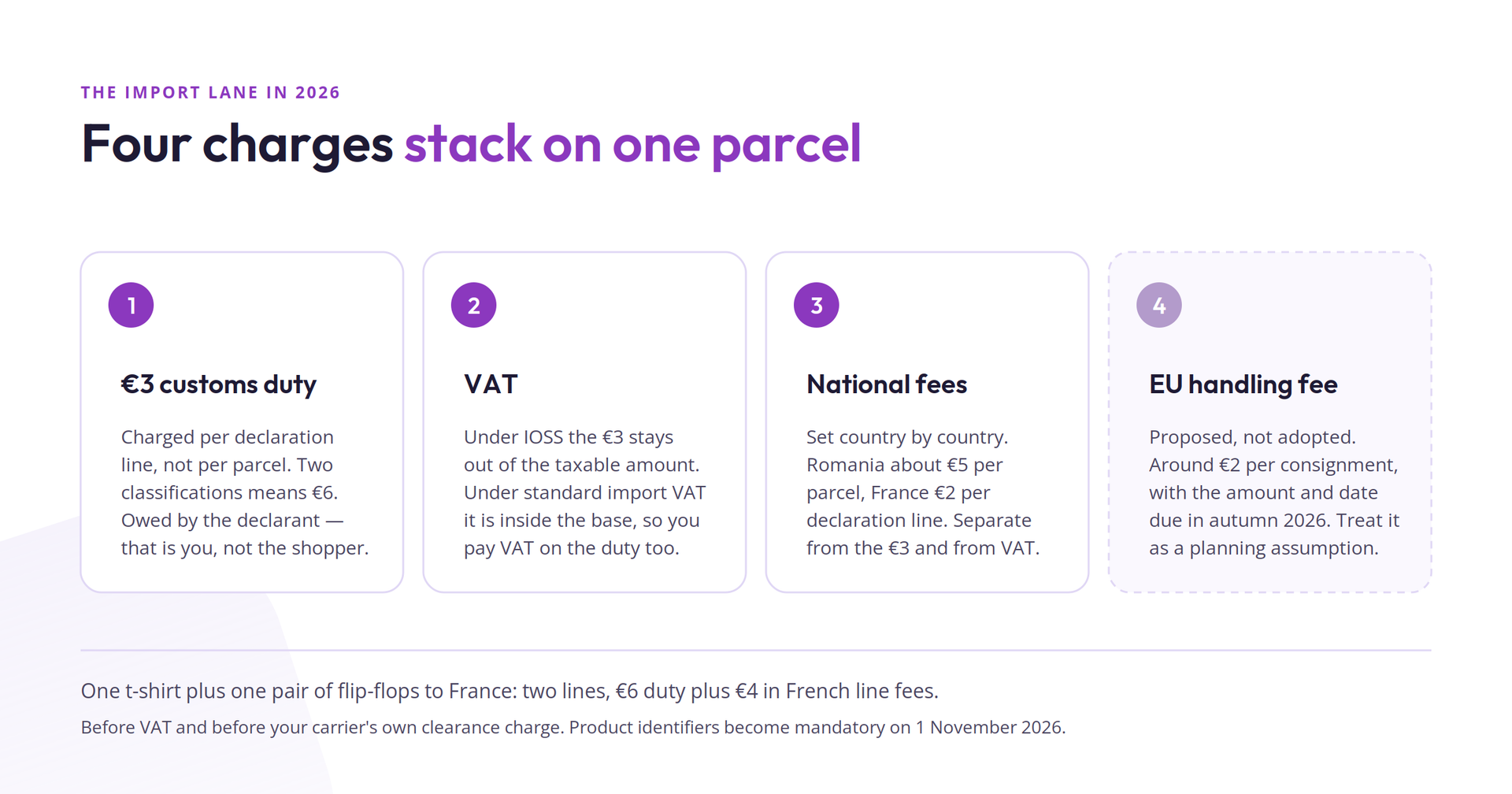
Four charges now sit on a low-value parcel entering the EU, and they stack.
1. The €3 temporary customs duty
The duty is charged per item rather than per parcel, which in practice means per declaration line. Goods share a line only when they share tariff classification, description and, where origin is a required data element, origin. A parcel holding one silk blouse and two wool blouses is two lines, so €6 rather than €3. On an H7 simplified declaration, grouping happens at 6-digit HS level. On a full H1 declaration, classification runs to 10 digits of TARIC, so items that would have grouped on H7 may not group on H1.
The duty applies to B2C distance sales up to €150 whichever VAT route you use, whether that is IOSS, Special Arrangements or standard import VAT. Two carve-outs are worth knowing. B2B consignments to a VAT-registered recipient fall under normal duty rates instead. Goods qualifying under a preferential trade agreement or a customs union arrangement keep that preferential rate, but only where the VAT was not collected through IOSS and the goods are declared on H1. Sell the same FTA-origin goods under IOSS and the €3 applies.
It also matters who pays. The €3 is owed by the declarant, meaning the seller, the importer, the IOSS holder or their indirect representative. It is not a charge collected from the shopper on the doorstep. If you have not priced it in, it comes out of your margin.
2. VAT, and whether VAT applies to the duty
The Commission's June 2026 addendum to the VAT e-commerce explanatory notes settled this question. Under IOSS, VAT is charged at checkout on the sale price and the €3 is not added to the taxable amount, because the duty arises on import rather than at the moment of sale. Under Special Arrangements or standard import VAT, the €3 does form part of the import VAT base, so the customer effectively pays VAT on the duty as well. It is a small advantage for IOSS, but a real one.

3. National handling fees
Several member states moved ahead of Brussels, so the picture differs by country.
Romania has charged 25 RON, roughly €5, on every low-value parcel since 1 January 2026. It is applied by destination, so routing the parcel through another member state does not avoid it. France has charged €2 per customs declaration line since 1 March 2026, which means a mixed parcel pays it more than once. Italy enacted a €2 per-consignment charge in its 2026 budget, but the start date has been postponed more than once, so confirm the current position with your broker before you price it in. The Netherlands and Belgium both put €2 proposals on the table and then held back, waiting to see how the EU-level approach lands.
These charges are separate from the €3 and from VAT, and they stack on top of both.
4. A possible EU-wide handling fee
This one is proposed rather than adopted. The Commission has said the amount and the start date will be determined in autumn 2026, and the figure discussed publicly is around €2 per consignment. Unlike the €3, it would count as payment for a customs service and would therefore sit outside VAT. Treat it as a planning assumption, not a date in your calendar.
And one data requirement
Product identifiers (PIDs) can be supplied voluntarily from 1 July 2026 and become mandatory from 1 November 2026. Three are involved: a merchant identifier such as your SKU, a manufacturer identifier, and a standardised identifier such as a barcode where the product carries one. Your carrier or broker files them, but the data has to come out of your systems. Parcels without valid identifiers risk being held.
What that adds up to
A UK seller ships a parcel to France containing one cotton t-shirt and one pair of flip-flops. That is two tariff lines, so €6 in duty plus €4 in French declaration-line fees. Ten euros on a single parcel, before VAT and before the carrier's own clearance charge. Send the same two items to a customer in Romania and it is €3 plus roughly €5.
Now multiply by your monthly parcel count.
What the intra-EU lane costs
Move the stock into an EU warehouse first and the arithmetic changes shape rather than disappearing.
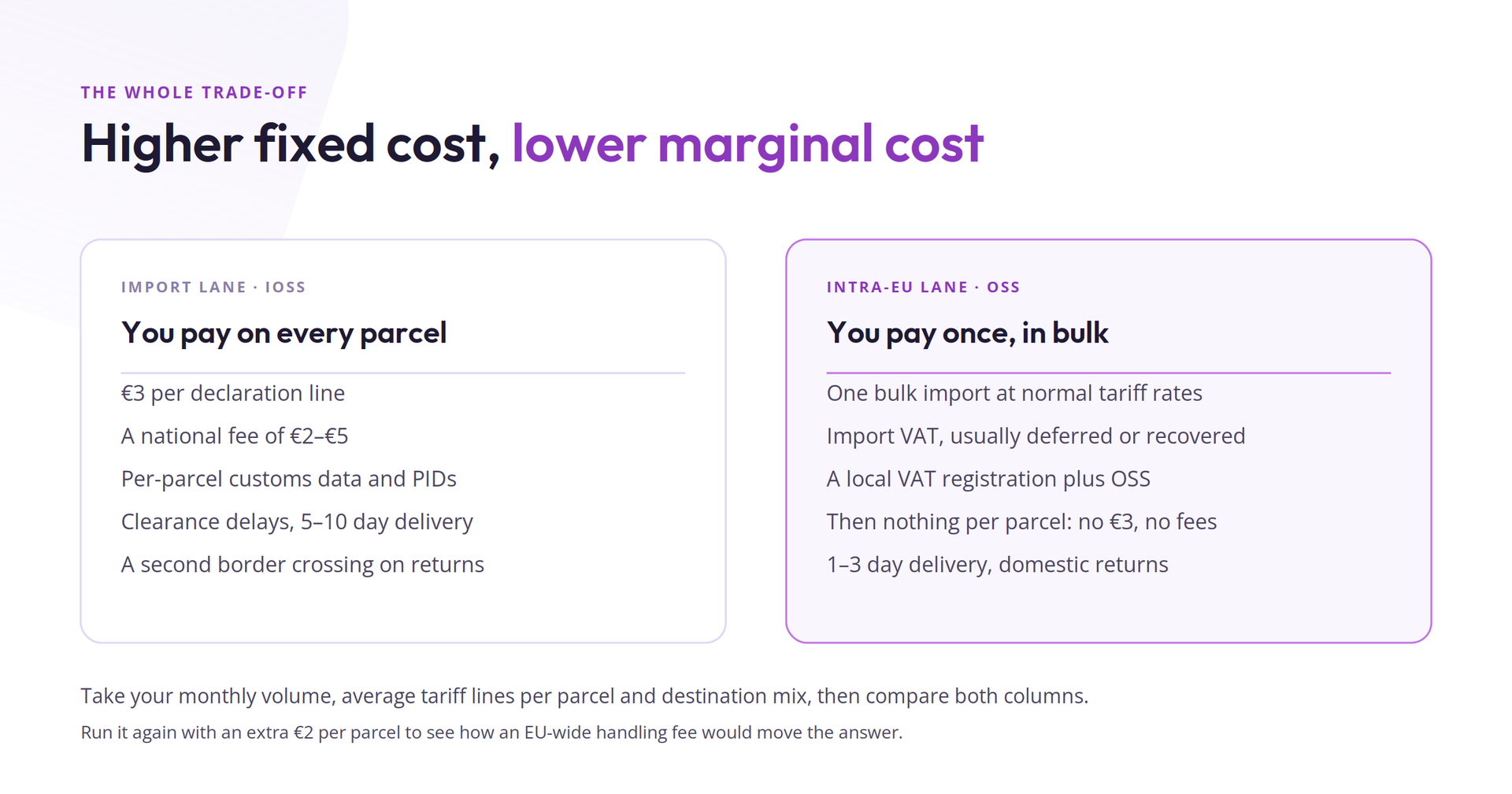
You still import, but once, in bulk, at normal tariff rates on the goods' actual classification, with a full customs declaration. Import VAT is due, though in most cases it is recoverable or can be deferred. In Poland, for example, that runs through the mechanism in Article 33a of the VAT Act. You will need a local VAT registration in the country where the stock is held, alongside the OSS return for the onward sales.
What you no longer carry on any of the resulting parcels is the €3, national handling fees, a future EU handling fee, per-parcel customs data, PIDs and clearance delays. A shipment from Poland to a customer in France is an intra-EU movement, not an import. Delivery drops to one to three days, and returns come back to an address inside the single market.
Higher fixed cost, lower marginal cost. That is the whole trade-off.
Three things sellers still get wrong
"IOSS covers the duty." It covers VAT. The €3 is customs duty, assessed at clearance and owed by the declarant. If your checkout does not price it in and your carrier arrangement does not remit it cleanly, the parcel either stalls or the cost lands on you.
"I will drop IOSS and avoid it." The relief was abolished for everyone. Leaving IOSS means standard import treatment: VAT collected on delivery, carrier handling charges passed to your customer, slower clearance, and VAT charged on top of the €3 rather than not. From 1 October 2026 the Commission is also required to monitor, month by month, whether traffic is being diverted away from IOSS to avoid the duty, and it can propose changes if it finds that happening.
"With OSS I pay nothing at import." You pay once, on the bulk shipment, at normal rates, and on some product lines that duty will be higher than €3 per item. What you buy is the removal of every per-parcel charge afterwards.
When switching actually pays
There is no universal threshold, so treat what follows as a way to build your own model rather than a rule.
Staying on IOSS makes sense while your EU volume is modest and your parcels are simple. If most orders contain a single product type, your exposure is €3 plus whatever the destination country charges, and building EU fulfilment would be premature. Price the duty into checkout, ship DDP, and get your customs data clean before the 1 November PID deadline.
Modelling a move to EU stock makes sense when your parcels contain several different tariff lines, when you compete on delivery speed, or when returns are a normal feature of your category, which is usually the case in fashion and footwear. Mixed baskets are what make the import lane expensive. Every additional tariff line is another €3, and in France another €2 on top.
The calculation itself is simple. Take your monthly parcel volume, your average number of distinct tariff lines per parcel and your destination mix, then multiply out the €3 and the national fees. Compare the result against the cost of holding stock in the EU: warehousing, a local VAT registration and one bulk customs clearance. Then run it again with an extra €2 per parcel to see how an EU handling fee would move the answer, and once more on 2028.
The cost most sellers forget: the return leg
Every EU return that travels back to a UK or other non-EU address crosses the border twice. You handle the re-import admin on the way out, and if you then resell that item to another EU customer it counts as a fresh import, with a fresh €3, a fresh national fee and fresh clearance. Duty refunds on returned goods are possible but administratively fiddly, and the VAT treatment depends on which import route the original sale used.
On a €25 order, a single transatlantic return can wipe out the margin on the sale that preceded it.
This is where a local EU returns address does most of its work. At ShopReturns, returned stock is received, inspected and restocked inside the single market, then goes back out to the next EU buyer as a domestic movement. No second border crossing, no second duty. It works with or without full EU fulfilment, which makes it a practical first step for sellers who are not ready to relocate their whole inventory.
FAQ
Does IOSS cover the €3 duty? No. IOSS is a VAT simplification. The €3 is customs duty, payable when the import declaration is accepted, and it applies to distance sales up to €150 whichever VAT scheme is used.
Who actually pays the €3? The declarant, normally the seller, the importer, the IOSS holder or their indirect representative. It is not collected from the consumer at delivery.
Is it really €3 per parcel? No, it is per declaration line. Items sharing tariff classification, description and origin group onto one line for a single €3. Different classifications mean multiple charges.
Do OSS sales pay it? No. Goods already in the EU are not imported when they are sold, so no customs declaration and no duty arises on those parcels.
Why is the duty called temporary? Because the regulation says so. It runs from 1 July 2026 to 1 July 2028, bridging the gap until the EU Customs Data Hub goes live, after which normal tariff rates apply per product. If the Data Hub slips, the Commission may propose extending the interim arrangement.
Can a non-EU company use OSS? Yes, for intra-EU distance sales from stock held in the EU, though it still needs a standard VAT registration in the country where that stock is stored.
What this means in practice
Both schemes do the same job - they simplify VAT reporting. Neither touches customs. So the setup that keeps your VAT clean leaves the duty untouched: €3 per item line on the way in, again on every replacement shipped from outside the Union, and no automatic recovery when the goods come back.
Which puts the fix outside the VAT question entirely. Stock and returns kept inside the single market never generate the import event in the first place - no duty on the exchange, nothing to reclaim, and your OSS reporting covers the resale to the next EU customer.
Not sure what your current setup is costing you?
Send us your numbers and we'll run them against the new regime - where the duty hits twice, what return freight costs against the goods you recover, and how much is avoidable.
Keep reading
More from the knowledge base

Are Free Returns Really Driving Growth - or Destroying Your Margins?

The First Black Friday Under the €3 Customs Rules