In-House vs Outsourced Returns: Which Model Handles Peak Season Better?
08.11.2026 · 9 min read
Navigation
- How many companies outsource returns todayCost structure of in-house and outsourced returnsWhat happens to returns costs at five times normal volumeWhere each returns model breaks in peak seasonWhen in-house returns are the better choiceWhen outsourcing returns is the better choiceThe hybrid option: outsource returns for peak season onlyQuestions to ask an outsourced returns providerIn-house vs outsourced returns: four peak season scenariosChecklist before you decide between in-house and outsourced returnsHow ShopReturns handles peak season returnsFAQNot sure what your current setup is costing you?
For most of the year, an in-house returns process is easy to manage. A few people, a corner of the warehouse and a returns screen in the warehouse management system are enough. Then peak season arrives, return volumes multiply for several weeks, and the same setup that worked well in October becomes the slowest part of the business.
Before Black Friday, many brands ask the same question: should they scale their own returns operation for peak, or hand part of it to a specialist? This comparison looks at the decision from the capacity side - what each model costs when volumes rise to five times their normal level, and where each one breaks.
In this article:
- How many brands outsource returns today.
- Fixed and variable costs in each model.
- What happens to both models at five times normal volume.
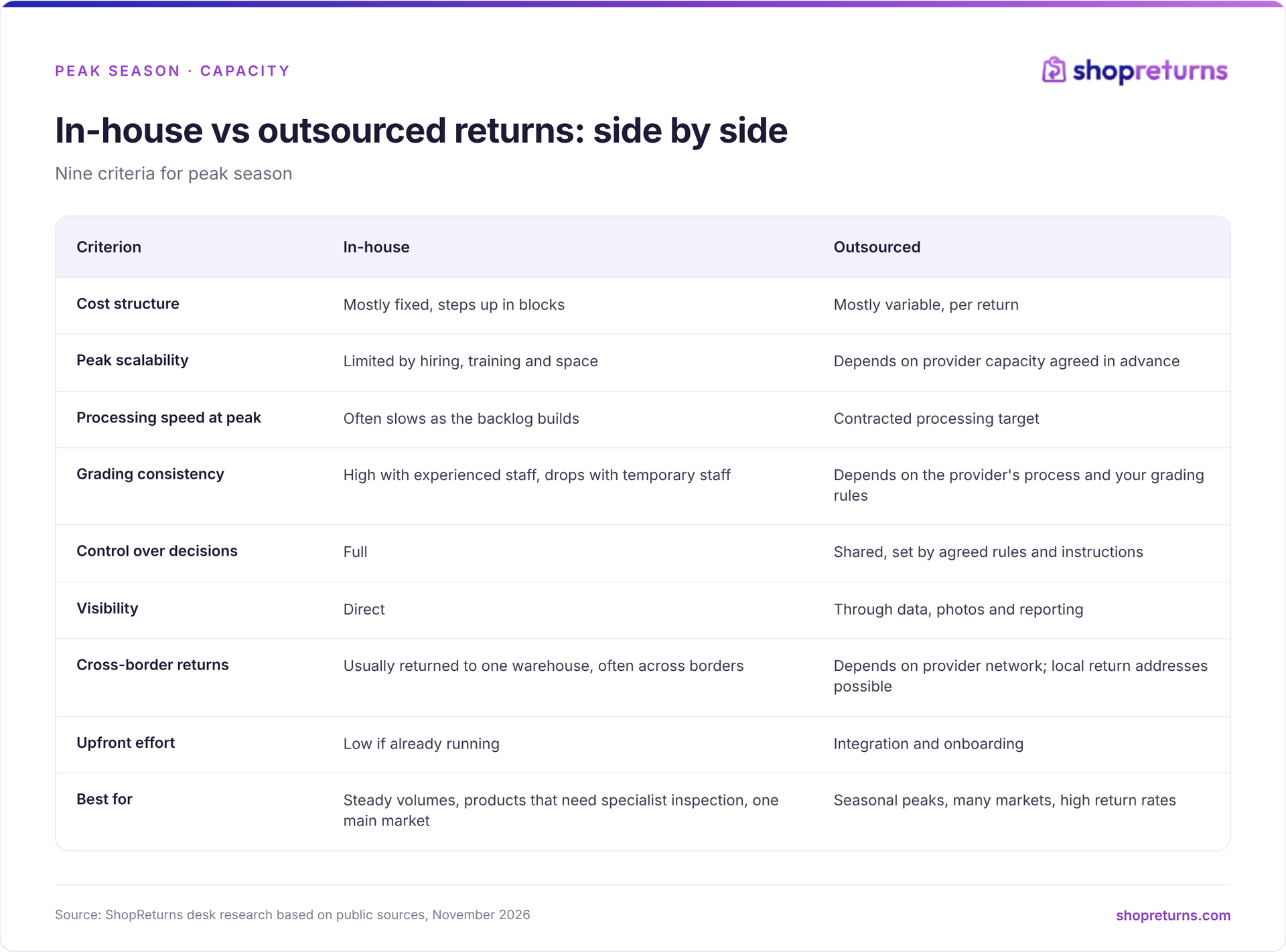
- A side-by-side comparison across nine criteria.
- When in-house is the better choice, and when outsourcing is.
- A hybrid option for peak season only.
How many companies outsource returns today
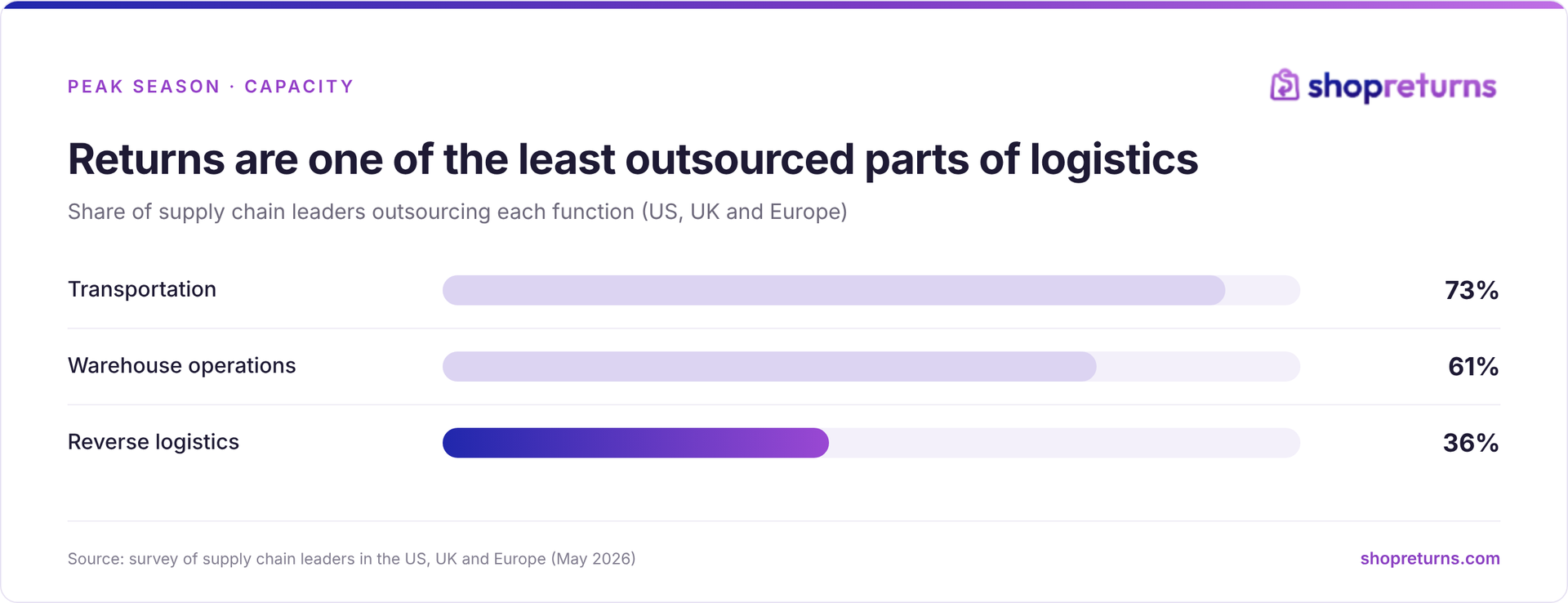
Returns are one of the least outsourced parts of logistics. In a survey of supply chain leaders in the US, UK and Europe published in May 2026, 88% outsourced at least part of their logistics. 73% outsourced transportation and 61% outsourced warehouse operations, but only 36% outsourced reverse logistics, which includes returns.
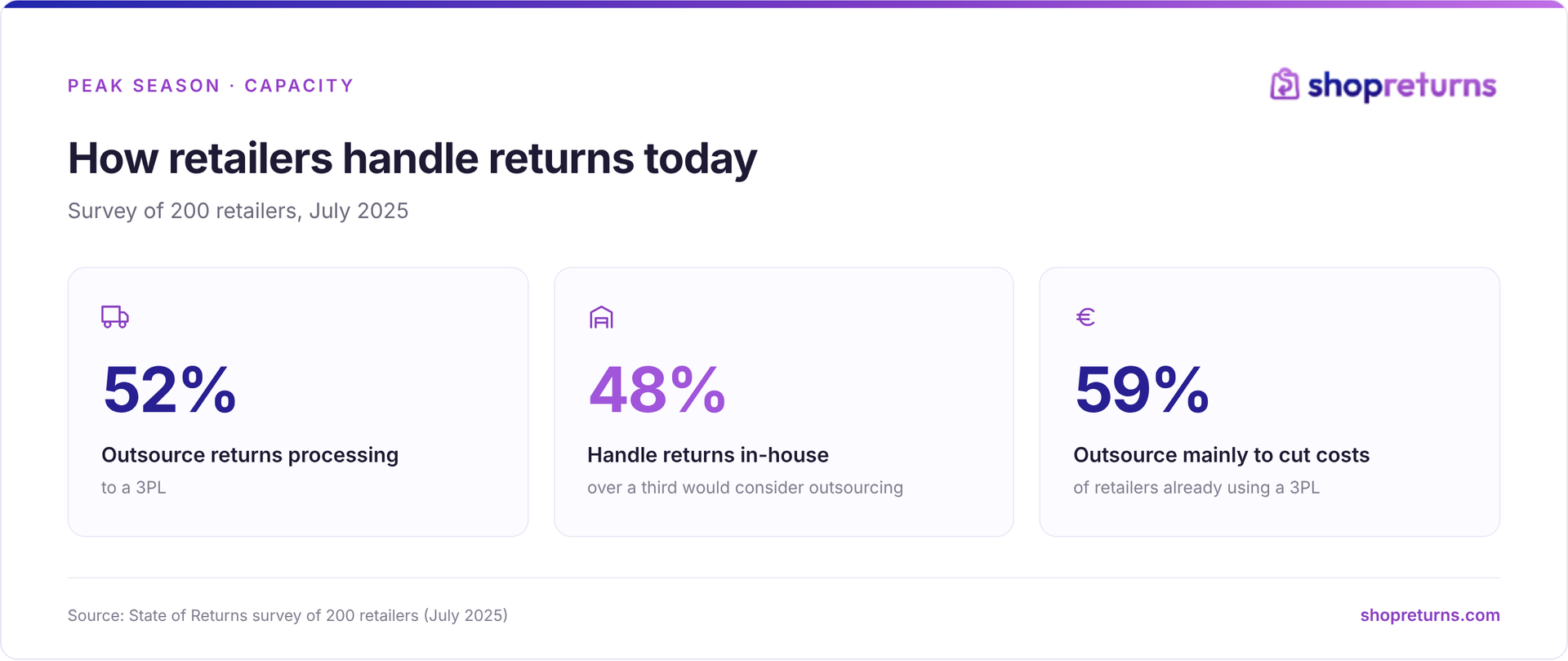
Among retailers, the picture is more evenly split. In a State of Returns survey of 200 retailers from July 2025, 52% outsourced returns processing to a third-party logistics provider (3PL), and 48% handled returns in-house. More than a third of the in-house group said they would consider outsourcing.
In apparel and footwear, 53% of retailers handled returns in-house, and nearly half of them were assessing a move. Among retailers already working with a 3PL, 59% said the main reason was to reduce returns processing costs.
The same report names the peak season problem directly: backlogs, missed processing targets and difficulties finding staff.
Cost structure of in-house and outsourced returns
In-house returns: mostly fixed costs that step up in blocks
An in-house returns operation carries costs that exist whether a parcel arrives or not:
- warehouse space reserved for returns,
- permanent returns staff,
- systems, scanners and photo equipment,
- management time and training.
When volume rises, these costs do not rise smoothly. They jump in blocks: another temporary worker, another shift, overtime, extra space or agency fees. Each block also comes with a delay, because new people have to be recruited and trained, and they work more slowly in their first days.
Outsourced returns: mostly variable costs, priced per return
With an outsourced returns provider, most costs are tied to volume. You usually pay a fee per return or per item processed, sometimes with separate charges for services such as photography, repackaging or consolidated transport. The provider carries the cost of space, staff and systems, and spreads it across many clients.
There is still a fixed element on your side: integration, setting the grading rules and managing the relationship. Contract terms also vary, so check minimum volumes and what is included in the price per return.
What happens to returns costs at five times normal volume
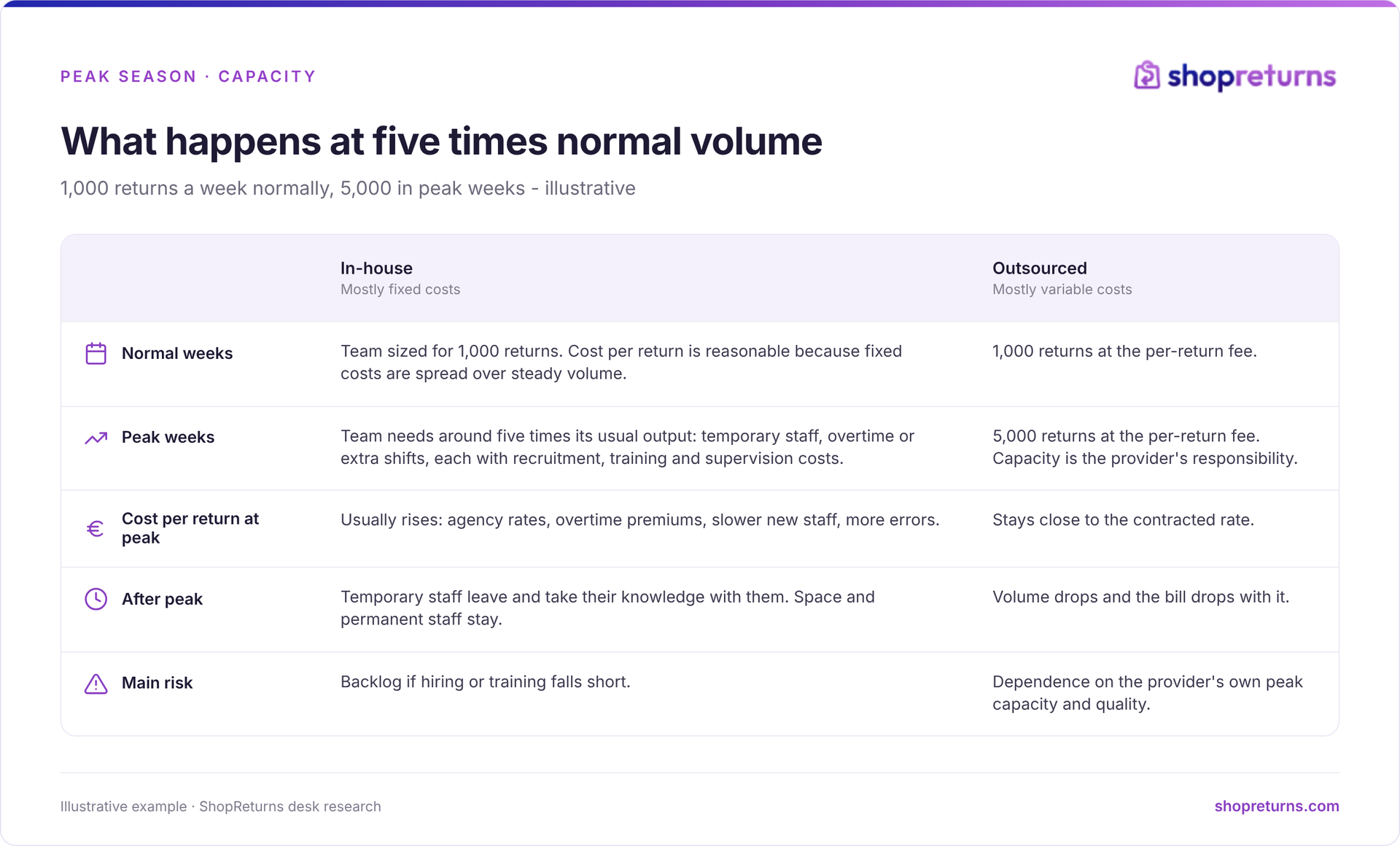
Imagine a brand that processes about 1,000 returns a week outside peak season and expects 5,000 a week in the busiest weeks of December. The comparison below is illustrative and shows how each model reacts to the jump in volume.
The key point is not that one model is always cheaper. In-house costs are designed around normal volume, and peak season breaks that design. Outsourced costs follow the volume curve up and down.
Where each returns model breaks in peak season
In-house returns break on people
Most in-house peak failures are staffing failures. The UK temporary workforce provider The Best Connection reported shortages appearing in October 2025, before peak season had properly started, with returns overlapping outbound fulfilment. When outbound and returns compete for the same people, outbound usually wins, and returns wait.
Outsourced returns break on fit
Outsourcing fails when the provider's process does not match the product. Products that need technical testing, complex refurbishment or brand-specific inspection may need very detailed instructions, or may be better kept in-house.
It also fails when the brand cannot see what is happening. Without photos, grading data and timely status updates, the brand loses the information it needs for refunds and claims.
When in-house returns are the better choice
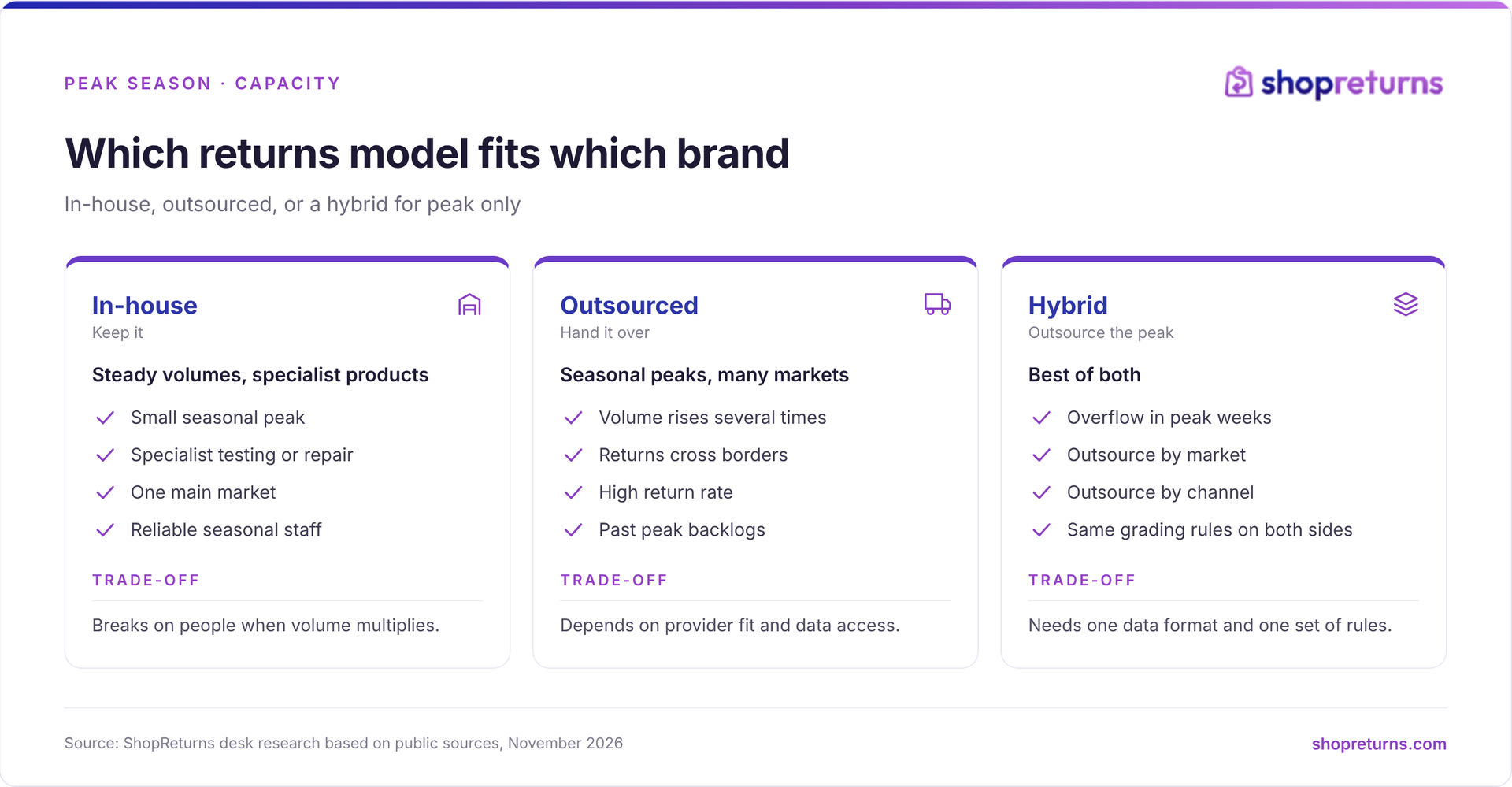
- Your return volumes are steady across the year, with only a small peak.
- Your products need specialist testing or repair that your team already does well.
- You sell mainly in one market, and returns arrive domestically.
- You have reliable access to trained seasonal staff every year.
- Returns are part of a wider in-house operation that already has spare capacity in December.
When outsourcing returns is the better choice
- Your return volumes rise several times during peak season and fall back afterwards.
- You sell into several countries, and returns cross borders to reach you.
- Your return rate is high, as it usually is in fashion and footwear.
- Peak backlogs have already caused late refunds, missed marketplace targets or unsold stock.
- You want to free warehouse space and people for outbound orders during peak season.
The hybrid option: outsource returns for peak season only
Brands do not have to choose one model for the whole year. A common middle path is to combine both, in one of three ways:
- By volume. Keep normal volume in-house and send the overflow to a provider during peak weeks.
- By market. Domestic returns stay in-house, and cross-border returns go to a provider with local return addresses.
- By channel. Marketplace returns with tight deadlines go to the provider, and direct-to-consumer returns stay in-house.
A hybrid setup only works if both sides use the same grading rules and the same data format. Otherwise stock and refund decisions will differ depending on who handled the return.
Questions to ask an outsourced returns provider
- What is your processing target from arrival, and how do you measure it during peak season?
- How much peak capacity is reserved for clients like us?
- How do you grade items, and can you apply our grading rules?
- Do you photograph every item, and how do we access the photos?
- How do you handle marketplace confirmations and claims?
- Where are your return addresses, and how are parcels consolidated?
- Which carriers do you work with, and does every return have tracking?
- What happens to items that cannot be resold as new?
- For UK brands: who handles customs on returns between the EU and the UK?
- What is included in the price per return, and what is charged separately?
In-house vs outsourced returns: four peak season scenarios
The October team. A brand's three-person returns team handles October easily. In the second week of December, volume is five times higher. Two temporary workers join on 8 December, need a week to reach full speed, and the backlog grows to three weeks before Christmas.
The overtime bill. An in-house team clears peak season through weekend overtime. The work gets done, but the cost per return in December is far above the October level, and nobody had budgeted for it.
The hybrid that worked. A brand keeps domestic returns in-house and moves cross-border returns to a provider with local return addresses. Its own team handles a manageable peak, and foreign customers return their parcels to an address in their own country.
The provider without photos. A brand outsources returns to a provider that sends only a grade code. When a marketplace asks for evidence on a worn item, the brand has nothing to send.
Checklist before you decide between in-house and outsourced returns
- What is your normal weekly return volume, and what is your peak week?
- How many weeks does peak season last, including the January wave?
- What was your in-house cost per return in December last year, including overtime and temporary staff?
- How many returns cross a border to reach you?
- Which marketplace deadlines apply to you, and did you meet them last peak season?
- Which products need specialist inspection?
- Could part of the volume - one market or one channel - be outsourced for peak season only?
How ShopReturns handles peak season returns
ShopReturns is built for the part of returns that breaks in peak season: high volumes, many markets and tight deadlines.
Local return addresses. ShopReturns provides local return addresses in nine European markets, so customers return their parcels domestically, and the parcels are consolidated before they travel to the hub.
Verification within 48 hours. Returned products are verified at our Wrocław hub within 48 hours, using barcode scanning and photo-documented inspections, so you see the condition of every item.
Carriers and tracking. ShopReturns works with carriers used for marketplace return handling, including DHL, Hermes, Evri and Royal Mail. Every return gets a tracking number, and for Zalando there is a direct integration with dedicated return labels.
Customs handled for UK brands. For brands based in the UK, ShopReturns handles the customs formalities for returns moving between the EU and the UK.
What happens next. Depending on your instructions, returned products can be put back into stock, resold, donated or disposed of.
FAQ
Is it cheaper to outsource returns?
It depends on how your volume changes during the year. In-house costs are mostly fixed and suit steady volumes. Outsourced costs are mostly charged per return and follow volume up and down, which usually suits brands with strong seasonal peaks. Compare your real December cost per return, including temporary staff and overtime, with a provider's price per return.
How many companies outsource returns?
Surveys give different numbers. In a 2026 survey of supply chain leaders, 36% outsourced reverse logistics. In a 2025 survey of 200 retailers, 52% outsourced returns processing to a 3PL.
Can I outsource returns only for peak season?
Often, yes. A hybrid setup is common: in-house for normal volume, and a provider for the overflow, for one market or for one channel. Agree on grading rules and data formats so both sides make the same decisions.
Will I lose control of returned stock if I outsource?
You keep control through rules and data: grading criteria, instructions for each grade, and photos and status updates for every item. Without those, you lose visibility.
What should I ask a returns provider before peak season?
Ask about their processing target and how it is measured, the peak capacity reserved for you, their grading and photo process, how they handle marketplace returns, their return address network, the carriers they use and what the price per return includes.
Not sure what your current setup is costing you?
Send us your numbers and we'll run them against the new regime - where the duty is hitting twice, what your return freight actually costs against the goods you recover, and how much of it is avoidable. One working session, and you leave with the figures either way.
Keep reading
More from the knowledge base
How EU Brands Should Handle UK Returns: The Complete 2027 Playbook
Returns Processing SLA: What 24-Hour, 48-Hour and 5-Day Targets Really Cost