Amazon FBA Returns: €3 EU Customs Duty Impact
29.06.2026 · 17 min read

Navigation
- Does the €3 duty make FBA more profitable?Why sellers get the impact wrongWhich Amazon model takes the biggest hit?Do FBA and your own EU warehouse solve the same problem?The data requirement most sellers haven't noticed yetWhen FBA fits, and when EU fulfilment fitsWhy returns may matter more than the duty itselfThe most expensive product is the one you can't sell againDoes an EU warehouse mean giving up FBA?FAQSummaryNot sure what your current setup is costing you?
If you sell on Amazon and your stock comes from outside the European Union, the €3 customs duty that took effect on 1 July does not automatically mean you should move everything into FBA. What it does mean is that how you import into the EU, and how you handle returns, now affects your profitability more than the gap between FBA fees and a third-party fulfilment rate card.
Our previous article covered how the duty works and how to calculate its effect on margin. This one is for Amazon sellers specifically, and answers the question most of them are asking a month into the new regime: FBA or your own EU warehouse, and where do returns fit in?

Does the €3 duty make FBA more profitable?
No. The duty doesn't crown a winner between FBA and your own EU warehouse. What it does is make one particular model harder to sustain: the one where every single parcel travels to the customer directly from outside the EU.
That distinction matters, because plenty of commentary since June has argued that moving everything into FBA is now the only sensible option. It isn't. The rules didn't pick a model. They changed how the arithmetic works.
Until this summer, most Amazon sellers compared four numbers: FBA fees, storage, shipping and marketplace commission.Since 1 July, several more belong in that calculation:
- How products enter the EU, and in what size of consignment
- How often stock is replenished
- Which declaration type your goods are cleared under, because that alone changes the number of charges
- How returns are handled, and whether a returned product can be resold
- The cost of customs formalities on every direct-to-customer shipment from outside the EU
This is why comparing Amazon's fee schedule against a fulfilment provider's rate card no longer answers the question. If you sell low-margin products, some ASINs may simply stop working once the duty is priced in, and that's worth checking before peak season rather than after it.
It's also worth remembering what FBA actually covers: storage, picking, packing, shipping and basic returns handling. It doesn't remove the cost of importing goods into the EU, and it doesn't decide how your supply chain is shaped or how much value you recover from returns.
The models winning right now are the ones that reduce the number of customs operations, get returned products back on sale faster, and run one pool of inventory across several sales channels.

Why sellers get the impact wrong
The most common mistake is looking at the size of the charge instead of the shape of the logistics model.
The second most common is assuming €3 means €3 a parcel. It doesn't. The duty is charged per item, and an item means goods sharing the same tariff classification, description and, where it is declared, origin. In practice the charge lands per line on the customs declaration, whatever the number of units on that line. Grouping items together to get a single charge is specifically not allowed where the €3 duty applies.
It's worth knowing where that assumption came from, because it wasn't invented by sellers. When EU finance ministers agreed the duty in December, a Council source briefed Reuters that it would apply per product type based on six-digit tariff codes - ten pairs of identical socks carrying one €3 charge, five wool pairs and five cotton pairs counting as two item types and carrying €6. That example ran everywhere, and most sellers budgeted against it.
It's accurate, as far as it goes. Six digits is the H7 and H6 world, and that covers a lot of Amazon inbound. It just isn't the whole picture.
Here is the part almost nobody has priced in: the same parcel can generate a different number of charges depending on which declaration is used.
- H7 requires a 6-digit HS classification
- H6 requires a 6-digit CN classification
- H1 requires a full 10-digit TARIC classification
The Commission's own worked example makes the point. A consignment worth €140 containing three women's suits - one in artificial fibre, one in wool, one other - is a single line in H7 or H6, so €3. The same consignment in H1 splits across three TARIC codes, so €9.
H1 becomes mandatory for goods subject to prohibitions and restrictions, for goods subject to excise duty, and where you want to claim a preferential rate. So the sellers most likely to be pushed into H1 are often the ones carrying the most mixed baskets.
On a €6 item, a single charge is a 50% cost increase. On a mixed parcel cleared in H1, the multiplier is real and it compounds.
Take two sellers importing the same product from China and selling it on Amazon.de. The first brings in one larger consignment a month. The second replenishes weekly. Sales are identical. What differs is the number of customs clearances, the administrative overhead, the inventory planning and the delivery frequency. From the customer's side nothing changes. From a cost side, the two models are not close.
Two dates to put in your planning calendar, both confirmed:
- 1 November 2026 - product identifiers become mandatory on declarations for distance sales (see below). Voluntary from 1 July 2026, with no penalties during the voluntary period.
- 1 October 2026 - the Commission must assess whether trade flows have been diverted and may propose extending the €3 duty to all goods in consignments up to €150, not just the categories currently caught.
The duty itself runs until 1 July 2028, after which normal tariff rates apply. There is also a review due by 1 December 2027 on whether the EU Customs Data Hub will be operational by that date; if it isn't, the transitional duty may be extended.
Which Amazon model takes the biggest hit?
Sellers shipping orders directly from outside the EU, rather than dispatching stock already held inside it. If your inventory is already in the EU, the picture is completely different, because that stock isn't charged again when it later ships to the customer.
Most cross-border Amazon sellers run one of three models.
Model 1: Direct shipping from outside the EU
Used mostly by sellers who source in China, hold no EU warehouse, and ship every parcel straight to the customer.
Until this summer the model minimised storage cost and tied up little capital. Since 1 July, every order is its own import procedure, with its own charge attached. Profitability falls accordingly, and it falls hardest on low-priced items where €3 is a meaningful share of the price.
Two operational details that catch sellers out:
Where you clear matters. If you use IOSS, the declaration can be lodged in any Member State. If you don't use IOSS, it must be lodged in the Member State where the transport ends - so a single central clearance point stops being an option.
Who is on the declaration matters. There is a fixed hierarchy: the IOSS holder or their indirect representative comes first; the Special Arrangements user or their indirectrepresentative second; the indirect representative of the importer third; and only as a residual last resort the consumer, and only in the few Member States offering a free web-based declaration. Whoever is named as declarant is the debtor for the duty.
High return rates make the model worse. A return travelling back out of the EU, or one stranded because there's no local return address, is often a product you never sell again. And on the €3 itself: you can no longer have the import declaration invalidated simply because the customer returned the goods. That route was closed for distance-sale consignments up to €150 with effect from 1 July. The Commission's guidance is explicit that the €3 cannot be recovered through that facilitation, while noting that the general customs repayment and remission rules under Article 116 of the Union Customs Code still exist. Those general rules are narrow, they are built around defective or non-conforming goods rather than ordinary change-of-mind returns, and they carry conditions - including taking the goods back out of the EU — that rarely fit an e-commerce returns flow. Treat the €3 as a sunk cost when planning, not as something to chase.
Model 2: Amazon FBA
Stock travels to an Amazon warehouse in the EU first, and customer orders ship domestically from there. Amazon takes over storage, picking, packing, shipping and basic returns handling.
For qualifying imports where Amazon acts as deemed supplier, the platform sits in the customs and VAT chain rather than you. How the €3 surfaces on your fee statements in practice has been slower to clarify than most sellers would like. Check your current position in Seller Central rather than assuming, and watch your settlement periods.
Note also that bulk imports into an EU FBA warehouse still clear customs under normal tariff rules. They avoid the €3 per-line arithmetic, not duty altogether.
One correction to advice circulating since June: for genuinely UK-origin goods, a preferential rate under the UK–EU Trade and Cooperation Agreement can mean 0%, but claiming it requires an H1 declaration and means you cannot have collected the VAT through IOSS. Preference and IOSS don't combine here. It depends on origin and on how you declare, not on where the warehouse is.
FBA doesn't solve everything. Returns follow Amazon's procedures, pulling stock back out means Removal Orders, and whether a returned product goes back on sale, and how fast, is largely out of your hands.
Model 3: Your own warehouse or fulfilment partner in the EU
Import a larger batch into an EU warehouse, then fulfil locally. Later shipments to customers are domestic, so the €3 doesn't apply to them.
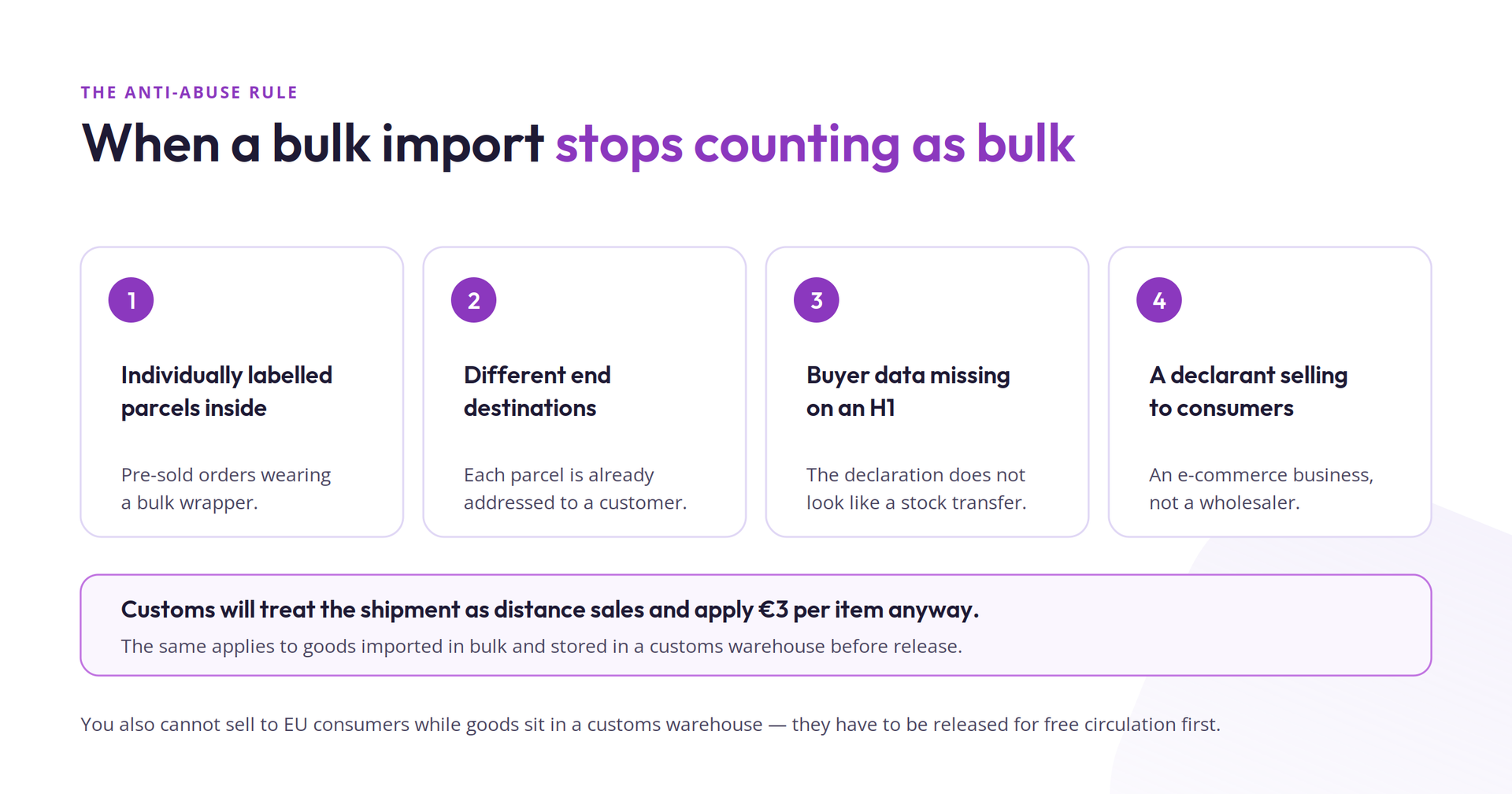
One warning that applies to this model specifically. Customs authorities now have an anti-abuse rule aimed at exactly this pattern. If a bulk consignment turns out on inspection to be a set of individual distance sales bundled together - individually labelled parcels with different end destinations, a declarant whose business is e-commerce to consumers, missing buyer data on an H1 - the authorities will treat it as distance sales and apply €3 per item anyway. The same applies to goods imported in bulk and stored in a customs warehouse before release.
Related, and often misunderstood: you cannot sell goods to EU consumers while they sit in a customs warehouse. To supply them, they have to be released for free circulation first. The Commission has flagged that it intends to tighten the underlying rule further.
So the model works - but only if the goods genuinely enter as stock, not as pre-sold orders wearing a bulk wrapper.
The advantage is flexibility. One pool of inventory can serve Amazon, your own store, eBay, Kaufland Global Marketplace and Etsy at the same time.
This doesn't automatically beat FBA on cost. It tends to win for businesses growing across several channels, and for sellers who want to decide themselves how returns are inspected, refurbished and put back on sale. That control matters more since June, when the EU withdrawal function rules came into force and made the exit path from a purchase as visible as the entry path.
Do FBA and your own EU warehouse solve the same problem?
On the surface, yes. In both, stock sits inside the EU, orders ship domestically, and delivery is faster than sending each parcel from outside the bloc.
In practice they're built for different objectives.
FBA optimises selling inside the Amazon ecosystem. Amazon stores your products, fulfils orders and runs most of the operational process for you. For a business concentrated on Amazon, that's a real reduction in time and headcount.
An independent EU warehouse gives you control. You decide how stock is stored, how returns are inspected, how products are repackaged or refurbished, and how inventory is redistributed across channels. The same stock can serve Amazon, your own store, other marketplaces and B2B.
The gap shows up most clearly in returns. A returned parcel isn't just another shipment. It's inventory that needs inspecting, processing and getting back on sale quickly. Under FBA that runs to Amazon's standards and Amazon's grading. In your own operation you set both, and products can be inspected, cleaned, repackaged, repaired where sensible and relisted far faster.
For a lot of growing businesses the answer is both. Fast-moving products stay in FBA for Prime delivery, while slower stock, multichannel orders and returns run through an independent EU partner.
The data requirement most sellers haven't noticed yet
From 1 November 2026, every declaration covering distance sales of imported goods must carry product identifiers:
- the merchant identifier assigned by the online seller, marketplace or platform - required in all cases
- the non-standardised manufacturer identifier assigned by the manufacturer or supplier - required in all cases
- the standardised manufacturer identifier (EAN, ISBN and similar) - required only where one exists, with an exception code where it doesn't
Operators can supply this voluntarily from 1 July 2026, and no penalty applies during that window. From 1 November, missing or incorrect identifiers become an enforcement issue, and the practical consequence is a declaration held rather than a parcel delivered.
The chain matters more than the rule. Your manufacturer has to give you the identifiers, you have to pass them to whoever declares the goods, and the declarant is responsible for their accuracy. If you sell on a marketplace and import through a third party, that's three handovers to get right before November. Sellers who start supplying identifiers now get a free run at fixing the pipeline; sellers who wait find out in November whether it works.
Second-hand and refurbished goods are in scope, not exempt. For a refurbished product, the identifier of the original product is what goes on the declaration.
When FBA fits, and when EU fulfilment fits
FBA fits sellers operating almost entirely on Amazon, with high-turnover products, where the priority is operational simplicity. Amazon handles storage, order processing, shipping and much of the customer service.
EU fulfilment fits businesses selling across several channels at once, where one EU warehouse serves Amazon, Shopify, eBay, other marketplaces and direct B2B. It fits particularly well where return rates are high, or where products need inspection, cleaning, repackaging, repair or testing before they can be sold again.
Either way, three practical jobs are worth doing this month: update your pricing so the duty is reflected in the customer-facing price, check your Seller Central settings so charges display correctly, and start collecting product identifiers from your suppliers. Amazon's Revenue Calculator is a reasonable place to re-test margins with the duty included, remembering that different products and shipping models need different assumptions.
Why returns may matter more than the duty itself
So far this has been a comparison through imports and storage. In practice, profitability increasingly turns on how fast you recover value from a returned product.
Say you sell a product for €40. A customer in Germany orders on Amazon and sends it back a few days later. This is where the two models separate.
Under FBA, the product goes backto an Amazon warehouse, and Amazon decides whether it's fit for resale, whether it's flagged damaged, whether it goes to liquidation, and whether you'll need a Removal Order to get it back. Only after the Removal Order do you get to assess it yourself. Products do sometimes get flagged as damaged when physical inspection shows they're fine.
In your own EU returns operation, the product goes to the warehouse handling your returns. You inspect it, photo-document the condition, verify the set is complete, replace packaging, relabel and put it back on sale. It never leaves the European market, and in many cases it's back on sale the same day. A local EU return address also keeps the whole movement domestic, so there's no second border crossing and no customs event on the way back.
The most expensive product is the one you can't sell again
That's the whole difference in one line. The longer a product sits off the market, the higher the cost in lost revenue and frozen capital. Time to resale is becoming a core KPI of returns logistics.
It doesn't matter whether the product cost €20 or €200. If it's out of your sales channels for weeks after a return, the cost grows daily. So when you analyse your Amazon logistics, count storage, fulfilment and shipping, but also:
- Time needed to get a product back on sale
- Percentage of products recovered after returns
- Cost of Removal Orders
- Cost of refurbishing
- Value lost to incorrect return grading
These rarely appear in FBA calculators, and in practice they move margin more than pick and pack differences do.
Does an EU warehouse mean giving up FBA?
No. For many sellers the answer is a hybrid.
The question has shifted. It's no longer FBA or your own fulfilment. It's which products belong in Amazon's network, which are better served from your own EU location, and where direct cross-border shipping still makes sense at all.
Fast-moving products go into FBA. If you're still sending merchant-fulfilled shipments from outside the EU, make sure your carrier is set up to transmit the customs data the new regime requires, because incomplete data is what turns a routine parcel into a held one - and from November that includes product identifiers. The rest of the inventory sits in an EU fulfilment warehouse serving your own store, eBay, Kaufland Global Marketplace, Etsy and the whole returns process.
You avoid holding separate stock per channel, and you keep control of what comes back.
FAQ
Does the €3 duty mean FBA is always more profitable? No. What changed is the falling profitability of shipping every parcel to the customer from outside the EU. The right model depends on how many channels you sell through, your return rates and how you import.
Is €3 charged per parcel? No, per item - meaning per line on the customs declaration, set by tariff classification. Five identical T-shirts on one line carry one charge. A T-shirt and a watch carry two. And the sameparcel can produce more charges in an H1 declaration than in H7, because H1 uses a finer 10-digit classification.
Can I get the €3 back when a customer returns the goods? Not through the returns route. Since 1 July, the import declaration for a distance-sale consignment up to €150 can no longer be invalidated because the goods were returned, and the Commission has confirmed the duty cannot be recovered that way. The general customs repayment rules still exist, but they are aimed at defective or non-conforming goods and carry conditions - including removing the goods from the EU - that rarely suit a returns operation. Plan on the €3 being spent.
Can I use FBA and my own warehouse at the same time? Yes, and increasingly sellers do. Highest-turnover products go into FBA; the rest sits in a fulfilment warehouse handling multichannel orders and returns.
What should I do when Amazon flags a returned product as damaged? It doesn't always mean the product is unsellable. It's worth knowing when a product can be recovered via a Removal Order and how to dispute the grading. A local EU returns partner can then inspect, document and refurbish it before it goes back on sale.
Do the new EU withdrawal rules affect Amazon sellers? Yes. Since 19 June 2026, under Directive (EU) 2023/2673, which inserted a new Article 11a into the Consumer Rights Directive, traders offering goods, services or digital content to consumers through an online interface must provide a clearly visible, continuously available electronic withdrawal function with a separate confirmation step and an acknowledgement on a durable medium. Despite the directive's title, the withdrawal function applies horizontally, not only to financial services. Marketplaces handle it within their own flows, but if you also sell through your own store or other channels, it shapes directly how you must handle withdrawals there.
Summary
The €3 duty doesn't answer whether FBA or your own EU warehouse is better. It shows that how you organise logistics now affects profitability more than it used to.
Come back to the two sellers from the start of this article. Same product, same order volume. The difference is that the first still looks mainly at shipping cost, while the second looks at the whole cost of logistics: imports, declaration type, returns, inventory management and the ability to resell recovered stock.
If you sell only on Amazon, FBA may well remain your best option. If you also sell through your own store or other marketplaces, your own EU fulfilment offers more flexibility, better control over returns and one shared inventory pool. For a growing numberof sellers, the answer is a hybrid that takes Amazon's speed and adds local returns handling on top.
Not sure what your current setup is costing you?
Send us your numbers and we'll run them against the new regime - where the duty hits twice, what return freight costs against the goods you recover, and how much is avoidable.
Keep reading
More from the knowledge base

Are Free Returns Really Driving Growth - or Destroying Your Margins?

The First Black Friday Under the €3 Customs Rules