How Marketplaces Handle the €3 EU Customs Duty
20.06.2026 · 9 min read
A buyer in Munich adds three things to their basket from your eBay store and checks out once. One order, one payment, one customer.
If that order goes through eBay International Shipping, you ship three separate parcels. The programme doesn't combine multiple items from the same buyer into a single shipment: each order generates its own label. eBay has acknowledged the limitation and hasn't resolved it.
Before 1 July, that was an annoyance and some extra postage. Now it's three consignments crossing the border instead of one, each carrying its own customs charge.
That's the kind of detail that decides your margin now, and it's different on every platform. Amazon, Zalando and eBay have arrived at three genuinely different answers to who deals with customs, and if you sell on more than one you're running three models at once.
The rule they're all responding to
Since 1 July 2026 every consignment worth €150 or less entering the EU from outside carries €3 in customs duty per tariff line. Per line on the declaration, not per parcel. Goods sharing tariff classification, description and country of origin sit on one line and carry one charge. Three categories in one parcel means three lines and €9.
Marketplaces sit in the middle of this because of the 2021 VAT reforms, which treat a platform facilitating a sale of imported goods up to €150 as though it bought and resold them itself. The 2026 reform bolts the duty onto that architecture and treats platforms making distance sales as the deemed importer.
That's the theory. Each platform has drawn its own line about how much of it they'll actually own.
Amazon: move the border, then charge you for crossing it
Amazon's answer is to make the problem disappear by relocating your stock.
Hold inventory in EU-based Fulfilment by Amazon warehouses and your customer orders never cross a customs border, so the €3 doesn't touch them. Your bulk inbound clears once, under normal tariff rules. Ship merchant-fulfilled from outside the EU and every parcel is its own import event with its own charge.
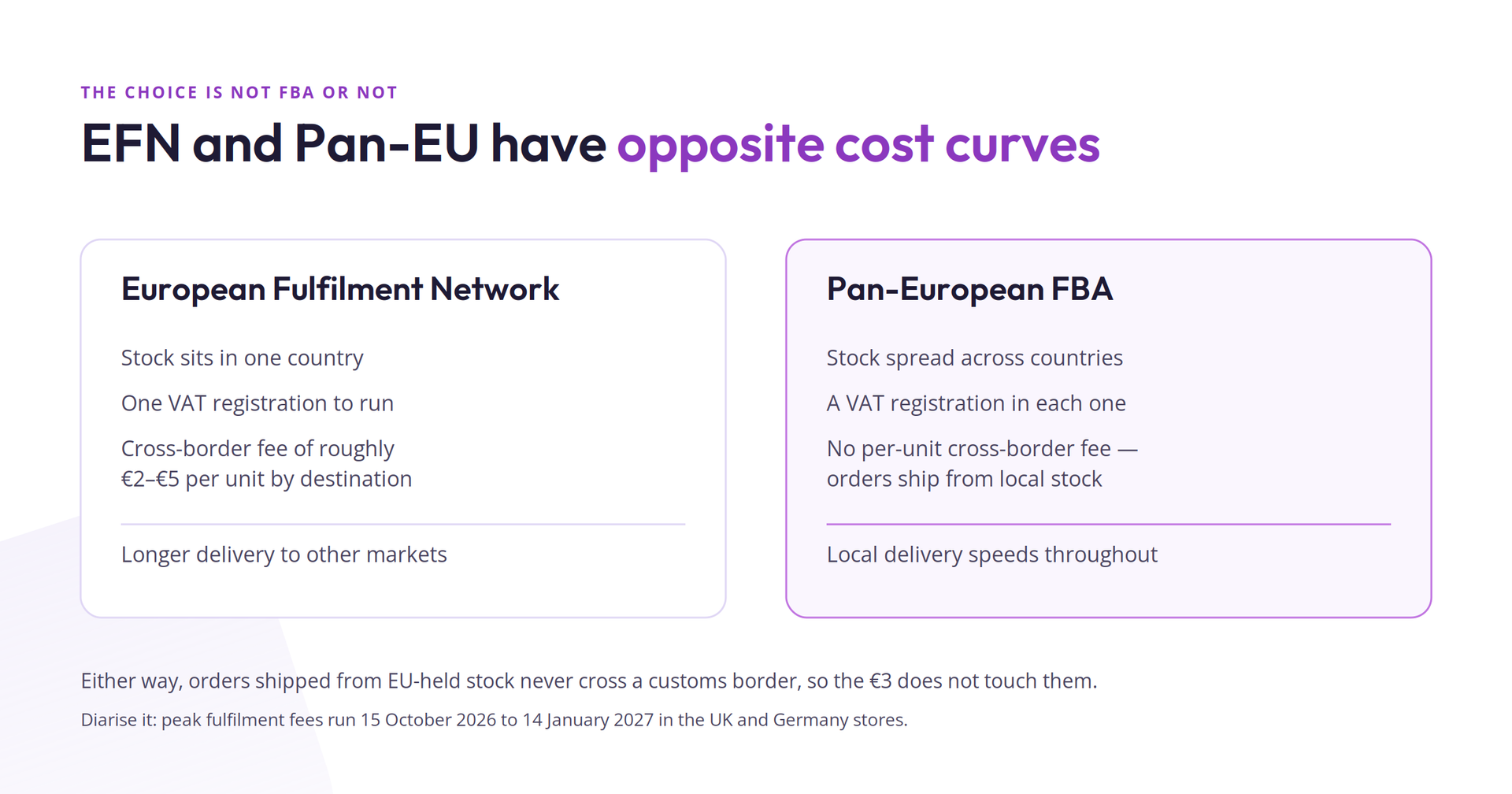
The catch is what happens between EU countries. If you store in one country and let Amazon ship cross-border to other EU marketplaces through the European Fulfilment Network, Amazon applies a cross-border fulfilment fee, commonly cited at around €2 to €5 per unit depending on destination. EFN keeps you to one VAT registration; Pan-EU spreads stock across countries, removes the per-unit cross-border fee, and gives you VAT registrations in every country you store in.
So the choice isn't FBA or not. It's which flavour of FBA, and the two have opposite cost curves.
Also worth diarising: Amazon confirmed in July that from 15 October 2026 to 14 January 2027, the UK and Germany stores apply a peak season fulfilment fee. That window covers Black Friday and the whole January returns wave.
For qualifying imports where Amazon acts as deemed supplier, the platform sits in the customs chain rather than you. Exactly how the €3 surfaces on the seller side has been slower to clarify than sellers would like, so check Seller Central rather than assuming, and watch your next few settlement periods.
Zalando: solve customs before you're allowed in
Zalando's position is the bluntest of the three, and it predates the duty.
Neither Zalando nor Zalando Fulfilment Solutions assists partners with customs clearance. All SKUs must be cleared for customs before they enter the programme. Partners bear the costs and risks of shipping and returning articles, against a 100-day return window.
For non-EU sellers, two requirements bite harder. Partners without an EU legal entity must use ZFS to deliver to EU customers. And an EU-based return address is mandatory in all cases, no exceptions.
Sit with that second one. Zalando decided, well before €3 existed, that returns crossing back out of the EU weren't a workable model on its platform. The rest of the market is now reaching the same conclusion for cost reasons.
How the fulfilment side works. ZFS defaults to fulfilling all orders from three German centres. International warehousing unlocks additional centres across Poland, Italy, France, Spain, Sweden and the Netherlands, and Zalando's own framing is that this removes cross-border fees on orders shipped from local centres. Switzerland, Norway and the UK aren't available through ZFS, so you self-fulfil there.
Zalando has effectively pre-solved the €3 problem by mandating the structure that avoids it. The price is that you do the customs work yourself, upfront, and ZFS couples those SKUs to Zalando's network.
eBay: it depends entirely on which shipping you pick
eBay draws the line at its own programme, and the difference between the two sides of that line is large.
Inside eBay International Shipping: the programme manages applicable import fees, buyers see a duty-inclusive total at checkout with nothing to pay on delivery, there are no additional seller fees for using it, and the international fee normally charged on cross-border transactions is waived when an order goes through the service. eBay has been expanding it, including into Germany, and it's replacing the older Global Shipping Programme in the UK.
Outside it: you ship on your own method. If duties are unpaid, the carrier may contact the buyer for import charges before delivery. That's the doorstep-charge scenario: the customer pays €3 plus the carrier's disbursement fee, and either refuses the parcel or writes about it. You also pay eBay's international fee, which varies by seller region and destination.
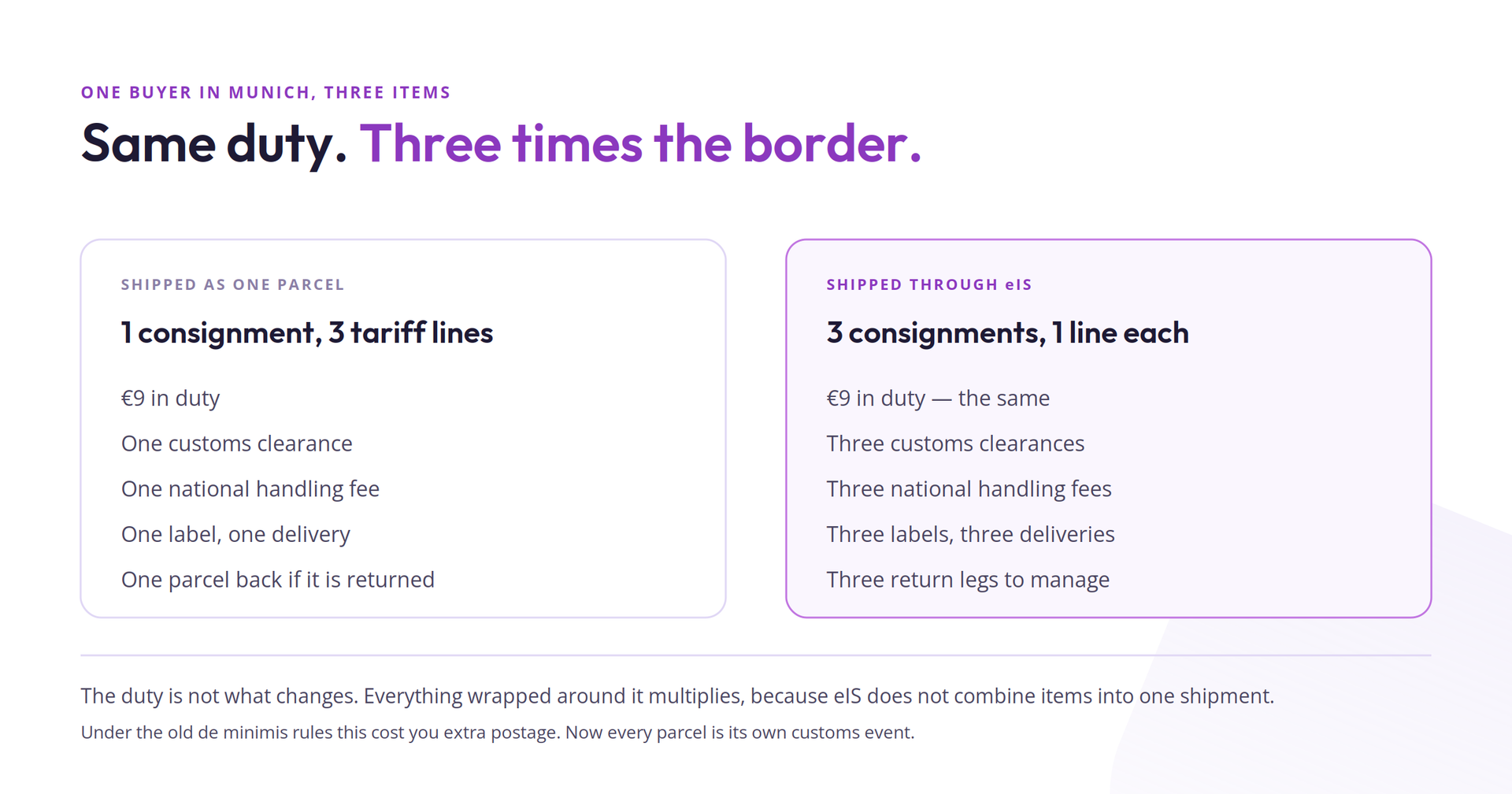
And then the split-shipment issue. eIS doesn't combine multiple items from one buyer into a single shipment. Three items bought together become three labels, three parcels and three consignments through customs. Under the old de minimis regime that mostly cost you postage. Now each consignment is separately in scope for the flat-rate duty, so a basket that would have carried three tariff lines in one parcel is instead three separate customs events.
If you sell multi-item baskets on eBay into the EU, this is worth modelling before you assume eIS is the cheaper route.
The pattern underneath all three
Read them together and the same conclusion appears three times.
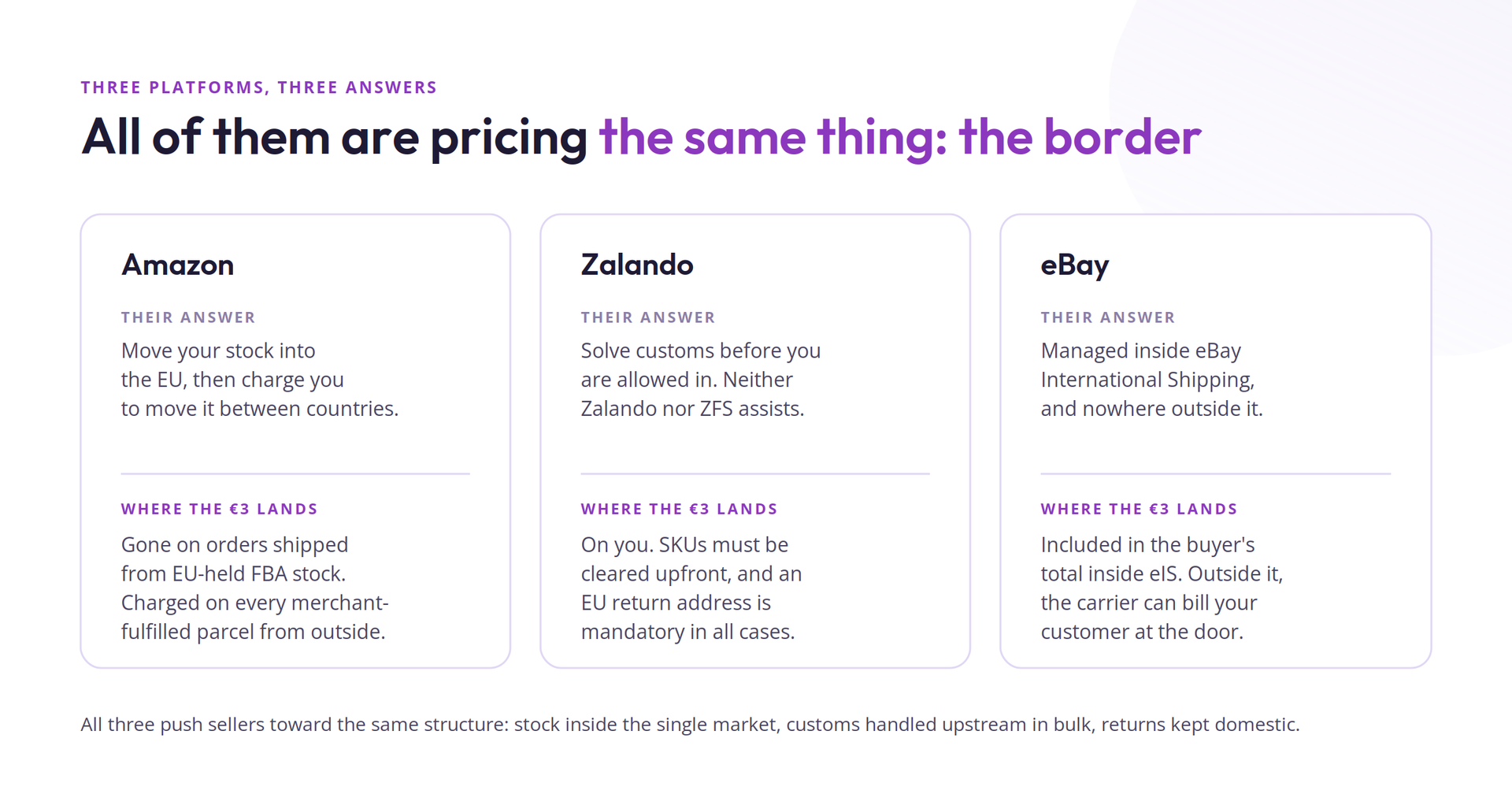
Amazon exempts EU-held stock from the charge and prices cross-border movement per unit. Zalando requires EU returns and pre-cleared customs as a condition of entry. eBay offers duty-inclusive pricing only inside its managed programme, and that programme multiplies your consignment count on multi-item orders.
None of them is being awkward. All three are pricing the same thing: the border. And all three are pushing sellers toward the same structure, which is goods inside the single market, customs handled upstream in bulk, and returns staying domestic.
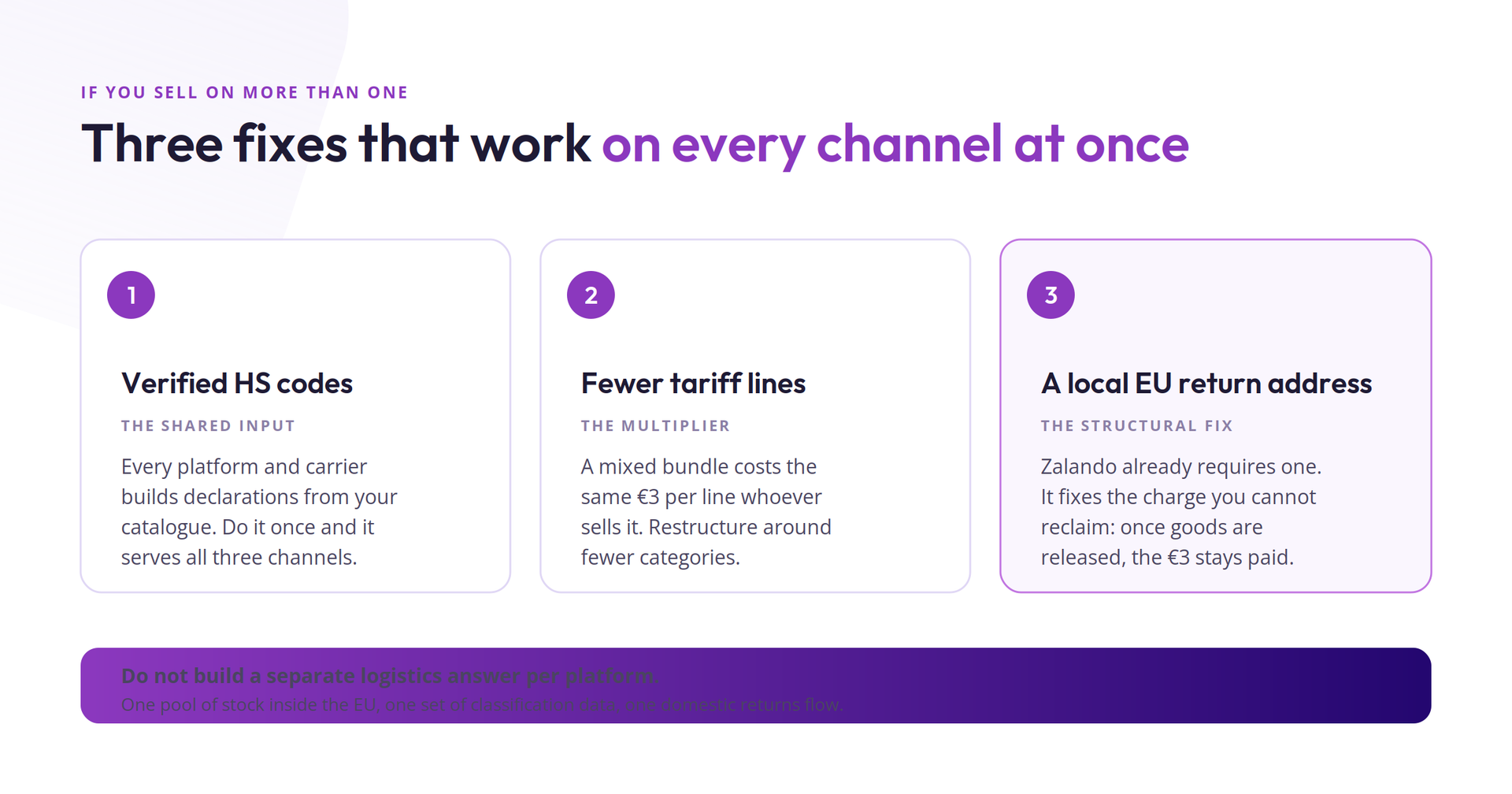
If you sell on more than one
Three things, in order of how much they save.
Your HS codes are the shared input. Every platform and carrier builds declarations from your catalogue data. Verified six-digit codes, structured descriptions and honest country of origin drive your duty bill on every channel simultaneously. From 1 November, Product Identifiers become mandatory on every declaration and vague descriptions get rejected. Do this work once and it serves all three.
Your tariff lines per order are the multiplier. A mixed bundle costs the same €3 per line whoever sells it. Restructuring bundles around fewer categories saves money everywhere at once.
Your returns address is the structural fix. Zalando already requires it. Amazon returns run to Amazon's grading, and pulling stock back out means Removal Orders. Your own store's returns are entirely yours. A local EU return address is the one change that works across every channel, and it addresses the charge you can't reclaim: when goods come back after release you can no longer have the import declaration invalidated because the customer changed their mind. The €3 stays paid, and is charged again if the item ships back into the EU later.
The thing not to do
Don't build a separate logistics answer per platform. That's how sellers end up holding three pools of inventory, paying for the same customs work three times, and still getting doorstep charges on the channel nobody checked.
One pool of stock inside the EU, one set of verified classification data, one domestic returns flow. Every platform's rules point at the same place.
FAQ
Which marketplace handles the €3 duty best for a non-EU seller? None of them handles it for you in the sense of absorbing it. Zalando is most explicit that customs is your job and requires it solved before entry. eBay handles it inside its own shipping programme and not outside it. Amazon removes it entirely if your stock is already in the EU. The best answer depends on where your inventory sits, not which platform you prefer.
Does eBay International Shipping really send separate parcels for one order? Yes. eIS doesn't support combining multiple items from the same buyer into a single shipment, and each order generates a separate label. eBay has acknowledged this and not resolved it. Since1 July each of those parcels is a separate consignment for customs purposes, so model it before assuming eIS is cheapest for multi-item baskets.
What does Amazon charge to ship between EU countries? Through the European Fulfilment Network, a cross-border fulfilment fee commonly cited at around €2 to €5 per unit depending on destination. Pan-EU removes that per-unit fee by placing stock in multiple countries, at the cost of VAT registration in each. EFN keeps you to one registration but costs more per unit and adds delivery time.
Can I sell on Zalando without an EU company? Yes, but partners without an EU legal entity must use Zalando Fulfilment Solutions to deliver to EU customers, and an EU-based return address is mandatory regardless. Zalando and ZFS don't assist with customs clearance, so all SKUs must be cleared before they enter the programme.
Do I need my own IOSS registration for marketplace sales? No. For facilitated marketplace sales the platform's registration applies. You need your own for sales from your own website, which is a separate flow with separate settings.
Five identical items in one parcel, how much duty? €3, provided they sit on one declaration line: same tariff classification, same description, same origin. Different origins or descriptions can split them into separate lines and separate charges. Five different categories is €15.
What's the deadline I should have in my calendar? 1 November 2026. Product Identifiers become mandatory on every declaration and the expected handling fee of around €2 lands around the same time. If you're on Amazon in the UK or Germany, note that peak fulfilment fees run 15 October 2026 to 14 January 2027.
Should I hold separate stock for each marketplace? Almost never. One pool inside the EU serving every channel is cheaper than three, and it's the only version where your customs and returns work is done once rather than repeated per platform.
Selling across several marketplaces?
Each platform pushes the customs cost onto you differently, and most sellers only see the total - not which channel is bleeding. Tell us where you sell and we'll show you where the money is going, and what one shared return setup would change.
Keep reading
More from the knowledge base

Are Free Returns Really Driving Growth - or Destroying Your Margins?

The First Black Friday Under the €3 Customs Rules