€3 EU Customs Duty: How to Prepare for the Change
08.07.2026 · 9 min read

Navigation
- First, the Customs Duty Number Nobody Priced InFailure Profile 1: The DDU Die-HardsFailure Profile 2: The Low Value Parcels Per-Parcel ModellersFailure Profile 3: The Dirty-Data ShippersFailure Profile 4: The Brands With No EU Return AddressFailure Profile 5: The Silent OverpayersThe Ghost Cohort: Brands That Simply LeftThe Pattern Behind Every Failure
Somewhere in a customs facility outside Frankfurt right now sits a cage of refused parcels. The customers wouldn't pay the surprise charges at the door. The carrier won't ship them back for free. And here's the detail their owners are only just discovering: under the new rules, the duty on those parcels is non-refundable even though they were never delivered.
Three weeks into the €3 duty era that began on 1 July 2026, the first results are already clear: low-value ecommerce parcels are seeing charges equal to roughly 34% of the average item's value, and brands that treated the change as a news item are already dealing with refused deliveries, unexpected customer charges, chargebacks, blown budgets, higher logistics costs, and lost EU customers as new duty and VAT processes bite. For international ecommerce sellers and marketplaces - especially small to midsize brands in the UK, EU, US, Canada, and Australia managing cross-border sales and returns into the EU and UK - that turns customs from a checkout detail into a margin, compliance, returns, customs-clearance, and customer-retention problem.
This is a field report for that second group. Not to gloat, but because every failure pattern on this list is fixable, and because if you're shipping into the EU, the honest question isn't "who failed to prepare". It's "which of these is quietly happening to us right now". From there, we'll get into where brands are getting the duty calculation wrong, why clean product data and the right VAT and duty payment model now matter more, how local return addresses, customs clearance processes, and returns verification reduce loss on refused parcels, what marketplaces increasingly expect, and where reverse-logistics, refund-claim management, and return processes need to change to protect margins, avoid customer fallout, and stay compliant under the new rules.
First, the Customs Duty Number Nobody Priced In
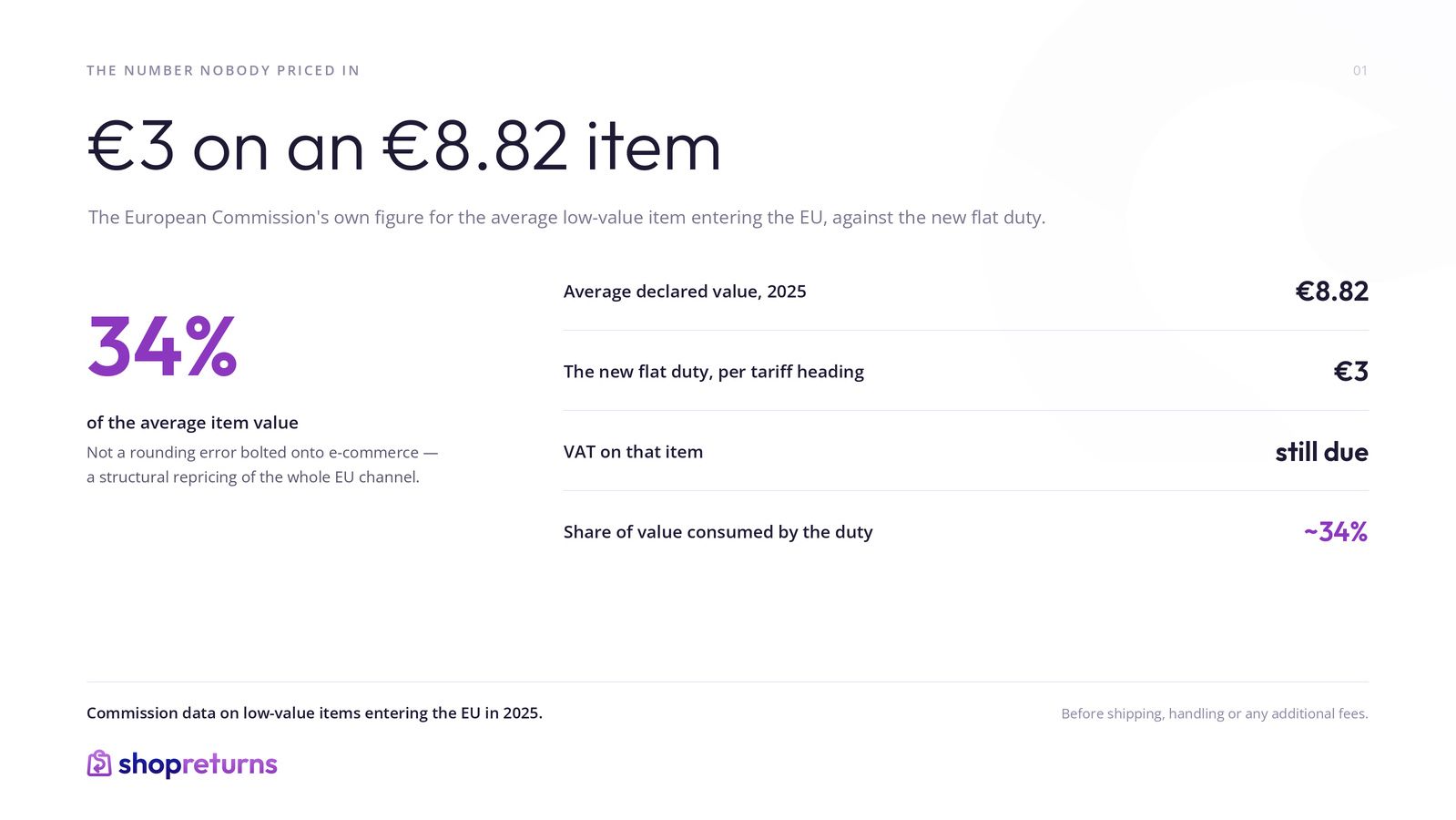
Before the profiles, one statistic that explains why the unprepared are hurting so much. According to the European Commission's own data, the average declared value of a low-value item entering the EU in 2025 was €8.82, and that average item was also subject to VAT alongside the new charge. Against that figure, the €3 duty represents roughly 34% of the average item's value, before shipping, handling or any additional fees.
This isn't a rounding error bolted onto e-commerce. For low-AOV products, samples, accessories and impulse-priced items, it's a structural repricing of the entire EU channel. Brands that understood this rebuilt their unit economics in spring. Brands that didn't are discovering it one carrier invoice at a time, as the change can affect pricing for businesses selling to EU consumers.
Failure Profile 1: The DDU Die-Hards
The single most expensive mistake of July 2026 is still shipping Delivered Duty Unpaid.
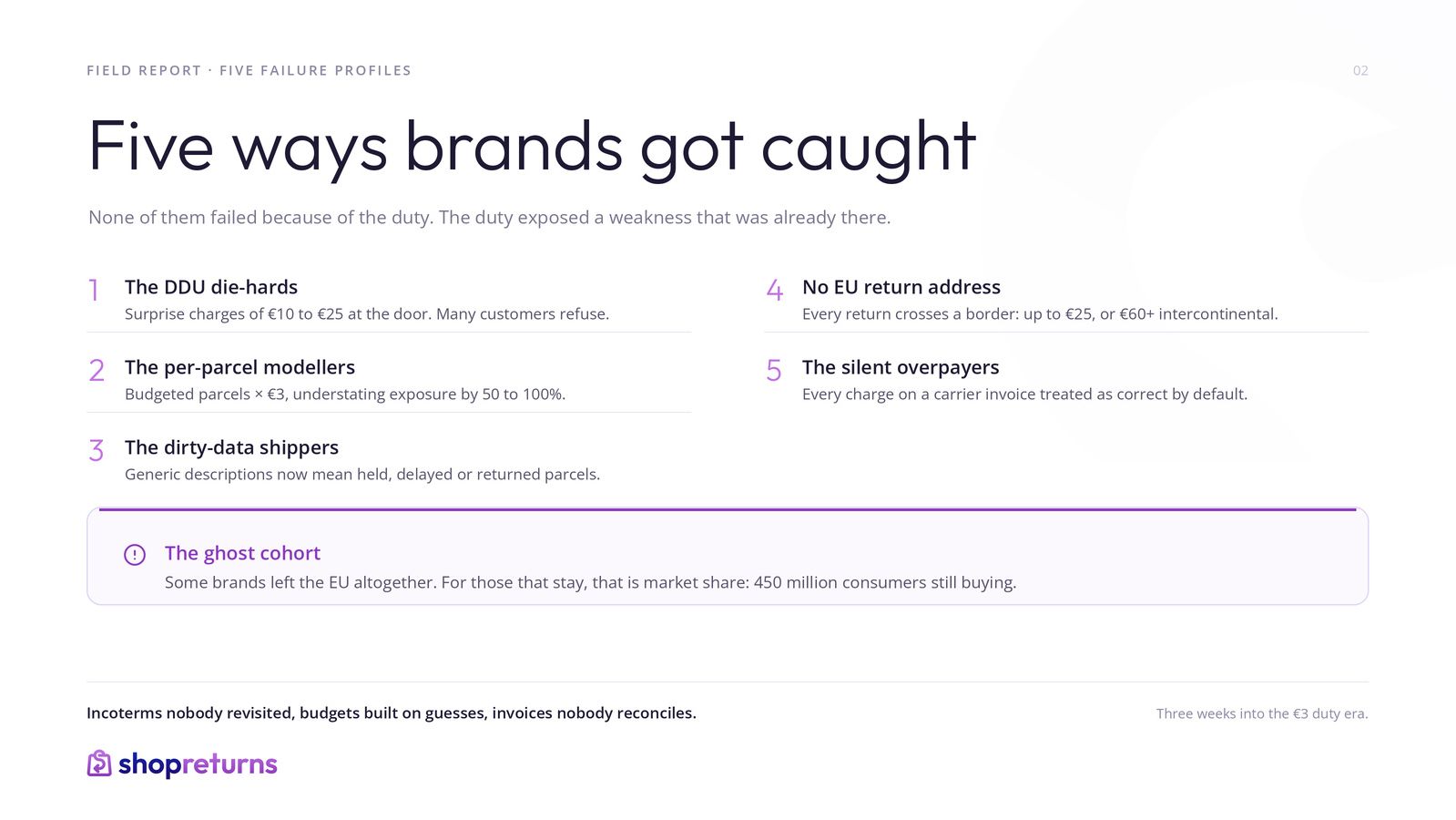
Under the old regime, DDU carried little risk, because most low-value parcels owed nothing on arrival. That protection is gone, and the market reacted fast: several EU member states have stopped accepting DDU shipments outright, and the ones that still take them follow customs procedures that vary by destination country, with handling fees of €15 to 25 per parcel charged in a way that lands on the customer's doorstep as a surprise. UPS has suspended its Worldwide Economy DDU service to Germany entirely.
The customer-side math is brutal. A shopper who ordered a €30 item gets asked for €10 to €25 in charges they never agreed to. Many refuse. The parcel bounces, the brand eats the logistics cost both ways, the duty stays paid, and the customer never comes back. The shopper doesn't blame Brussels for any of this. They blame the brand whose name is on the box.
The prepared cohort saw this coming and moved to DDP, letting them pay VAT and duty at checkout for smoother delivery and a better customer experience. Their customers noticed nothing on 1 July. That was the whole point.
Failure Profile 2: The Low Value Parcels Per-Parcel Modellers
A large group of finance teams budgeted the duty as "parcels × €3" and signed off. The regulation says otherwise: the €3 is a new duty charged per tariff sub-heading in the consignment, not per package. Six T-shirts under one HS code cost €3. A T-shirt plus a pair of shoes costs €6. Every additional tariff code in the basket adds another €3; for example, adding an accessory creates a third chargeable line.
For fashion and lifestyle brands, whose best orders are precisely the multi-category baskets (top plus shoes plus accessory), this modelling error understated duty exposure by 50 to 100%. Three weeks in, those teams are explaining a variance to their CFO that was entirely predictable in February, when the regulation's final text was agreed.
The uncomfortable twist: the same mechanism punishes the merchandising strategies brands spent years building. Bundles, cross-category upsells and "complete the look" widgets all multiply tariff lines. Nobody has to abandon them, but somebody has to measure and price those basket effects.
Failure Profile 3: The Dirty-Data Shippers
The new regime runs on data, and it is unforgiving about it. As goods enter the EU, the customs process starts before arrival, with customs authorities relying on complete pre-arrival declarations to assess clearance. Importers and carriers must now submit standardised electronic shipment data before goods enter the EU: precise product descriptions, seller and buyer details, and accurate HS classification codes. Generic descriptions like "accessories" or "gift" have gone from lazy to risky. Goods shipped into an EU country with missing or incomplete data can be held, delayed or returned at customs.
And the data bar keeps rising. From 1 November 2026, three product identifiers (PIDs) per item become strictly mandatory: a merchant product ID such as a SKU, a manufacturer ID such as a model number, and a standardised ID such as an EAN, GTIN, UPC or ISBN. Most origin postal operators don't collect this today, and most merchants don't flow it through their export data. Brands that haven't started this work in July will be doing it as a fire drill in October.
There's a hidden cost dimension here too. Sloppy classification doesn't just delay parcels. It generates wrong charges: phantom tariff lines, misapplied duty, parcels pushed into the wrong regime, with errors that can also affect tax treatment and whether goods are subject to the correct regime. Those charges are contestable under the Union Customs Code, but only if you have the clean data to prove what the shipment actually contained. Dirty data means overpaying twice: once at the border, and again by forfeiting the refund, especially as the EU Customs Data Hub is expected to reshape data handling.
Failure Profile 4: The Brands With No EU Return Address
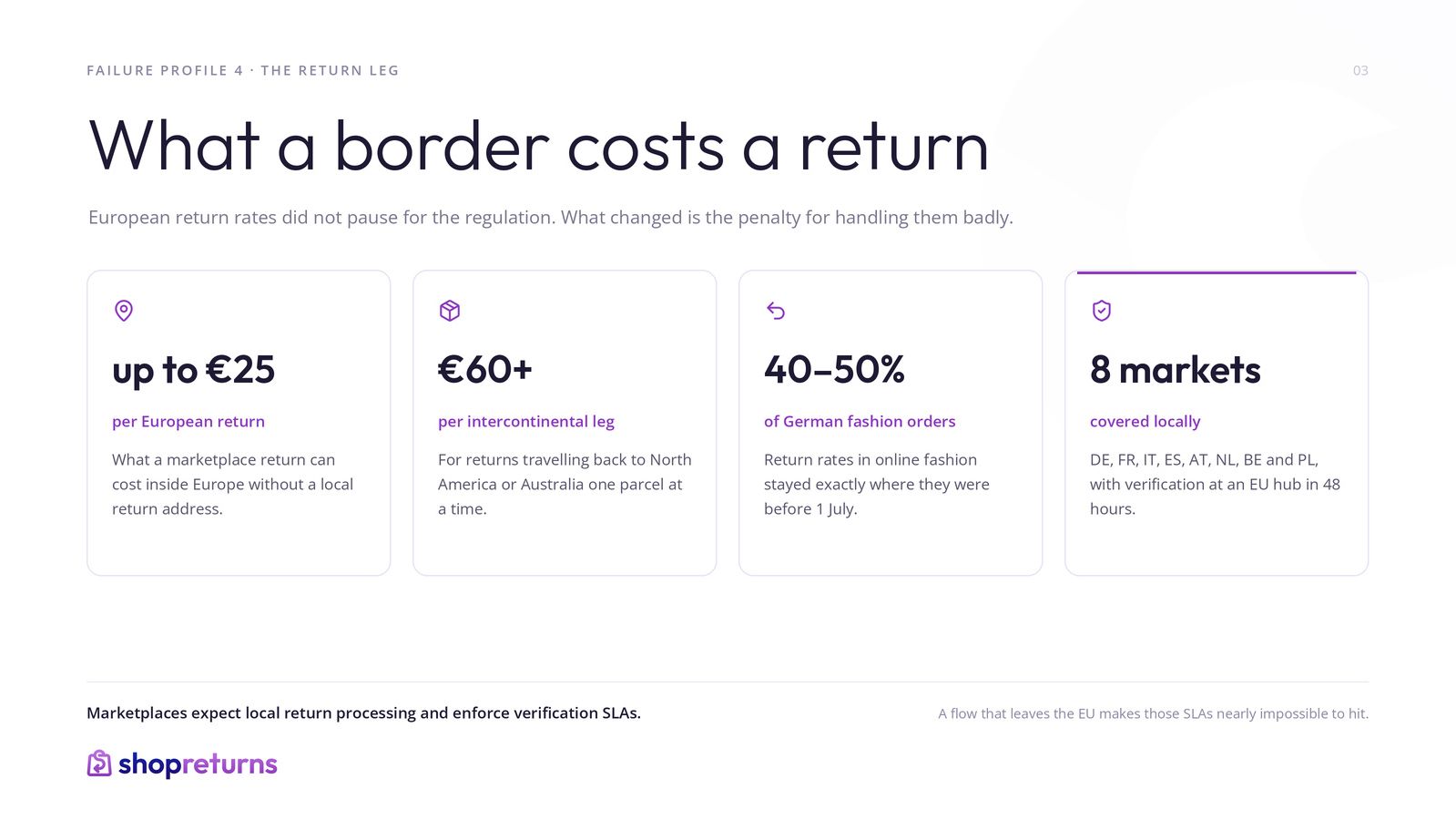
Return rates in Europe didn't politely pause for the regulation. German online fashion still runs 40 to 50% of orders returned, and france is a prominent example of a market where return handling expectations remain high. Italy has also announced an additional €2 charge on qualifying small parcels, compounding the EU duty for return-sensitive cross-border sellers. What changed is the penalty for handling those returns badly.
A brand with no local EU return address sends every return on a journey across a customs border. Best case, that's slow and expensive: marketplace returns without a local address can run up to €25 per parcel within Europe, and €60 or more for intercontinental legs back to Australia or North America. Postal returns handled through operators such as royal mail also show how parcel fees and customs friction can stack up across borders. Worst case, the re-import of the brand's own goods triggers fresh charges because government-set rules and paperwork errors can undermine a customs duty exemption.
Meanwhile the marketplaces this cohort depends on (Zalando, Amazon, ASOS, About You) expect local return processing and enforce verification SLAs. A returns flow that physically leaves the EU makes those SLAs nearly impossible to hit.
The prepared cohort solved this structurally: local return addresses in the destination countries (DE, FR, IT, ES, AT, NL, BE, PL), 48-hour verification at an EU hub, stock restocked or resold locally, and only consolidated bulk shipments crossing borders. Their returns never re-entered the customs procedures of each destination country.
Failure Profile 5: The Silent Overpayers
The final group did almost everything right on the outbound side and still leaks money, because they treat every duty charge on a carrier invoice as correct by default.
Weeks-old customs systems processing 12 million parcels a day produce errors: duplicates, misclassifications, duty charged on consignments under the €150 customs duty exemption threshold, charges surviving on invalidated declarations. Each error is small. At 50,000 to 100,000+ parcels a year, the annual total is not. EU law provides a refund route even when the charge was introduced as a temporary measure and remains contestable (Articles 116 to 121 of the Union Customs Code, with a three-year claim window), and enterprise brands running systematic refund pipelines recover €100,000+ per year.
The silent overpayers have no such line in their P&L. Not because they evaluated it and declined, but because no one in the organisation owns the process, even though it affects sales and margin. That's the quietest failure on this list, and pound for pound the most expensive one.
The Ghost Cohort: Brands That Simply Left
There's a sixth group worth naming: brands that looked at the new regime and walked away from the EU entirely. It happened before. After Brexit, a wave of UK brands stopped selling to the EU rather than deal with customs friction, and many never returned. The €3 duty era is producing the same quiet exits among smaller US and Australian sellers.
For the brands that stay, that's not a tragedy. It's market share. Every competitor that gives up on 450 million consumers because of a solvable logistics problem leaves demand on the table for whoever solved it.
The Pattern Behind Every Failure
Look back at the five profiles and one thing repeats: none of them failed because of the €3 customs duty alone. They failed because the change exposed a structural weakness that was already there. Incoterms nobody had revisited since 2021. Budget models built on guesses. Product data that was never audit-ready. Returns flows designed for a single home market. Invoices nobody reconciles.
The €3 duty didn't create those weaknesses, and the authorities did not simply introduce a fee in isolation - the broader customs process changed with it, in line with post-1 July customs and VAT guidance from the European Commission.
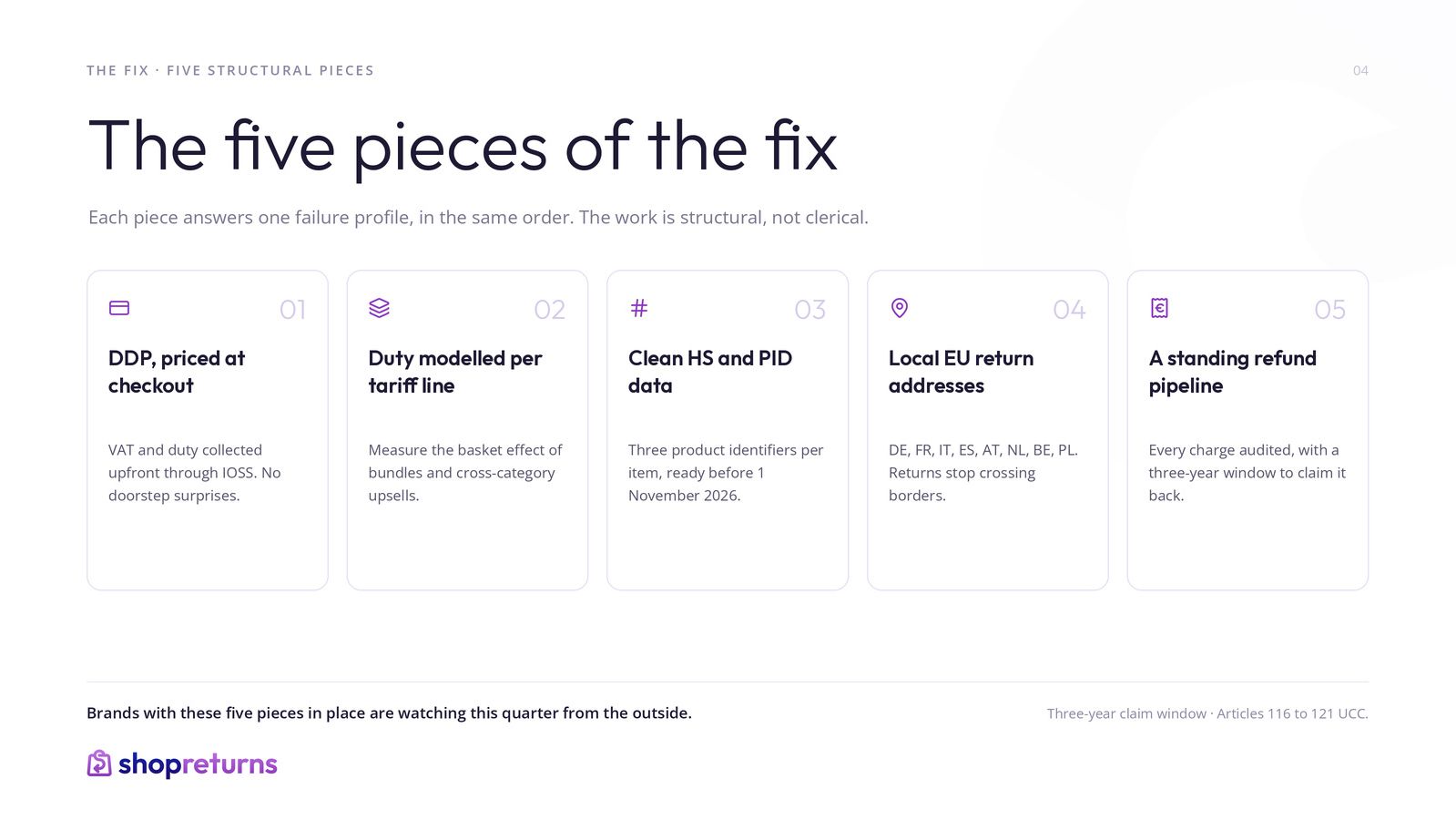
Which makes the fix less about customs and more about structure. Five pieces:
- DDP with VAT priced at checkout through IOSS - IOSS simplifies VAT declaration for EU imports under €150 and lets you collect VAT at checkout instead of on delivery.
- Duty modelled per tariff line, not as a flat assumption across the catalogue.
- Clean HS and PID data, audit-ready before November 2026.
- Local EU returns infrastructure, so returns stop crossing borders.
- A standing refund pipeline that audits every charge - particularly if you're based outside the EU, where checkout, VAT and customs setup need configuring early.
Brands with those five in place are watching this quarter's chaos from the outside. And the same structures improve delivery and returns for the customer, which is what keeps you selling in every EU country rather than retreating to the easy ones.
Not sure which side of the list you're on?
Send us your numbers and we'll run them against the new regime - where you're exposed, what it's costing, and how much of it is avoidable. One working session, and you leave with the figures either way.
Keep reading
More from the knowledge base

Are Free Returns Really Driving Growth - or Destroying Your Margins?

The First Black Friday Under the €3 Customs Rules