EU Additional Administration Charges: Full Guide
01.08.2026 · 9 min read

Navigation
- Why is this a problem for low value imports right now?Where does the money actually leak to cover customs processing costs?What should the ideal cost-control process and cost categories look like?What does this mean for your business?Before you scale: a practical checklistHow does Shopreturns solve this?FAQNot sure what your current setup is costing you?
The EU Additional Administration Charges Guide explains what sits on top of the €3 customs duty that went live on 1 July 2026: national parcel taxes in countries such as France, Italy and Romania, an upcoming EU-wide handling fee of about €2, and other overlapping charges that make the real import cost per parcel depend on destination, tariff headings, and local rules. For small to mid-size international ecommerce sellers, marketplace sellers, and higher-volume brands shipping cross-border into the EU and UK, the difference between “€3 per parcel” and the full fee stack is the difference between a workable landed-cost model and a margin leak.
This guide maps the 2026 duty changes, country-level administration charges, the new handling fee, and the return-logistics issues that follow when parcels are refused or sent back across borders. If you do not model the full stack by country, you risk underpricing, unexpected customer charges at the door, customs-data compliance issues, and double costs on returns-problems that hit profit, delivery acceptance, and customer satisfaction fast.
Why is this a problem for low value imports right now?
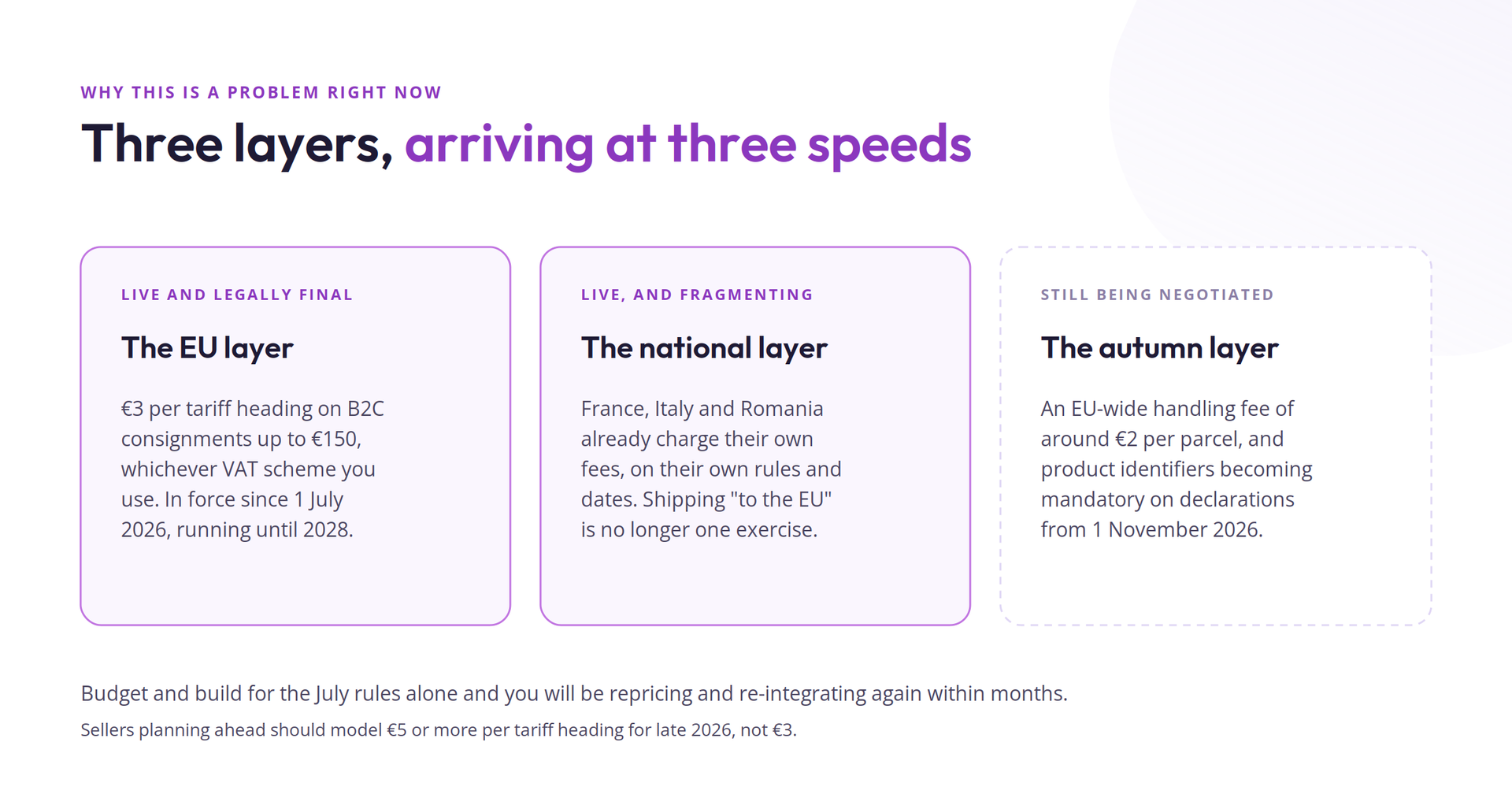
The EU layer is live and legally final. Council Regulation (EU) 2026/382 abolished the €150 duty-free threshold on 1 July 2026 and introduced a temporary €3 customs duty per item, applied by tariff heading, on B2C distance-sale consignments with an intrinsic value up to €150. According to the European Commission's guidance published on 8 June 2026, the duty applies regardless of which VAT scheme you use (IOSS, Special Arrangements or standard import VAT). It runs until 1 July 2028, when the EU Customs Data Hub is scheduled to take over with standard tariff rates.
The national layer is fragmenting the single market. Several member states decided not to wait for Brussels and introduced their own parcel charges, each with different rules, dates and scopes. Exporting "to the EU" is no longer one uniform exercise.
More is coming in autumn 2026. A separate EU-wide handling fee, intended to cover customs processing costs and expected at around €2, is still under negotiation with a possible start as early as November 2026. In parallel, Product Identifiers (PIDs) such as SKUs, manufacturer IDs and GTIN/EAN barcodes become mandatory on customs declarations from 1 November 2026 (voluntary since 1 July). Sellers who budget and build systems for the July rules alone will be repricing and re-integrating again within months.The full charge stack and customs duties, country by country
EU-wide: the €3 temporary customs duty. Charged per item according to tariff heading, not per parcel. Five identical t-shirts under one heading pay €3 once; a parcel with a shirt, shoes and a belt pays €9. The Commission's guidance explicitly prohibits grouping goods under the highest tariff heading to reduce the count. Intrinsic value means the price of the goods excluding separately invoiced transport and insurance. The administration fee is not included in the customs value for calculating duties. Importantly, the duty is not collected through an IOSS number: based on the current guidance, the carrier pays it to customs and invoices the merchant, while IOSS continues to handle import VAT exactly as before, with import VAT and added tax handled separately from the customs duty.
France: €2 Small Parcel Tax. In force since 1 March 2026, applying to parcels worth €150 or less imported from outside the EU, charged at €2 per HS6 code per parcel. A parcel with products under two HS6 codes pays €4 in French tax on top of the €3-per-heading EU duty.
Italy: €2 administrative levy. Introduced under Italy's 2026 budget on low-value goods imported from outside the EU. Italian customs has confirmed it applies universally, to both B2C and B2B transactions, and is collected at final import clearance.
Romania: 25 lei (around €5) fixed fee. Active since January 2026 on low-value consig-nments. Notably for returns-heavy sellers, goods in transit and returned parcels are exempt.
Belgium and the Netherlands: watching, not charging. Belgium had planned its own €2 fee but has opted, for now, to rely on the EU-level duty. The Netherlands proposed a levy and postponed it to gauge the impact of the EU-wide measure.
Part of the policy case for the planned EU Small Parcel Levy is to balance competition for eu retailers.
Proposed EU handling fee (~€2). Legally distinct from the customs duty, envisaged per parcel rather than per tariff heading, still under negotiation between the Council and the European Parliament, with autumn 2026 as the earliest realistic start. It would also require formal approval before implementation.
The practical consequence: a mixed two-category parcel to a French customer already carries €6 in EU duty plus €4 in French tax before VAT, raising the total cost. Sellers planning ahead should model €5 or more per tariff heading for late 2026, not €3.
Where does the money actually leak to cover customs processing costs?
Leak 1: pricing per parcel instead of per tariff heading. The single most common miscalculation. Your effective duty is a function of your HS code diversity, and inaccurate or inconsistent classification means paying more times than necessary, or having parcels stopped for data errors.
Leak 2: shipping DAP into a fee-stacked market. When charges are collected at the door, parcels may be subject to carrier handling fees and other charges, customers refuse deliveries, and refused parcels sit in customs limbo generating storage penalties. Every refused delivery then becomes a return, with its own cross-border cost, and refused parcels can also stall or pick up extra handling across carriers and postal services.
Leak 3: paying the stack twice on exchanges and forgetting returns entirely. A replacement parcel shipped from outside the EU is a new import that runs the whole gauntlet again: EU duty, national fee, clearance. Meanwhile returns travelling out of the EU one by one carry their own reverse-logistics and customs burden. Almost no one budgets this line, and the total amount grows exactly as fast as your EU sales do.
What should the ideal cost-control process and cost categories look like?
- Classify following cost categories: assign accurate HS codes (most EU-bound carriers require 8 digits) to every SKU and record how many tariff headings appear in your typical basket.
- Model: calculate landed cost per destination country, applying the applicable rules by country and layering the €3 per heading, any national fee, VAT and carrier charges, and stress-test the model at €5 per heading for Q4 2026.
- Collect at checkout: move to DDP-style pricing so every fee is calculated and paid upfront, keeping parcels in the fast clearance lane and customers away from doorstep surprises.
- Contain the reverse flow: route all EU returns to a local return hub inside the EU, verify and restock or consolidate there, so no return or exchange re-enters the fee stack and returns planning also captures indirect costs.
What does this mean for your business?
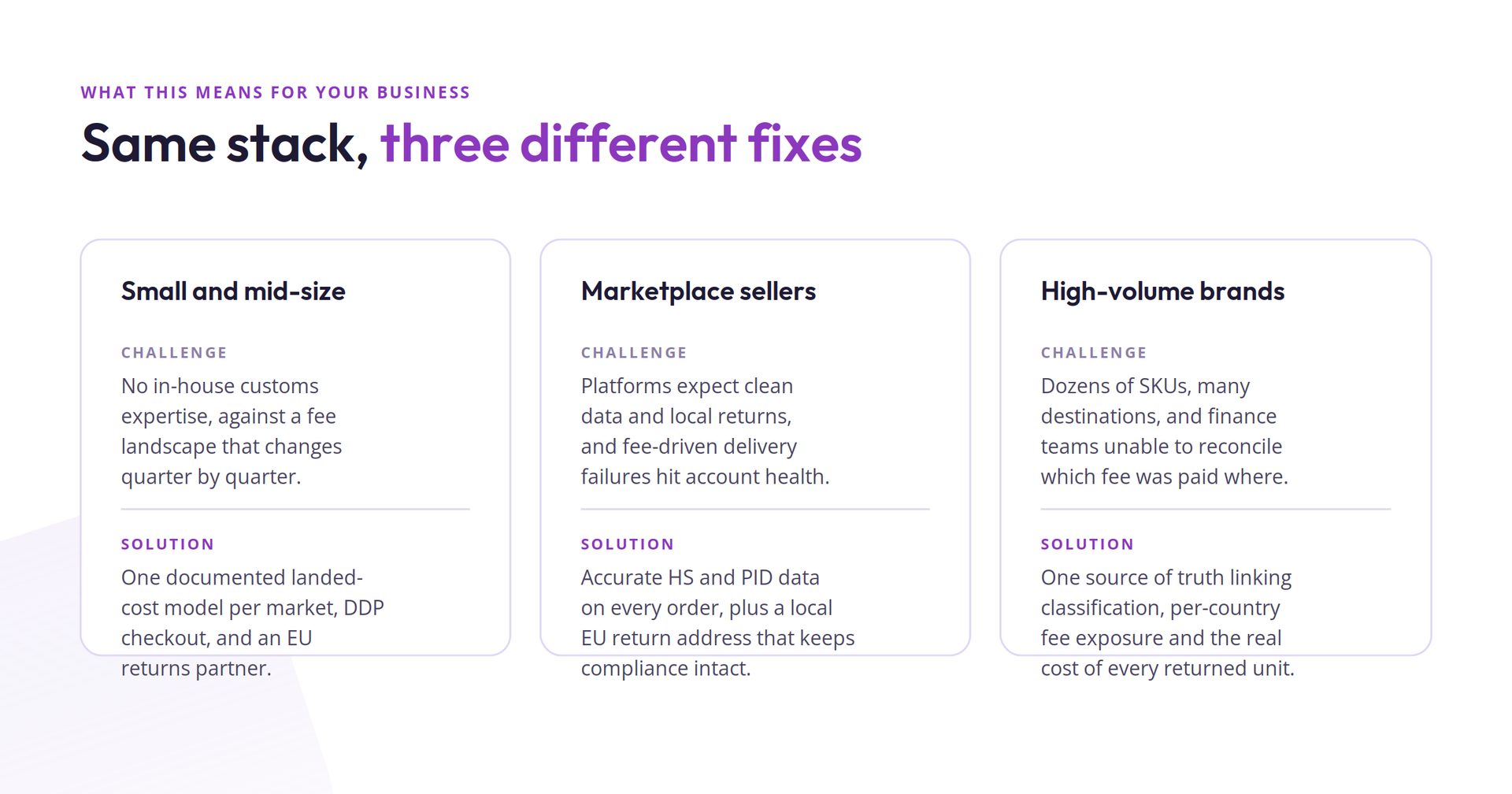
Small and mid-size cross-border sellers. Challenge: small sellers and medium-sized enterprises often have no in-house customs expertise, and a fee landscape that now changes quarter by quarter. Solution: one documented landed-cost model per market, DDP checkout, and a returns partner inside the EU so the reverse flow never touches customs while still supporting relevant compliance standards.
Marketplace sellers (Amazon, eBay, Zalando). Challenge: platforms expect clean data and local return handling, and fee-driven delivery failures damage account health metrics. Solution: accurate HS and PID data passed to carriers on every order, plus a local EU return address that keeps marketplace compliance intact. Marketplace integrations also support international sellers by keeping fee data, return handling and related services aligned across channels to help optimize margins.
High-volume brands and enterprise. Challenge: dozens of SKUs, multiple destination countries, and finance teams that cannot reconcile which fee was paid where. Solution: a single source of truth connecting product classification, per-country fee exposure and the real cost of every returned unit.

Before you scale: a practical checklist
- Do you know how many tariff headings appear in your average EU order?
- Have you modelled landed cost separately for France, Italy and Romania?
- Do you have further details on each carrier's local administrative charges?
- Is your checkout collecting all duties and fees upfront (DDP), or is your customer discovering them at the door?
- Does your payment flow clearly assign who pays each fee and when?
- Are PIDs (GTIN/EAN, manufacturer IDs) ready in your product data before the 1 November 2026 deadline?
- Do your internal guidelines cover low-value import pricing, declarations and returns handling?
- Do you know what one EU return costs you once fees, reverse shipping and handling are included?
How does Shopreturns solve this?
Shopreturns takes the most fee-exposed flow, your returns, out of the customs equation entirely, turning the return-flow setup into an operational project for scaling sellers. Returned parcels travel domestically to a local EU return address, where return verification includes checking quantity and quality with photo documentation within 24 hours, helping control services costs before items are restocked, resold locally or consolidated into bulk shipments home with customs clearance handled. Over 2,500 brands use this model to make sure the import fee stack is paid once, on the outbound parcel, and never again on the way back, while gaining more detailed information on return verification and customs-clearance handling.
FAQ
Is the €3 duty the same as the proposed €2 handling fee? No. The €3 is a customs duty charged per tariff heading, in force since 1 July 2026. The €2 handling fee is a separate, still-unconfirmed charge intended to cover customs processing costs, expected per parcel, possibly from late 2026, and the two arise under different legal mechanisms rather than the same fee regulation.
Do national fees like France's €2 tax replace the EU duty? No, they stack. A parcel to France can pay both the €3-per-heading EU duty and the €2-per-HS6 French tax, plus VAT.
Who physically pays the €3 duty? Under the Commission's current guidance it is not collected through IOSS: the carrier pays customs and invoices the merchant, who can build it into checkout prices. IOSS continues to handle import VAT as before, so the duty is billed as a separate fee from VAT handling.
Does the same fee apply across all EU countries? No. The EU duty can be uniform, but national charges and local administration costs vary, so you should not expect the same fee everywhere.
Not sure what your current setup is costing you?
Send us your numbers and we'll run them against the new regime - where the duty hits twice, what return freight costs against the goods you recover, and how much is avoidable.
Keep reading
More from the knowledge base

Are Free Returns Really Driving Growth - or Destroying Your Margins?

The First Black Friday Under the €3 Customs Rules