Can you reclaim the €3 EU import duty when a customer returns something?
26.06.2026 · 11 min read

Since 1 July 2026 every low value parcel you ship into the EU carries a €3 customs duty, charged per item line rather than per parcel. When the first returns came back in July, most brands assumed the duty came back with them. It does not, in the majority of cases, because the rule that used to allow it was switched off on the same day the duty started. At 50,000 to 100,000 parcels a year, the difference between what you think is recoverable and what actually is runs into six figures, and it sits in a different pool than the one everyone is looking at.
Why this matters now
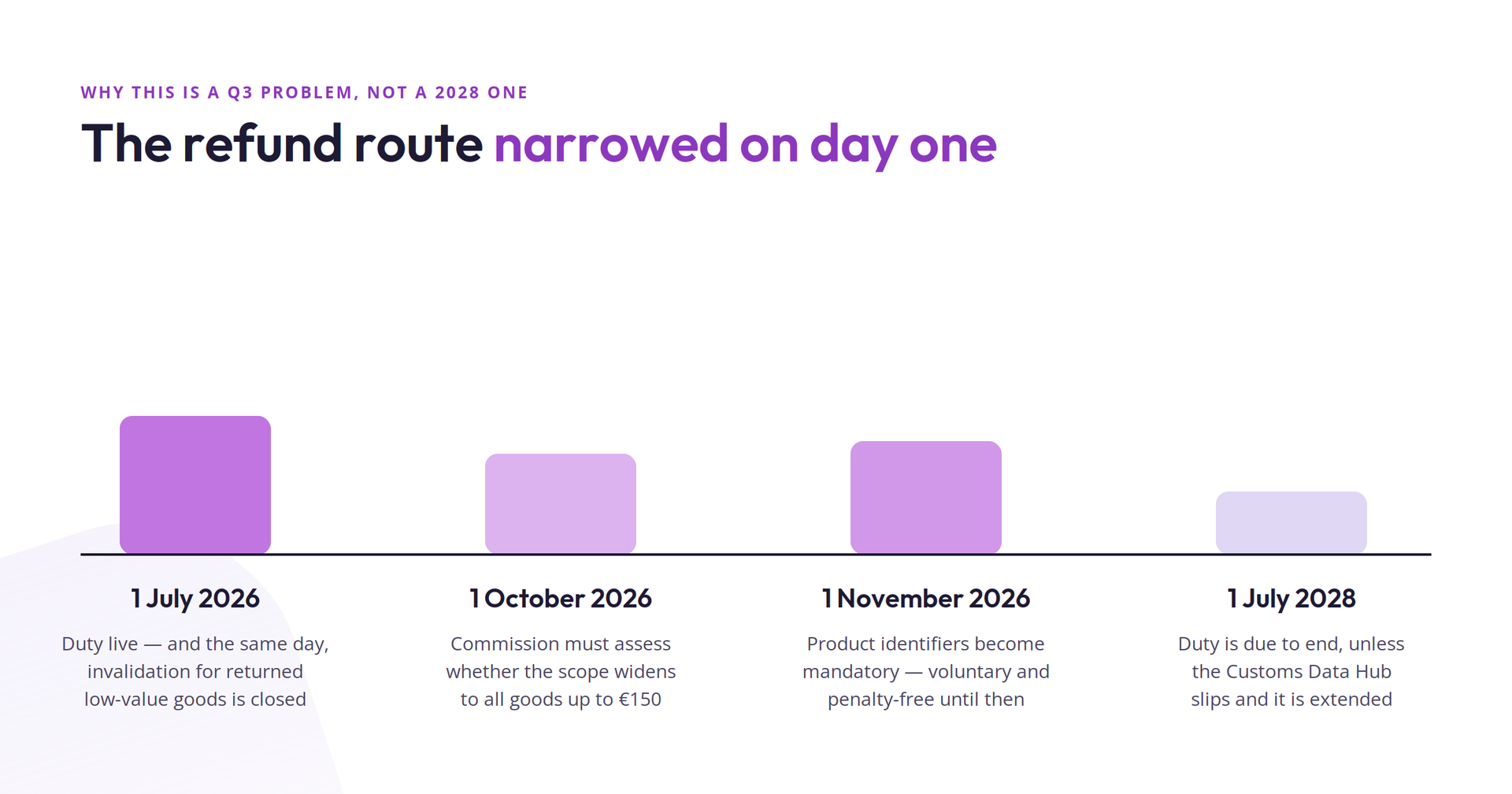
The duty is live and it is not going away soon. Council Regulation (EU) 2026/382 set a flat €3 charge on goods sold into the EU in consignments with an intrinsic value up to €150, applying from 1 July 2026 until 1 July 2028, with a possible extension if the EU Customs Data Hub is not ready in time. It applies regardless of the VAT route you use, so IOSS, Special Arrangements and standard import VAT are all caught.
Three things make this a Q3 and Q4 problem rather than a 2028 problem.
The refund route for returns narrowed on day one. The amended Article 148(3) of the UCC Delegated Act removed the ability to invalidate an import declaration for a low value distance sale simply because the goods came back after release (Commission Delegated Regulation (EU) 2026/1022).
The scope may widen shortly. The Commission must assess by 1 October 2026 whether the duty should cover all goods in consignments up to €150, not just the categories currently caught.
The data burden tightens on 1 November 2026, when product identifiers become mandatory on distance sale goods. They are voluntary from 1 July 2026, with no penalties in that window, so the catalogue work has a deadline attached.
Add a proposed EU handling fee, still unfixed in amount and start date, and the €3 stops being a rounding error on your landed cost model.

What usually goes wrong
1. Treating every return as a recoverable duty. A customer changing their mind is not one of the four grounds for repayment in Article 116(1) of the Union Customs Code, which lists overcharged duty, defective or non-conforming goods, error by the authorities, and equity. The Commission's Q&A confirms Article 148(3) does not close off those grounds, but a change of mind never fitted them in the first place.
2. Claiming the €3 and reselling the same unit. Article 118(3)(c) says repayment is not granted where the applicant sells the goods after it has been established that they are defective. Article 118(2) also requires the goods to leave the EU, or to go into inward processing, external transit, customs warehousing or a free zone under Article 118(4). You get one or the other on any given unit, never both.
3. Missing the one year clock because nobody knows when it started. Deadlines run from notification of the customs debt, not from the invoice or the return date. On H6 and H7 declarations, where the €3 is calculated automatically, release of the goods by customs is the notification. The Article 118 clock therefore starts at the border, weeks before the customer opens the box.
4. Filing against the wrong debtor. Repayment goes to whoever paid the duty, and that is the declarant. Since 1 July there is a fixed hierarchy: the IOSS holder or their indirect representative, then the Special Arrangements user or their representative, then the indirect representative of the importer, and only as a residual last resort the consumer. If your carrier's indirect representative is named as declarant, they are the debtor, not you. This is the single most common reason a well founded claim goes nowhere.
5. Chasing refunds while overpaying at source. An item means goods sharing the same tariff classification, description and, where the dataset carries it, origin. Ten identical T shirts on one line cost €3 once. The same ten split across three lines cost €9. Declaration type compounds it: €140 of women's suits in three fabrics is one line in H7 or H6, so €3, and three lines in H1, so €9. The Article 177 grouping simplification is specifically switched off where the €3 applies, so the split has to be correct at source.
How the process should work
Step 1. Capture the data before the parcel leaves the warehouse. What is inside, how it classifies, which products share classification, description and origin and therefore belong on one line, the intrinsic value with transport and insurance held separately, whether the sale is a distance sale at all, which VAT route it uses, and who is named as declarant.
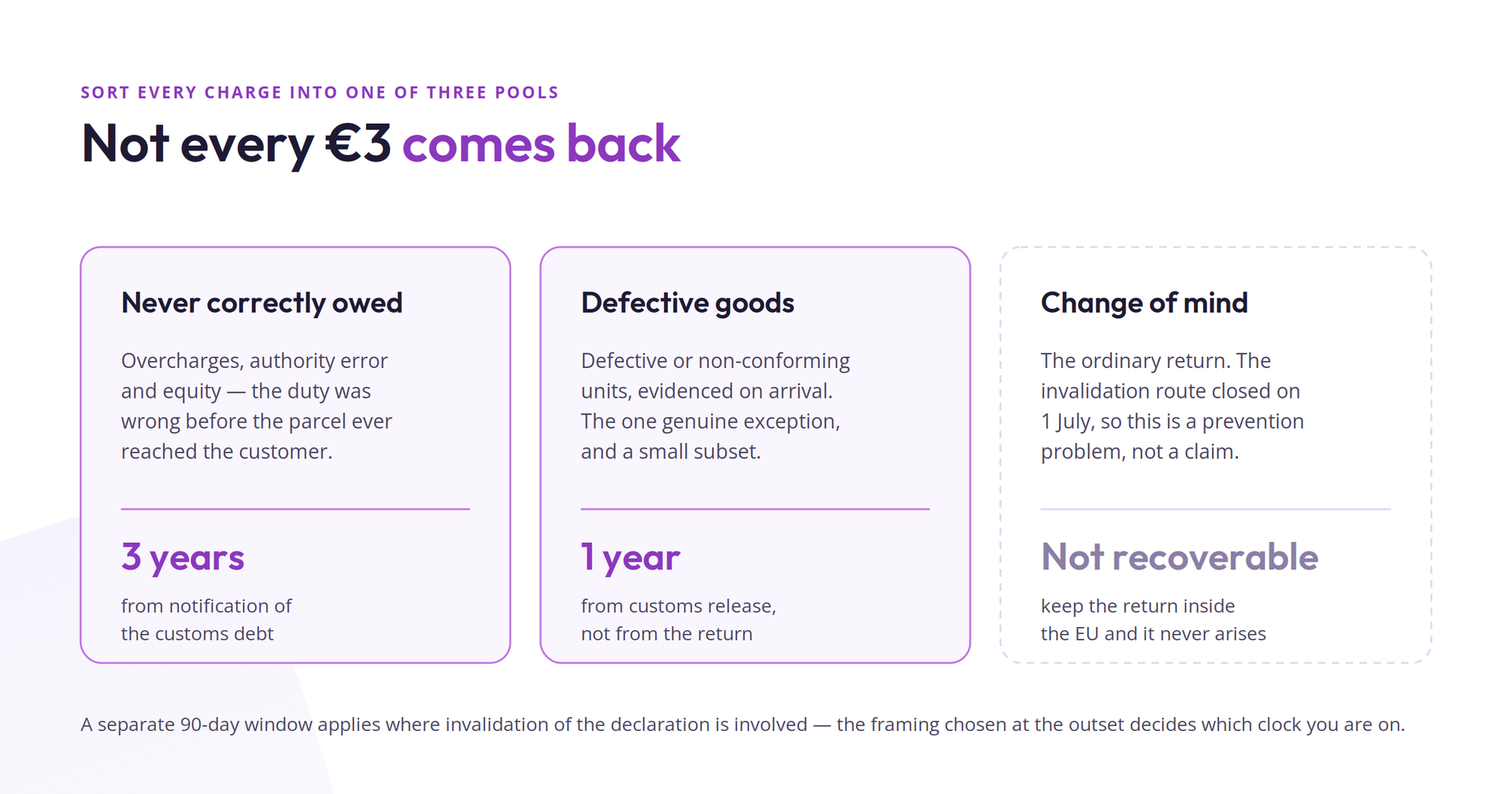
Step 2. Sort every charge into one of three pools. Duty that was never correctly owed, recoverable within three years under Article 121(1)(a). Duty on defective or non-conforming goods, recoverable within one year under Article 121(1)(b). Duty on ordinary change of mind returns, not recoverable at all, and therefore a prevention problem.
Step 3. Let the customer return domestically. The customer registers the return, ships to a local address in their own market with a carrier they already use, and the parcel never crosses a border. No border crossing means no customs event and no charge to claim back.
Step 4. Verify on arrival, within 48 hours. Barcode scan plus photo documented quality check. This is what tells you which units were genuinely defective, which is the small subset where the Article 118 route is open, and it produces the evidence a claim needs.
Step 5. Decide the fate of the unit, per unit. Resell locally, return to stock, donate, dispose, or claim the €3 and send it out of the EU or destroy it under customs supervision. On a €40 jacket resale wins every time. On an €8 accessory heading for write off, the claim wins. This decision belongs in your returns rules, not in a year end review.
Step 6. File where the debt actually sits. A repayment application goes to the customs authority of the Member State where the debt was notified, in its language and format. Without IOSS the declaration is lodged where delivery ends, so five destination countries means five procedures. With IOSS clearance can concentrate in one Member State, and so can the claims. Charges are batched per country with evidence attached, because customs repay €10 or more as a matter of course and smaller amounts only when asked (Article 116(2)).
Step 7. Reconcile and push fixes upstream. Each repayment matches back to a specific parcel and declaration, so finance can trace where the money came from. Recurring line count and classification errors are traced to their source, whether that is a product feed, a carrier setting or a broker default, and corrected there, so the same charge has no reason to recur on the next shipment.
What this looks like inside the business
The number that lands in the accounts. There are two figures here, not one: what customs owes you, and what your own declarations are costing you unnecessarily. The second is almost always larger, and it is the one nobody is reporting, because it never appears as an error anywhere. It just appears as duty. One detail changes the arithmetic on non IOSS flows: the €3 forms part of the import VAT base, so VAT is charged on the duty itself, and a successful refund should recover both. Under IOSS it does not, because the VAT base is fixed at checkout before the customs debt exists.
The first 48 hours after a return arrives. Whether a unit is genuinely defective, or merely unwanted, is a factual question, and it has to be answered before anyone decides what to do with the unit. A barcode scan and a photo documented check produce that answer, and with it the evidence a claim would need. Skip it, and the resale or reclaim decision becomes a guess made weeks later, by which point the goods have usually already moved.
The peak season release that stalls. Goods are only released once the duty is paid or covered. Where you clear on multiple declarations across a period, that means a comprehensive guarantee with a reference amount set against expected duty and charges. Size it against a normal week and it will run out in the middle of November, and a week of stalled releases costs considerably more than a quarter of duty.
The return journey the customer actually takes. A parcel that goes back to a domestic address, with a carrier the customer already uses, does not cross a border, and what does not cross a border cannot generate a customs charge. That is the whole mechanism. It also happens to be what keeps you inside marketplace verification windows on Zalando, Amazon, About You, Otto and Allegro, which run on their own clocks regardless of what customs is doing.
The date the claim was always going to turn on. Three windows apply and they are not interchangeable. Three years for overcharges, authority error and equity. One year for defective or non conforming goods, counted from customs release rather than from the day the customer complained. Ninety days where invalidation of the declaration is involved. The framing chosen at the outset decides which window you are in, and where a duplicate can properly be argued as an overcharge rather than an invalidation, that choice is worth real money.

What to check before you scale
- Who is named as declarant on each lane, because that determines who can claim.
- Whether your line counts match the goods, or whether identical products are arriving split across lines.
- Which declaration type your broker defaults to, per product family, and whether H1 is actually mandatory for those goods.
- Whether intrinsic value is calculated on the goods alone, with transport and insurance shown separately on the invoice.
- Whether preferential origin is being claimed where it qualifies, remembering that preference works only in H1 and only where IOSS was not used for the VAT.
- Whether your returns policy states, per price band, if a defective unit gets resold or gets claimed.
- Whether the one year clock is being tracked from customs release rather than from the return date.
- Whether product identifiers will be ready before 1 November 2026.
How ShopReturns helps
We connect to your shop and systems, record the full picture of every EU bound parcel, and check each duty charge on your carrier invoices against what the parcel actually contained and what it legally owed. Charges that were wrong go into batched repayment applications per country, filed through local customs representation with evidence attached. Charges that were correct but avoidable go into a prevention queue, because settings are cheaper to fix than claims are to win.
The structural piece is the return leg. Local return addresses in nine markets mean your customer returns domestically, the parcel never crosses a border, and the whole category of charge you cannot reclaim simply does not arise. Returns land in our Wrocław hub, get verified within 48 hours, and are handled the way you decide.
FAQ
Can I get the €3 customs duty back if a customer returns an item? Not for an ordinary change of mind return. The invalidation route was closed for low value distance sales returned after release, and a change of mind is not one of the four repayment grounds in Article 116(1) UCC. Defective and non-conforming goods are a genuine exception under Article 118.
Can I claim the duty and still resell the returned item? No. Article 118(3)(c) blocks repayment where the goods are sold after the defect has been established, and Article 118(2) requires the goods to leave the EU or go into a customs procedure. It is one or the other, decided per unit.
How long do I have to claim a €3 refund? Three years from notification of the customs debt for overcharges, authority error and equity. One year for defective or non-conforming goods. Ninety days where invalidation of the declaration is involved.
Is the €3 charged per parcel or per item? Per item, and item means per line on the customs declaration. Goods sharing the same tariff classification, description and, where the dataset carries it, origin belong on one line. Quantity does not increase the charge, but extra lines do.
Does the duty apply if I use IOSS? Yes. The €3 applies to distance sales of imported goods up to €150 regardless of the VAT scheme. IOSS changes where you clear and how the VAT base is calculated, not whether the duty is owed.
Sources: European Commission guidance and Q&A on the €3 temporary customs duty (DG TAXUD, June 2026), Council Regulation (EU) 2026/382, Commission Delegated Regulation (EU) 2026/1022, Commission Implementing Regulation (EU) 2026/1200, and Articles 116 to 121 of the Union Customs Code (Regulation (EU) No 952/2013). Guidance documents are not legally binding.
Not sure what your current setup is costing you?
Send us your numbers and we'll run them against the new regime - where the duty hits twice, what return freight costs against the goods you recover, and how much is avoidable.
Keep reading
More from the knowledge base
Are Free Returns Really Driving Growth - or Destroying Your Margins?

The First Black Friday Under the €3 Customs Rules